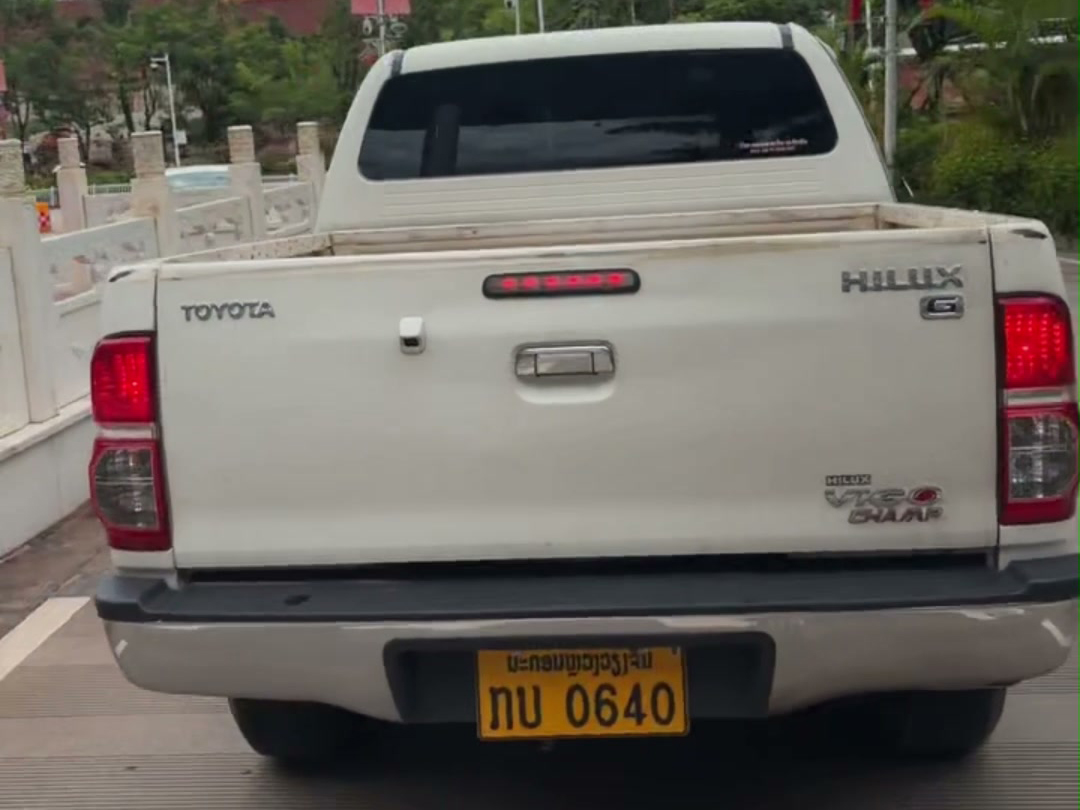
The last thing I expected at 磨憨 (Mohan) was a Lao lorry driver laughing at my Thai-registered pickup while I clutched a folder of paperwork like a man boarding a long-haul flight with the wrong passport. It was the end of a wet May, the tarmac dark and glossy, and the air smelled of diesel, damp teak and grilled bananas from a stall just beyond the China-Laos gate.
I had spent weeks imagining foreign vehicle China entry as a cold bureaucratic wall. Instead, it was a queue, a photocopier, a very serious customs officer, and a woman from Yunnan Province International Travel Agency (Group) Co., Ltd calmly telling me by phone not to lean on the counter like a teenager at a headmaster's office.
Why Mohan, and can a right-hand-drive car actually enter?
Yes. Both left- and right-hand-drive vehicles are accepted at every open port listed for this route, with the same fees and no surcharge for steering from the “wrong” side. Mohan is the China-Laos land crossing; the others are 霍尔果斯 (Khorgos) on the China-Kazakhstan border, 吉隆 (Gyirong) on the China-Nepal border, and 二连浩特 (Erenhot) on the China-Mongolia border. There are also sea entries at Dalian, Guangzhou and Shenzhen.
I came through Mohan because the road north from Laos felt like the natural continuation of a Southeast Asian overland loop. My pickup wore Thai plates, the steering wheel was on the right, and every overtaking manoeuvre for the first day felt like trying to shake hands with the wrong person.
China drives on the right. That sounds obvious on paper. On the road, after months in Thailand and Laos, your hands know one routine and the lane asks for another. I gave myself half a day near the border, driving gently, re-learning pillar positions and roundabout sightlines. No heroics.
The rule nobody should learn at the barrier
A foreign vehicle must be declared through a qualified travel agency acting as guarantor. An individual has no standing to declare it and cannot clear customs independently. I met a Belgian couple at the border who had arrived assuming they could sort the paperwork themselves, the way you might handle a visa-on-arrival. They were polite, patient, and completely stuck until an agency could take on the declaration.
The agency qualification matters. Yunnan Province International Travel Agency (Group) Co., Ltd holds a tourism quality deposit of RMB 1.6 million; qualification requires that deposit plus three years of operation. That is not dinner-table glamour, but it is the reason a guarantor can stand behind the vehicle in the first place.
What the Mohan service fee covers
For entry via Mohan, the service fee is RMB 5,000-6,000 per vehicle. Laos-registered vehicles pay RMB 4,000. Cars, motorhomes and motorcycles are the same price. It is not charged per day, and it is the same whether the trip lasts one month or three months.
The fee includes customs declaration, immigration formalities, the Temporary China Licence, temporary plate, exit clearance, route filing and on-site port assistance. To my mind, the useful bit is that someone knows which window wants which stamp before you discover it by facial expression.
It excludes the customs deposit, vehicle insurance, document translation, vehicle inspection at about RMB 200, and your own fuel, tolls, food, accommodation and guide. For comparison, Khorgos entry is RMB 6,000-9,000, Erenhot is RMB 8,500, and a cross-through package entering Khorgos and exiting Mohan, or the reverse, is RMB 8,000. Sea entry through Guangzhou is RMB 22,000 and Dalian RMB 18,000, neither including ocean freight.
The deposit: boring, but get it right
With the agency guarantee, the customs deposit paid by the owner is RMB 10,000. It goes into the company's corporate account, never a personal account. It must arrive three days before entry; if it is late, the declaration is cancelled and the service fee is not refunded.
I once nearly sabotaged my own trip over a bowl of noodles. More on that shortly. The deposit point is sharper: after exit, it is refunded by the same route within 3-5 working days, provided you leave on time without overstay, have no outstanding traffic fines, and have no unpaid fees or unfinished customs matters.
No, an IDP does not save you
China is not party to the UN road convention and does not recognise the International Driving Permit. To drive your own car into China, you need a China temporary driving licence, which the agency arranges as part of the process. I watched a French rider wave his home licence and a translated booklet at the window; everyone was charming, but the answer did not change.
The temporary plate is valid for three months. Do not build a road trip around assumptions; plan around that validity from the start.
Compulsory traffic insurance is also mandatory, because without it a temporary plate cannot be issued. Commercial third-party cover from RMB 500,000 is optional. The agency purchases insurance before entry and the client pays the actual cost.
Documents, age and the 20-day head start
Send documents at least 20 days before entry. For a Tibet itinerary, allow a month. You will need your passport, Chinese visa, driving licence, white-background ID photo, vehicle licence, registration certificate, engine number, and one photograph each of the vehicle's front, rear and side.
Vehicles over six years old need an inspection certificate and must pass an inspection at the vehicle management office after entry; some ports also require a valid home-country annual inspection certificate. Documents other than a Chinese licence need Chinese translation, which the agency arranges.
If your own visa timing does not cover the plan, China offers 30-day visa-free entry; for a longer stay, the agency can issue an invitation letter to support a longer tourist visa application.
Where a foreign-registered car can go
The filed route can run nationwide, with restrictions worth respecting rather than negotiating at a roadside barrier.
- Tibet requires a full-time guide and a Tibet permit. The Temporary China Licence is valid nationwide; there is no separate Tibet driving licence.
- Beijing requires a capital entry permit.
- Certain border-restricted areas in Xinjiang and Gansu are off limits.
- The G219 Dahongliutan section and the Kashgar/Yecheng to Ritu (Pangong Lake) section are closed to foreigners.
- The new Minfeng no-man's-land highway is closed to foreigners.
- Travelling from Xinjiang to Tibet means detouring via Golmud on G109. Legal highways into Tibet are G109, G318 and G214.
You must drive the filed route. No escort or lead vehicle is needed, apart from the mandatory Tibet guide. Ports are not open 24 hours, which is why sleeping through an alarm is not a colourful mistake until it becomes a logistics problem.
Noodles, a nap, and why I trust Chinese street food more than my own discipline
The noodle incident happened in a small Yunnan town on the drive towards Kunming. Rain had stopped at dusk, steam was rising from the pavement, and a woman was pulling fresh noodles behind a glass counter while her husband flipped dough in a wok. I ordered one bowl. Then, out of greed disguised as research, I ordered another, plus dumplings, plus a grilled potato dusted with chilli.
At 1 a.m. my stomach staged a formal protest. I sat on a plastic stool outside a nearly empty night market, sweaty and repentant, while the stall owner's wife brought hot water, then a warm bowl of congee, then argued with me gently when I tried to pay. A taxi driver waiting nearby used translation software to ask whether I needed a hospital. I did not, but I have never felt more foolish or more looked after.
China is remarkably safe for late-night wandering, which is dangerous for someone with no self-control. I later walked bright, crowded streets at midnight for grilled mushrooms, soybean pudding and corn skewers, telling myself this was cultural research. It was not. It was appetite.
The near-miss with the border came earlier, in Laos. I had set an alarm, then treated it as an opening negotiation. A guesthouse owner banged on the door at 8.40 a.m. after I had asked, half-asleep, for “five more minutes” that apparently lasted ninety. I packed with toothbrush in mouth, kicked my sandals into the footwell, and reached Mohan flustered. The deposit deadline was already handled, thank goodness, because transfers cannot be fixed with regret at the barrier.
Checkpoints and the first Chinese toll road
At police stops or checkpoints, the agency provides supporting documents remotely. Keep your passport, temporary licence, temporary plate paperwork and vehicle papers where you can reach them without unpacking three weeks of laundry. I kept mine in a bright orange folder. Boring, but impossible to lose in a footwell full of banana peels and charging cables.
Beyond the border, the road opened into clean lanes, cuttings pinned with wire mesh, and green signs I could not yet read fast enough. My Thai plate drew glances at fuel stations. Attendants would point, grin, say “Thai?”, and then ask where I was going with the universal language of hand-drawn maps. One man in Jinghong gave me a small bag of passion fruit after I filled up, either from kindness or because he admired a vehicle foolish enough to arrive in the rain.
Would I bring an RHD vehicle again?
Yes, but not casually. The steering wheel position is accepted; the adjustment is yours. Sort the guarantor, documents, deposit and Temporary China Licence before you arrive, respect the filed route, and leave your border-day bravado in the glovebox.
For Mohan entry planning, contact Zara at Yunnan Province International Travel Agency (Group) Co., Ltd on WeChat or WhatsApp at +86 13759155671, WeChat ID qxzj7557, or email [email protected].
And if a Yunnan grandmother offers you a second bowl at midnight? Eat it. But perhaps share it with her first.
Zara
Yunnan Province International Travel Agency (Group) Co., Ltd
WeChat/WhatsApp: +86 13759155671
WeChat ID: qxzj7557
Email: [email protected]