Before the border: why Mohan at dawn is worth the early start
The fog over 磨憨 Mohan was the colour of weak tea when our Thai-registered Honda, right-hand drive and plastered with three weeks of Lao road dust, rolled up to the China-Laos border. I'd slept badly in Luang Namtha the night before, which was entirely my own fault. One more khao soi at 11pm, I'd told myself. I am middle-aged and I still reason like a student. By 5am I was on first-name terms with the guesthouse bathroom, and by the time we reached Mohan my co-driver was refusing to make eye contact with me.
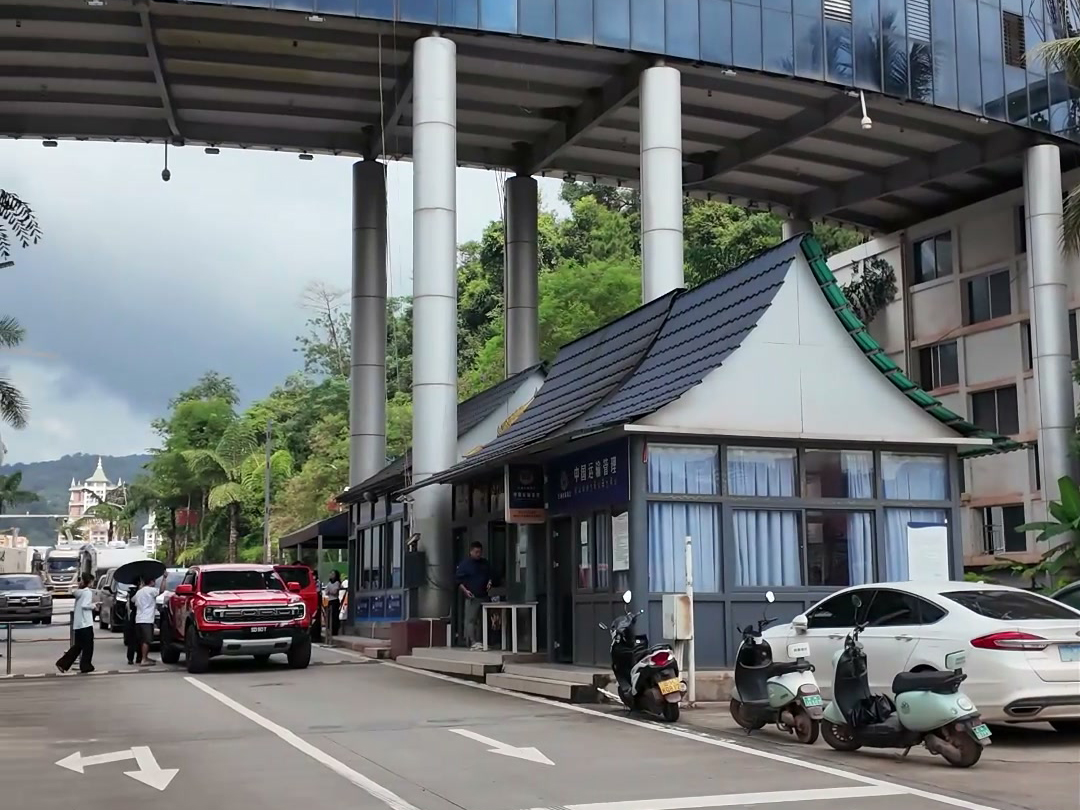
Still, dawn is the right call. The light comes over the Yunnan hills in soft bands, the tarmac stops being a black mirror and starts being readable, and the port is calm before the coach parties. Mohan is one of four land ports you can use for foreign vehicle China entry — the others are 霍尔果斯 Khorgos, 吉隆 Gyirong and 二连浩特 Erenhot — with three sea options at Dalian, Guangzhou and Shenzhen. Both left- and right-hand-drive vehicles are accepted at every port for the same fees, so my Thai steering wheel raised no eyebrows, only my own anxiety about which side of the lane I was drifting toward.
The bit nobody tells you: you cannot declare yourself
Here is the rule that breaks most overland plans, usually a fortnight too late: a foreign vehicle must be declared through a qualified travel agency acting as guarantor. Individuals have no standing to declare and cannot clear customs on their own. No amount of polite English at the window changes this. I know a retired couple who arrived at Mohan with a folder of paperwork thick enough to prop open a fire door, convinced charm and a clean driving record would see them through. They spent two days drinking Nescafé in a shipping office while arrangements were made remotely. Don't be them.
Our paperwork was handled by Yunnan Province International Travel Agency (Group) Co., Ltd, contact person Zara — WeChat/WhatsApp +86 13759155671, WeChat ID qxzj7557, email [email protected]. The company holds a tourism quality deposit of RMB 1.6 million; qualification requires that deposit plus three years of operation, which is exactly the kind of boring credential I now check before handing over copies of my passport. Zara met us at the port with a folder, a thermos and the faintly pitying expression of someone used to drivers who underestimated Chinese breakfast portions.
What the Mohan service fee actually covers
For Mohan entry the service fee is RMB 5,000–6,000 per vehicle; Laos-registered vehicles pay RMB 4,000. Cars, motorhomes and motorcycles are the same price, which I find quietly cheering if you're on two wheels and quietly painful if you're on eighteen. For comparison, Khorgos entry is RMB 6,000–9,000, Erenhot is RMB 8,500, and a cross-through package — Khorgos in and Mohan out, or the reverse — is RMB 8,000. Sea entry at Guangzhou is RMB 22,000 and Dalian RMB 18,000, ocean freight not included.
The fee covers customs declaration, immigration formalities, the temporary driving licence, temporary plate, exit clearance, route filing and on-site port assistance. It is a flat fee whether your China road trip runs one month or three, not a daily charge. It does not cover the customs deposit, vehicle insurance, document translation, the vehicle inspection of about RMB 200, or your fuel, tolls, food, accommodation and guide.
The deposit, and why the account name matters
With the agency's guarantee, the customs deposit the owner pays is only RMB 10,000. It goes into the company's corporate account — never a personal account — and must arrive three days before entry. If it lands late, the declaration is cancelled and the service fee isn't refunded, so this is not the moment to test international transfer speeds on a Friday afternoon. After exit it is refunded by the same route within 3–5 working days, provided you leave on time without overstay, carry no outstanding traffic fines, and have no unpaid fees or unfinished customs matters. Ours came back on the fourth working day while I was eating dumplings in Kunming, which felt like the country paying for my lunch.
The Temporary China Licence and the plate
Let me settle the question I'm asked most. China is not party to the UN road convention and does not recognise the International Driving Permit. You need a China temporary driving licence, arranged through the agency. Zara's team sorted ours as part of the package; there was no separate fee and no theatrical test, just the paperwork done properly in advance. The temporary plate is valid for three months, and that is the period you plan around.
Documents need to be with the agency twenty days ahead — a full month for Tibet itineraries. They ask for your passport, Chinese visa, driving licence, a white-background ID photo, vehicle licence, registration certificate, engine number, and one photo each of the front, rear and side. Anything other than a Chinese licence needs a Chinese translation, which they arrange. Our Honda was under six years old; if yours is over six, it must pass an inspection at the vehicle management office after entry, and some ports also want a valid home-country annual inspection certificate. The inspection costs about RMB 200.
Insurance, without the border-queue folklore
Compulsory traffic insurance is mandatory; without it a temporary plate cannot be issued. Commercial third-party cover from RMB 500,000 is optional. The agency purchases insurance before entry and the client pays the actual cost — that's the whole sentence, and anyone at a border café telling you a longer story about a special desk is usually selling something.
Through the gate, and onto the right side of the road
What I remember after the stamps wasn't bureaucracy. It was the road surface. After weeks of Lao tarmac that kept changing its mind, the Chinese highway appeared like something laid by a surveyor with a conscience — smooth lane markings, reflective studs, gantries, a service area with clean toilets and a woman selling corn from a steel tub. I bought two cobs out of pure gratitude and ate both, despite my stomach's formal written objection.
China drives on the right. In a right-hand-drive car this takes genuine adaptation, mostly at junctions and toll booths, where I twice reached for a passenger-side window that wasn't there. Take the first twenty miles slowly. Ports are not open 24 hours either, so don't arrive at midnight expecting a friendly wave-through.
At checkpoints or police stops, the agency supports you remotely with the filed documents. You drive the filed route yourself; no escort or lead vehicle is required. The exception is Tibet, where a full-time guide and a Tibet permit are mandatory — note this is not a separate licence, the Temporary China Licence is valid nationwide. Beijing needs a capital entry permit, some border-restricted areas of Xinjiang and Gansu are off limits, and the G219 Dahongliutan section, the Kashgar/Yecheng to Ritu (Pangong Lake) section, and the new Minfeng no-man's-land highway are closed to foreigners. Xinjiang-to-Tibet traffic must detour via Golmud on G109; the legal highways into Tibet are G109, G318 and G214.
The night I stopped worrying
A week in, near Jinghong, I made the second greedy mistake of the trip. We'd spent the evening at a barbecue street where a grandmother with iron patience kept handing us skewers of grilled eggplant and something she charmingly called "mystery mushroom," which I ate out of politeness and then out of greed. At half past midnight I realised I wanted cold beer and a plate of rice noodles and, more to the point, felt entirely free to go and find them. Streets were lit, families were still out, a group of teenagers was playing cards on plastic stools, and the only danger to my person was my own ordering. I walked back to the motel at 1am through steam, laughter and the smell of chilli oil, and thought: this is what road trips are actually for.
The kindnesses were small and repeated. A petrol-station attendant noticed our Lao plates, mimed turning on our headlights — dusk had caught me daydreaming — and refused a tip. A mechanic in a small town checked our tyre pressures for nothing and used Google Translate's terrible Chinese to tell me my brake pads were "still okay, old man," which I chose to take as encouragement. When my co-driver slept through an intended dawn start — yes, this time it was him, revenge is sweet — the motel owner simply knocked, laughed, and pressed two warm baozi into his hand for the road.
Visa timing and a blunt bit of planning
China offers 30-day visa-free entry, which suits a short Yunnan loop. If you want longer, the agency issues an invitation letter to support a longer tourist visa. Plan your paperwork honestly: twenty days for standard routes, a month for Tibet, deposit three clear days before entry, and build your China road trip inside the three-month plate window rather than hoping the calendar will bend.
If you'd rather not bring a vehicle at all, that's a separate conversation — local rental runs from RMB 260 a day for a VW Lavida 1.5L or Jetta 1.4T with unlimited mileage, to RMB 400 for a Tank 300 2.0T, with a temporary licence arranged for RMB 1,500 without attending in person. But that's not why most of us cross Mohan. We cross because we want our own steering wheel under our hands when the Yunnan hills appear out of the fog.
Pack immodium, arrive early, message Zara before you book anything, and don't eat the second cob. Or do. I'm not your father.
Zara
Yunnan Province International Travel Agency (Group) Co., Ltd
WeChat/WhatsApp: +86 13759155671
WeChat ID: qxzj7557
Email: [email protected]