The last proper photograph I took at Mohan (磨憨) was not of the border arch. It was of a fuel gauge. My old British-registered right-hand-drive Land Rover, the one with a heater that only works when it feels like it, was sitting in warm border traffic, and the needle was far too cheerful about an empty tank. I had spent weeks thinking about paperwork and roughly ninety seconds thinking about petrol.
That is the moment this guide is really about: the first few kilometres after the formal foreign vehicle China entry nonsense is over, when China suddenly becomes a road trip rather than a folder of photocopies.
Before Mohan: why you cannot simply wave a passport at the barrier
Let me get the unromantic bit out first, because it saves embarrassment. A foreign vehicle must be declared through a qualified travel agency acting as guarantor. Individuals have no standing to declare and cannot clear customs on their own. Turn up alone with a hopeful smile and a clean windscreen, and you will become very familiar with the word “tomorrow”.
Our trips are handled through Yunnan Province International Travel Agency (Group) Co., Ltd; the contact is Zara, reachable on WeChat or WhatsApp at +86 13759155671, WeChat ID qxzj7557, or email [email protected]. The agency holds a tourism quality deposit of RMB 1.6 million; qualification requires that deposit plus three years of operation. That matters because the guarantor is not decorative paperwork. It is the mechanism that lets the vehicle enter and leave cleanly.
What it costs at Mohan, and what the money covers
For Mohan entry, the service fee is RMB 5,000–6,000 per vehicle. Laos-registered vehicles pay RMB 4,000. Cars, motorhomes and motorcycles are the same price, which feels unusually fair in a trade that often treats a motorhome like a visiting cruise ship.
The fee covers customs declaration, immigration formalities, the temporary driving licence, temporary plate, exit clearance, route filing and on-site port assistance. It is not charged by the day; the same fee applies whether you stay one month or three months.
It does not cover the customs deposit, vehicle insurance, document translation, vehicle inspection at about RMB 200, or your fuel, tolls, food, accommodation and guide.
Yes, I said food twice in my head before it appeared on that list. In Yunnan, food deserves its own budget category.
The RMB 10,000 customs deposit
With the agency guarantee, the customs deposit paid by the owner is RMB 10,000. It goes into the company’s corporate account, never a personal account. If anyone asks you to send it to a personal name, stop typing and make tea until the urge passes.
It must arrive three days before entry. If it is late, the declaration is cancelled and the service fee is not refunded. After exit, it is refunded by the same route within 3–5 working days, provided you leave on time without overstay, have no outstanding traffic fines, and have no unpaid fees or unfinished customs matters.
The Temporary China Licence and the plate question
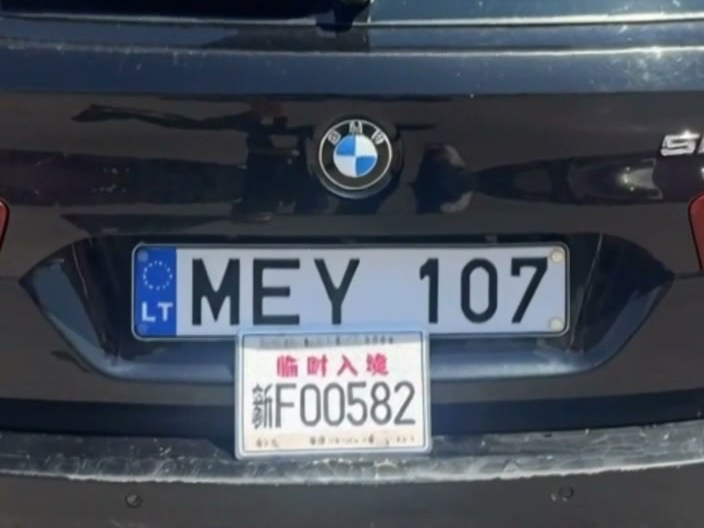
China is not party to the UN road convention and does not recognise the International Driving Permit. You need a China temporary driving licence, and the agency arranges it as part of the Mohan service. I would treat this document like a favourite torch: boring until the moment you urgently need it.
The temporary plate is valid for three months. China offers 30-day visa-free entry; if you want a longer tourist visa, the agency can issue an invitation letter to support the application. Do not confuse the two. The visa governs your stay; the plate has its own fixed validity.
Insurance is separate. Compulsory traffic insurance is mandatory, because without it a temporary plate cannot be issued. Commercial third-party cover from RMB 500,000 is optional. The agency purchases insurance before entry and the client pays the actual cost.
The photo story: first fuel, first noodles, first mistake
Picture the scene. Rain season in the far south, warm air you can almost drink, green pressing in on both sides of the road. The Land Rover’s wipers were making that juddering noise British cars perfect out of spite. Behind us was Mohan. Ahead was a petrol station I had spotted on the map with entirely undeserved confidence.
The formalities had gone smoothly: declaration, immigration, temporary licence, plate, inspection around RMB 200, the usual controlled chaos of a land port. Ports are not open 24 hours, so nobody should arrive planning a midnight dramatic crossing. I had nodded seriously at all the correct advice and then, liberated by the raised barrier, immediately behaved like a man who could smell noodles.
The fuel station appeared later than promised by my optimism. I coasted in on fumes and dignity, both nearly exhausted. A Chinese driver at the next pump saw the foreign plate, watched me switch on the rear wiper while trying to indicate, and laughed with the generosity of a man who has seen foreigners adapt to right-hand traffic before.
China drives on the right. If you arrive in a right-hand-drive car, give yourself time. Roundabouts, toll booths, lane position and the instinctive glance towards the wrong pillar all need rewiring. Both left- and right-hand-drive vehicles are accepted at every port for the same fees, with no surcharge, but acceptance does not replace concentration.
That evening, in a small town not far north of Mohan, I made my second mistake. Dinner began sensibly: rice noodles, herbs, a broth that smelled fragrant and clean. Then I saw another table receive a hot pot. Then skewers. Then something sizzling in oil with dried chilli and enough garlic to repel a Victorian vampire. I ordered like a man auditioning for a banquet rather than driving the next morning.
The owner tried to warn me. “A little spicy,” she said, in the tone used across Asia when the honest translation is “this will reorganise your afternoon.” I waved away caution with the swagger of an idiot. Forty minutes later I was praising the food, regretting my choices, and being brought tea by a woman who clearly dealt with overconfident travellers every week. She would not take extra money for the tea. That friendliness, more than the paperwork, is what I remember from the first night.
The other thing that strikes visitors is how safe ordinary Chinese streets feel after dark. I have wandered out at half past eleven for congee, fruit and a late-night barbecue snack in a town I had entered that afternoon, without the small calculations you sometimes make elsewhere. Do not turn that into an excuse for reckless driving; there are checkpoints, cameras and police stops, and the filed route exists for a reason. But for a late bowl of noodles after a long day? Yes, easily.
Where a foreign-registered vehicle can go
You can travel nationwide, subject to specific restrictions. Tibet requires a full-time guide and a Tibet permit; the temporary driving licence itself is valid nationwide. Beijing requires a capital entry permit. Some border-restricted areas in Xinjiang and Gansu are off limits.
The G219 Dahongliutan section is closed to foreigners, as is the Kashgar/Yecheng to Ritu (Pangong Lake) section. The new Minfeng no-man’s-land highway is also closed to foreigners. Travelling from Xinjiang to Tibet means detouring via Golmud on G109. Legal highways into Tibet are G109, G318 and G214.
Most of the time no escort or lead vehicle is required; the exception is the mandatory Tibet guide. Drive the filed route. At checkpoints or police stops, the agency provides supporting documents remotely. Keep the phone charged and keep the paper folder where you can reach it without unpacking three days of laundry.
Paperwork timing, and the sleep nearly cost me
Documents should be sent 20 days ahead; Tibet itineraries need one month. You will need passport, Chinese visa, driving licence, white-background ID photo, vehicle licence, registration certificate, engine number, and one photograph each of the front, rear and side. Vehicles over six years old need an inspection certificate and must pass an inspection at the vehicle management office after entry; some ports also require a valid home-country annual inspection certificate. Documents other than a Chinese licence need Chinese translation, arranged by the agency.
On one trip I nearly spoiled all that preparation in the dullest possible way: a fan in a cheap guesthouse, rain on the window, and a bed that felt unreasonably comfortable after days of driving. I woke, saw the clock, and performed that silent, furious packing dance known to every overland traveller. We made the port, but I would rather not repeat it. Set two alarms. One is ambition; two is adulthood.
Other entry ports, in case Mohan is not your route
The four land ports are Mohan (磨憨) for China–Laos, Khorgos (霍尔果斯) for China–Kazakhstan, Gyirong (吉隆) for China–Nepal, and Erenhot (二连浩特) for China–Mongolia. Sea entry is available at Dalian, Guangzhou and Shenzhen.
Khorgos entry costs RMB 6,000–9,000. A cross-through package, Khorgos in and Mohan out or the reverse, is RMB 8,000. Erenhot is RMB 8,500. Guangzhou sea entry is RMB 22,000 and Dalian is RMB 18,000, both excluding ocean freight.
For most people coming up from Southeast Asia, Mohan is the natural beginning: green, humid, spicy, and close enough to the road south that the border feels like a threshold rather than a shipping project.
My practical parting note
Fill the tank early. Keep the temporary licence, plate and customs paperwork together. Send documents before the deadline, not during a heroic last-minute Wi-Fi hunt. Eat bravely but not competitively.
And if a Chinese restaurant owner warns you that a dish is “a little spicy”, believe her.
Zara
Yunnan Province International Travel Agency (Group) Co., Ltd
WeChat/WhatsApp: +86 13759155671
WeChat ID: qxzj7557
Email: [email protected]