The last proper Lao coffee had barely worn off when the jungle around 磨憨 began to change: fewer wooden houses, more fresh tarmac, and a long line of lorries carrying tropical fruit north. My old British-registered Land Rover, right-hand drive and rather too full of biscuits, was about to drive your own car into China for the first time.
I had imagined the Mohan border as a gate I could reason with, like a ferry terminal with extra stamps. It is not. A foreign vehicle China entry has to be declared through a qualified travel agency acting as guarantor. Individuals have no standing to declare and cannot clear customs on their own. That sentence is dull until you are standing in the heat, watching a truck driver inspect your suspension, and suddenly it becomes the whole day.
Why Mohan felt like the sensible door
Mohan is the China-Laos land port. The other land options are 霍尔果斯 on the China-Kazakhstan border, 吉隆 on the China-Nepal border, and 二连浩特 on the China-Mongolia border. There are also sea ports at Dalian, Guangzhou and Shenzhen if your vehicle arrives by ship.
For a slow overlander coming up from South-East Asia, Mohan keeps the journey logical: Laos, jungle, then Yunnan's climbing roads. Both left- and right-hand-drive vehicles are accepted at every port, with the same fees and no surcharge. Good news for my steering wheel, which was sitting on the wrong side for China.
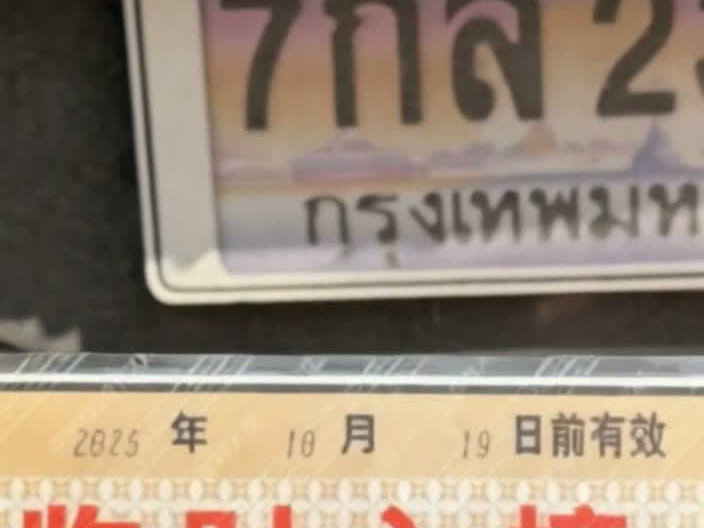
The service fee for Mohan entry is RMB 5,000-6,000 per vehicle. Laos-registered vehicles pay RMB 4,000. Cars, motorhomes and motorcycles are charged the same price. That fee covers customs declaration, immigration formalities, the temporary driving licence, temporary plate, exit clearance, route filing and on-site port assistance.
It does not cover the customs deposit, vehicle insurance, document translation, vehicle inspection, fuel, tolls, food, accommodation or a guide. I noted food separately. As my waistline would later prove, this was a serious omission from the budget.
The paperwork mountain starts before the real mountain
Yunnan Province International Travel Agency (Group) Co., Ltd handled the declaration. My contact was Zara, reachable on WeChat or WhatsApp at +86 13759155671, WeChat ID qxzj7557, or email [email protected]. The company holds a RMB 1.6 million tourism quality deposit; qualification requires that deposit plus three years of operation. In a process where someone is legally guaranteeing your vehicle, that matters.
Documents need to be ready 20 days before entry. Tibet itineraries need a month.
- Passport and Chinese visa
- Driving licence
- White-background ID photo
- Vehicle licence and registration certificate
- Engine number
- One photo each of the front, rear and side of the vehicle
Vehicles over six years old need an inspection certificate, and after entry must pass an inspection at the vehicle management office; some ports also require a valid home-country annual inspection certificate. Anything except a Chinese licence needs Chinese translation, which the agency arranges. My vehicle was old enough to have opinions, so I packed both paperwork and patience.
The deposit, the plate and the licence nobody should joke about
With the agency's guarantee, the customs deposit is RMB 10,000. It must be paid into the company's corporate account, never a personal one. It has to arrive three days before entry; if it is late, the declaration is cancelled and the service fee is not refunded. After exit, it is refunded by the same route within 3-5 working days, provided you leave on time, have no outstanding traffic fines, unpaid fees or unfinished customs matters.
I set a phone alarm, a calendar alarm and, for good measure, asked a friend to insult me if I forgot. He needed very little encouragement.
China is not party to the UN road convention and does not recognise the International Driving Permit. You need a China temporary driving licence, arranged through the agency. The temporary plate is valid for three months. The vehicle inspection costs about RMB 200.
Compulsory traffic insurance is mandatory; without it, a temporary plate cannot be issued. Commercial third-party cover from RMB 500,000 is optional. The agency purchases insurance before entry and the client pays the actual cost.
At Mohan: stamps, sunshine and one proud photograph
The port was not open 24 hours, which I mention because I once nearly tested this by sleeping through dawn. I had eaten too much the previous night in Luang Namtha, woke in a sweaty panic, threw bags into the back, and arrived looking like a man fleeing a laundry explosion. Zara's port assistance meant the actual formalities were calmer than my face suggested.
When the Temporary China Licence and temporary plate were finally in my hand, I did the embarrassing overlander thing: photographed the plate, photographed the windscreen, photographed my coffee beside the plate. A Chinese customs officer smiled, pointed at the mountain road, and made an upward gesture. Up, he said. Everything from here goes up.
He was right.
The first pass, the wrong side of the car and grilled cheese
China drives on the right. In a right-hand-drive car, overtaking takes a reset of instincts built over years. I did not rush. I sat behind trucks, used the lay-bys, and let my brain relearn where the white line should appear through the windscreen. By the first mountain pass, the scenery had turned from green steam to cooler air, pine shadows and villages where smoke rose straight in the evening calm.
Then came the food incident.
At a small Yunnan restaurant I pointed enthusiastically at grilled cheese, mushrooms, herbs, noodles and a dish of potatoes the owner seemed to admire deeply. Everything was excellent. Everything was also too much. Twenty minutes up the pass, my stomach staged a formal protest. I pulled over, walked in circles, and apologised to the mountains. A local couple in a small van stopped, genuinely concerned, and offered hot water and digestive tablets. I tried to refuse with dignity. My dignity had already left the vehicle.
That kindness kept appearing. A mechanic tapped a suspicious tyre and waved away payment. A shopkeeper gave me extra fruit because the foreigner clearly could not use chopsticks efficiently, which was fair. Late one night in a Yunnan town, I wandered out for noodles at an hour when, back home, I would be checking street signs rather than menus. Families were still eating, children were running around, and the cook laughed as she added more chilli. China felt safe in the practical way that matters: ordinary people out enjoying ordinary midnight snacks.
Where a foreign plate can actually go
The temporary plate allows nationwide travel, but there are restrictions.
Tibet requires a full-time guide and a Tibet permit. Beijing requires a capital entry permit. Some border-restricted areas in Xinjiang and Gansu are off limits. The G219 Dahongliutan section, the Kashgar/Yecheng to Ritu (Pangong Lake) section, and the new Minfeng no-man's-land highway are closed to foreigners. Travelling from Xinjiang to Tibet means detouring via Golmud on G109. Legal highways into Tibet are G109, G318 and G214.
The temporary driving licence is valid nationwide; there is no separate Tibet driving licence. Tibet's extra requirement is the guide and permit, not another licence.
On the road, you must drive the filed route. No escort or lead vehicle is needed, except the mandatory Tibet guide. At checkpoints or police stops, the agency provides supporting documents remotely. Ports keep their own hours, so do not plan a midnight border dash.
Fees from other ports, in case Mohan is not your route
Khorgos entry costs RMB 6,000-9,000. A cross-through package, Khorgos in and Mohan out or the reverse, is RMB 8,000. Erenhot entry is RMB 8,500. Sea entry through Guangzhou is RMB 22,000, and through Dalian RMB 18,000; neither includes ocean freight.
The fee stays the same whether your China road trip lasts one month or three months. It is not charged by the day. If 30 days is enough, China's visa-free entry may suit you. For a longer journey, the agency can issue an invitation letter to support a longer tourist visa application.
What I would do differently
I would eat less before a pass. Obvious, apparently only to everyone else.
I would also send documents earlier, label every vehicle photograph clearly, and confirm the deposit had landed well before the three-day deadline. I would not arrive at Mohan sleepy, overfed and relying on charm. Charm does not process customs forms.
But I would absolutely use Mohan again. The road lifts quickly into proper mountains, the light over Yunnan is wonderful, and the first sight of that temporary plate on a foreign bonnet is a quiet thrill. Just order the grilled cheese like a sensible person, not a competitive sport.
Zara
Yunnan Province International Travel Agency (Group) Co., Ltd
WeChat/WhatsApp: +86 13759155671
WeChat ID: qxzj7557
Email: [email protected]