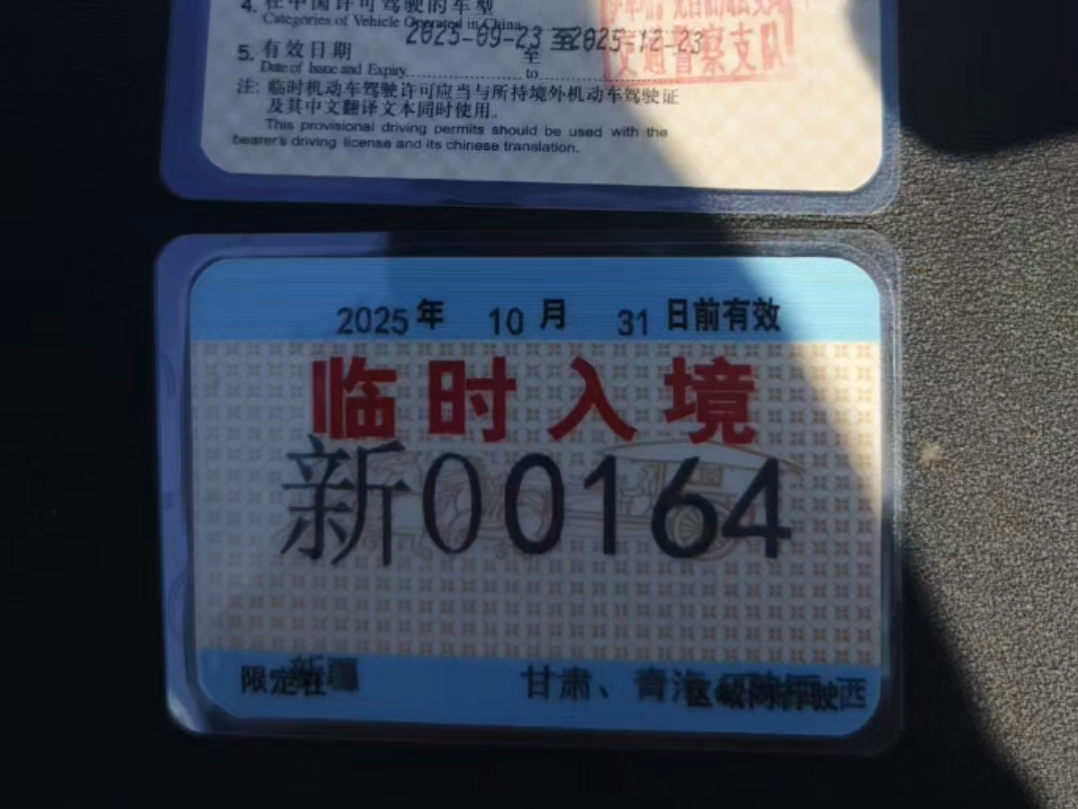
The paperwork in this photograph comes from the western side of the country rather than the southern borders: a Xinjiang temporary entry plate shown together with the provisional driving permit that lets a foreign driver use it. It is worth examining because the two documents are often confused, and seeing them side by side makes the distinction clear. One gives the vehicle its authority to be on the road; the other gives the person the authority to drive it.
Xinjiang is where the Khorgos land crossing sits, on the border with Kazakhstan, and it is the main gateway for traffic entering from the west. A foreign vehicle brought in through that route is handled under the same broad temporary entry framework as one entering from the south, though the service fee band and the regional context differ.
1. What the plate authorises
The temporary entry plate is the vehicle's document. It is issued for a foreign-registered car under the temporary entry arrangement and displayed alongside the original foreign registration, which stays on the vehicle. It makes the car legal to drive on Chinese roads during the visit.
It is valid for three months, and that is the figure to plan around. Even on a long cross-country trip from the western border, the route should be timed so the vehicle exits before the paperwork runs out.
2. What the provisional driving permit authorises
The provisional driving permit is the driver's document, not the car's. China does not recognise the international driving permit, so a foreign licence alone is not enough even with a translation. The provisional permit, arranged through the agency, is what allows the named driver to operate the vehicle legally. It is tied to particular people and the relevant vehicle category, so if more than one person will drive, each needs to be named.
3. Why the agency is required even at Khorgos
There is a detail worth getting right. In theory, Khorgos is the one crossing where a customs broker alone can handle the customs declaration, but the moment the vehicle needs a temporary plate to be driven legally, the traffic authority still requires the documentation that a qualified travel agency provides. In practice, anyone wanting to drive the car inside China rather than merely clear it through customs goes through a licensed agency, which makes the declaration and provides the guarantee.
The agency meets the usual qualifying bar, including the quality guarantee deposit and operating history, and acts as the bonded, responsible party for the vehicle while it is in the country.
4. The costs for a western entry
The service fee band for Khorgos differs from the southern crossings, and a cross-country route that enters at one side and exits at another has its own arrangement. The fee covers the customs declaration, the immigration processing, the provisional driving permit, the temporary plate, the route filing, the exit clearance and the support at the port.
The customs guarantee is separate. Under the agency's guarantee, the owner lodges a fixed 10,000 yuan into the corporate account in place of the larger value-based assessment, three days before entry, refunded in full within a few working days after the vehicle leaves. The compulsory insurance is arranged before the plate is issued, with the owner paying the actual premium, and the inspection fee of around 200 yuan and the translation costs apply.
5. The route restrictions that matter in this region
This is where Xinjiang entries need particular care. Some border-adjacent zones in Xinjiang and Gansu are restricted, and certain high-altitude roads are closed to foreign visitors, including sections of the G219 around the Dahongliutan area, the stretch from Yecheng towards Rutog and Pangong Lake, and the new unmanned-area road from Minfeng. A foreign driver wanting to get from Xinjiang down towards Tibet cannot take the direct high-country routes; the proper way is to loop back to Golmud and use the Qinghai-Tibet road, the G109.
The capital needs its own entry permit, and Tibet proper requires a full-time guide and a Tibet permit with a longer lead time. The filed route is therefore especially important for a western entry, and the agency advises on the roads that are actually open.
6. Documents to prepare
Allow around twenty days, longer if the trip reaches Tibet. The agency needs the passport and Chinese visa, the driving licence, a white-background ID photo, the vehicle registration and ownership papers, the engine number, and photographs of the vehicle. The non-Chinese documents need translations.
Check the identifying numbers before the long approach. Any frame number altered, ground or welded, or not matching the registration, is a genuine blocker.
7. Why the two documents belong together
The photograph is genuinely useful because it shows the two halves of the legal position in one frame. The plate answers the question of whether the car may be on the road, and the permit answers the question of whether this particular person may drive it. Neither substitutes for the other, and both are arranged through the agency as part of the same entry.
If you are planning to bring a vehicle in from the west rather than the southern borders, the framework is familiar but the regional rules deserve respect. Get the guarantee moved in the three-day window, follow the filed route through the open roads, keep within the three-month plate, and the car and the driver will both be properly covered for the long journey across the country.
The distances in the western regions are greater than many visitors expect, with long stretches between towns and fuel stations, so a little planning makes the crossing far more comfortable. Fill the tank whenever the opportunity arises rather than waiting for it to run low, carry water and some basic supplies, and check each day's route and accommodation in advance rather than relying on finding somewhere at the last minute. Keep the provisional permit and the plate paperwork within easy reach, because there are routine checks along these roads, and having the documents ready keeps each stop short. The agency's remote support is useful here, as a question from an officer can be settled quickly with a phone call rather than a long discussion at the roadside.