The border itself is where every planning document meets reality, and this photograph shows Vietnamese motorcycles at the China immigration checkpoint, the point at which riders and machines pass from one country's authority into another's. It is a useful image to end this batch on, because a checkpoint looks intimidating if you do not know what is happening, and it is considerably more orderly once you understand the sequence.
The immigration checkpoint handles the people, while the customs side handles the vehicles, and the two run in parallel as part of a coordinated entry. For a foreign motorcycle, arriving properly prepared through an agency makes the difference between a smooth crossing and a frustrating one.
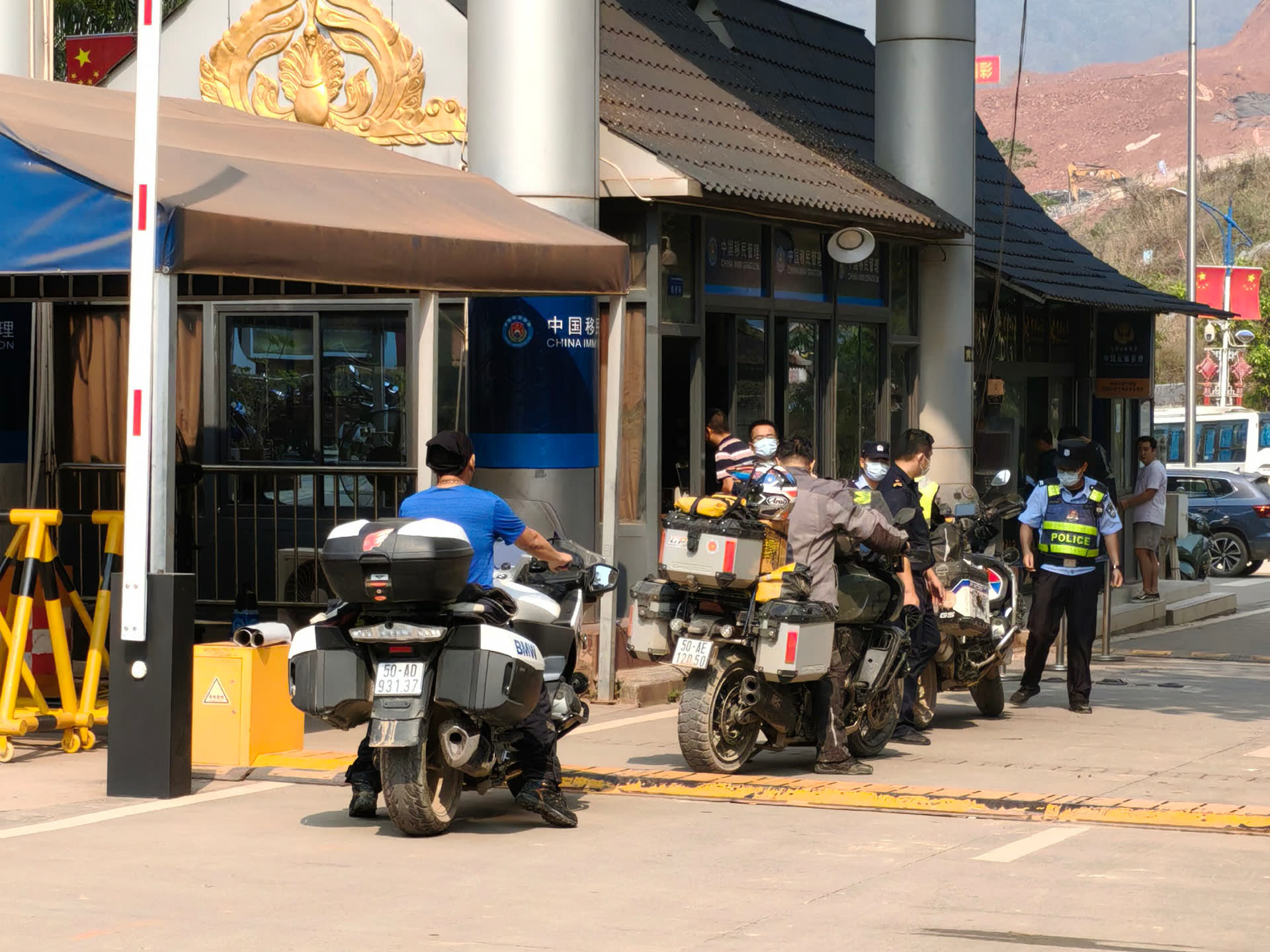
1. The plates the bikes are arriving with
Each motorcycle comes across as a foreign vehicle and will display a China temporary entry plate alongside its original Vietnamese registration, which stays on the bike. The temporary plate is the authority for riding on Chinese roads once the checkpoint has been cleared, and it is valid for three months. The route should be timed so every bike exits before the paperwork runs out.
2. What actually happens at the checkpoint
In practice, the riders present their passports and Chinese visas for the immigration checks, while the agency handles the customs declaration for the motorcycles and the guarantee that stands behind them. The temporary driving licences and the vehicle paperwork are checked against the filed route. Because the agency has prepared the declarations in advance and organised the group, the riders move through as a managed set rather than improvising answers at the booth.
3. Why the riders cannot do this alone
The rule is the same here as everywhere else: a foreign vehicle has to enter through a licensed travel agency that makes the customs declaration and provides the guarantee. The checkpoint is the visible front of a process that was actually set in motion weeks earlier, with the documents assembled and the guarantee in place. There is no way for an individual rider to bypass that and complete the entry independently, however prepared they personally are.
The agency meets the usual qualifying bar, including a quality guarantee deposit and an operating history, and acts as the bonded, responsible party for the bikes while they are in the country.
4. The costs behind the crossing
The service fee per motorcycle covers the customs declaration, the immigration processing, the temporary driving licence, the temporary plate, the route filing, the exit clearance and the practical support at the port, including the hands-on help at a checkpoint like this. The customs guarantee is separate. Under the agency's guarantee, each rider lodges a fixed 10,000 yuan into the corporate account in place of the larger value-based assessment, three days before entry, refunded in full within a few working days after the bikes exit.
The compulsory insurance is arranged before the plates are issued, with each rider paying the actual premium, and the inspection fee of around 200 yuan and the translation costs apply per machine.
5. The temporary driving licence at the border
Each rider needs a Chinese temporary driving licence in the motorcycle category, because the international permit is not recognised and the Vietnamese licence alone is insufficient even with a translation. The agency arranges these ahead of time, so at the checkpoint the rider simply presents the correct documents rather than trying to arrange a licence on the spot, which cannot be done.
6. After the checkpoint
Once cleared, the group rides onto the filed route, keeping together and following the plan that was submitted. The usual national rules apply from there: the capital needs its own entry permit, Tibet requires a full-time guide and a Tibet permit with a longer lead time, some border zones in Xinjiang and Gansu are restricted, and certain high-altitude roads, including parts of the G219 and the new unmanned-area route, are closed to foreign riders. Getting from Xinjiang towards Tibet means looping back to Golmud and the Qinghai-Tibet road.
Vietnam keeps to the right, as does China, so the riders are already on the familiar side of the road, and the main adjustment is simply local traffic behaviour.
7. Documents to have ready
Allow around twenty days for the preparation, longer if Tibet is involved. For each rider and bike, the agency needs the passport and Chinese visa, the motorcycle licence, a white-background ID photo, the registration and ownership papers, the frame and engine numbers, and photographs of the machine. The non-Chinese documents need translations.
Check the identifying numbers before the trip, because any number altered, ground or welded, or not matching the registration, is a blocker that will surface at exactly this checkpoint. Standard bikes with consistent paperwork pass through without issue.
8. Why the checkpoint is nothing to fear
The photograph shows a serious, controlled environment, but it is not an obstacle course for a well-prepared group. It is simply the place where the paperwork arranged over the previous weeks is checked and stamped, and the temporary entry becomes real. The riders' job is to carry the right documents and follow the agency's lead; everything else has been set up in advance.
If the idea of presenting a foreign motorcycle at a Chinese immigration checkpoint has been the thing holding you back, the practical reality is that it is orderly and routine when handled through the proper agency. Get the guarantees in during the three-day window, make sure the temporary plates and licences are ready, keep within the three-month validity and the filed route, and the checkpoint becomes just the first step of the ride rather than a hurdle.
On the day of the crossing, it helps to arrive early and to remember that the border does not operate around the clock, so the opening and closing times are worth confirming in advance. Have every rider's passport, visa, temporary licence and the motorcycle paperwork gathered in one place rather than split across different bags, which keeps the queue moving when the officer asks for them. Keep the bikes reasonably clean around the frame and engine numbers so they can be checked without delay, and follow the agency's instructions about where to line up and wait. A calm, well-organised arrival sets the tone for the whole trip, and the group clears the checkpoint without unnecessary waiting.