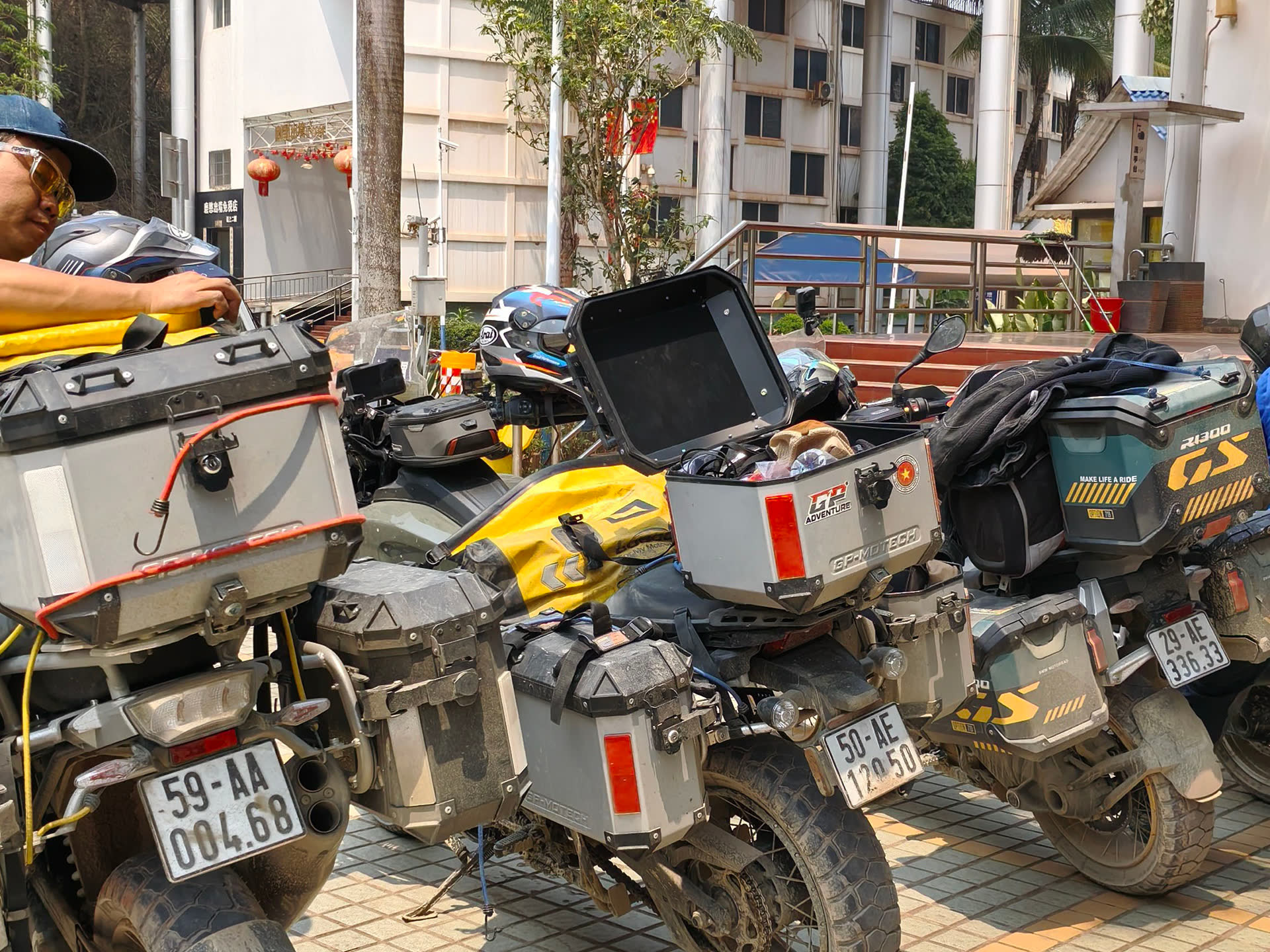
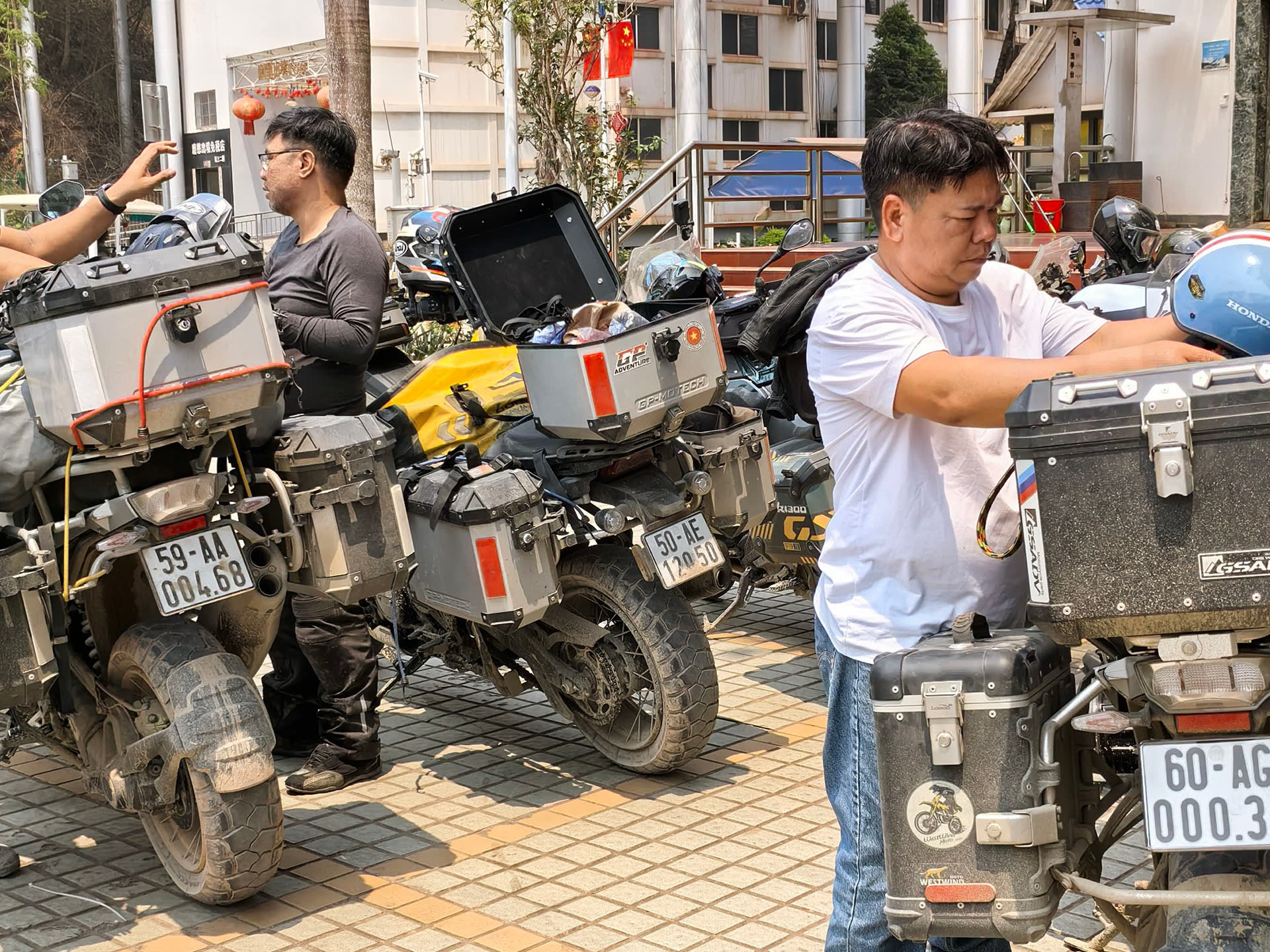
Every long motorcycle trip has a quiet daily rhythm, and a good part of it happens not on the road but at the hotel. The photos show Vietnamese riders with their hard aluminium panniers swung open, laying out and repacking gear in the car park or by the entrance. To a non-rider it might look like a routine chore, but the way luggage is organised and the way the hotel is used as a base tell you a lot about how a multi-week trip actually runs. This piece looks at the daily packing routine, what the riders carry and why the hard cases make the whole process work.
The reason this matters is that on a long trip the packing happens every single day, often twice, and a clumsy system becomes genuinely exhausting. Riders who have thought it through can empty, check and reload the bikes quickly and get on with the journey, while the ones who have not are forever hunting for a single item buried at the bottom of a bag. The open cases in the photograph are a window into that practical side of the journey.
1. Why the cases are opened at the hotel
After a day in the saddle, the panniers come open for a few reasons. Valuables and the document folder tend to come inside for the night, wet or muddy clothing needs to be dealt with before it ruins everything else, and the bikes get a quick check while the luggage is off. In the morning, the cases are repacked in a deliberate order so the things needed during the day are within reach without emptying everything.
Hard aluminium cases are particularly good for this because they hold their shape when open, stand up to being packed and repacked, and keep the contents protected if the weather turns. Soft bags can be rummaged through, but rigid boxes make the daily routine far quicker and less messy, especially when the ground is wet or dusty.
2. How disciplined riders organise the load
The experienced riders in the photo tend to follow a consistent system. Heavy items sit low and close to the bike's centre of gravity, which keeps the handling predictable, while lighter bulk goes higher or in the top box. Each side case is balanced against the other so the weight does not pull the bike one way, and the things needed in a hurry, such as waterproofs or the document folder, live in a known, easy-to-reach place.
There is real discipline in not overfilling. Large boxes invite carrying more than is needed, and the extra weight changes how the bike feels on climbs and when braking. Treating the fixed capacity as a limit rather than a target keeps the load sensible and the daily repacking fast. Most riders quickly learn that a few well-chosen items serve them better than a mountain of spares they never use.
3. What actually gets carried
The contents spread across the hotel floor usually tell a familiar story. There are tools and a puncture repair kit for the inevitable roadside problem, spare bulbs and fuses, a charger and the cables needed on the road, and a basic first-aid kit. Clothing is kept in waterproof liners inside the metal cases, and there is a separate set of wet-weather gear ready to hand.
The document folder deserves a mention of its own. The temporary plate paperwork, the Chinese temporary driving licence, the insurance and copies of the declaration are kept together in something waterproof, because that is the set asked for at checkpoints. Keeping it in the same place every time means it can be produced without panic when an officer asks.
4. The documents behind the journey
The bikes themselves are in China under the usual temporary import arrangements, which the riders have sorted before reaching the hotel. Each motorcycle has a Chinese temporary entry plate with a validity of three months, and each rider holds a Chinese temporary driving licence for the motorcycle category, since China does not rely on an international driving permit in the way many visitors assume. The home licence and its Chinese translation support the application.
A foreign vehicle cannot be self-declared, so the entry has been arranged through a licensed travel agency with the proper outbound-tourism qualifications and the required quality deposit. The agency acts as the guarantor for the bikes, prepares the customs declaration and arranges the plates and licences, and it remains a point of contact on the road if anything needs confirming.
5. The deposit, insurance and costs
The financial side follows the same structure as for any temporary entry. Each bike has a refundable customs deposit of 10,000 yuan, paid into the agency's corporate account and cleared at least three days before the crossing so the declaration can proceed. Once the motorcycles leave on time and with no outstanding issues, the deposit is returned in full, usually within three to five working days.
Insurance is compulsory and has to be in place before the temporary plates are issued, with the agency arranging it ahead of entry and the riders paying the actual cost. A vehicle inspection fee of around 200 yuan applies across the board, and translation costs may add a little. Understanding these as separate items, rather than one vague fee, helps the riders know exactly what they are paying.
6. The hotel as a base for the trip
The riders in the photograph are using the hotel the way overland travellers always do. It is somewhere secure to leave the bikes, a place to dry and sort gear, and a chance to rest properly before the next long day. Venues used to foreign riders tend to offer safe parking and a little space to work on the bikes, which makes a genuine difference over several weeks.
The evening routine also includes a look at the route for the next morning, a check of the weather and a walk around the bikes to spot anything loose or worn. Catching a problem in the car park is far better than discovering it on a remote stretch. That calm, methodical habit is what separates smooth trips from stressful ones.
7. Getting back on the road
By the time the cases are closed and the bikes are loaded again, the riders are ready for the next leg. The repacking has been quick because the system is consistent, the documents are back in their known place and the load is balanced. What looks like a chore at the start of a trip becomes an automatic routine after a few days.
The open panniers in these photos are a reminder that a successful motorcycle journey is built on small, repeated habits as much as on the big rides. A reliable set of hard cases, a disciplined and balanced packing system, the correct temporary plate and licence arranged through a licensed agency, and the hotel used as a proper base all add up. Get that daily routine right and the long kilometres across China become the enjoyable part rather than a constant battle with luggage.