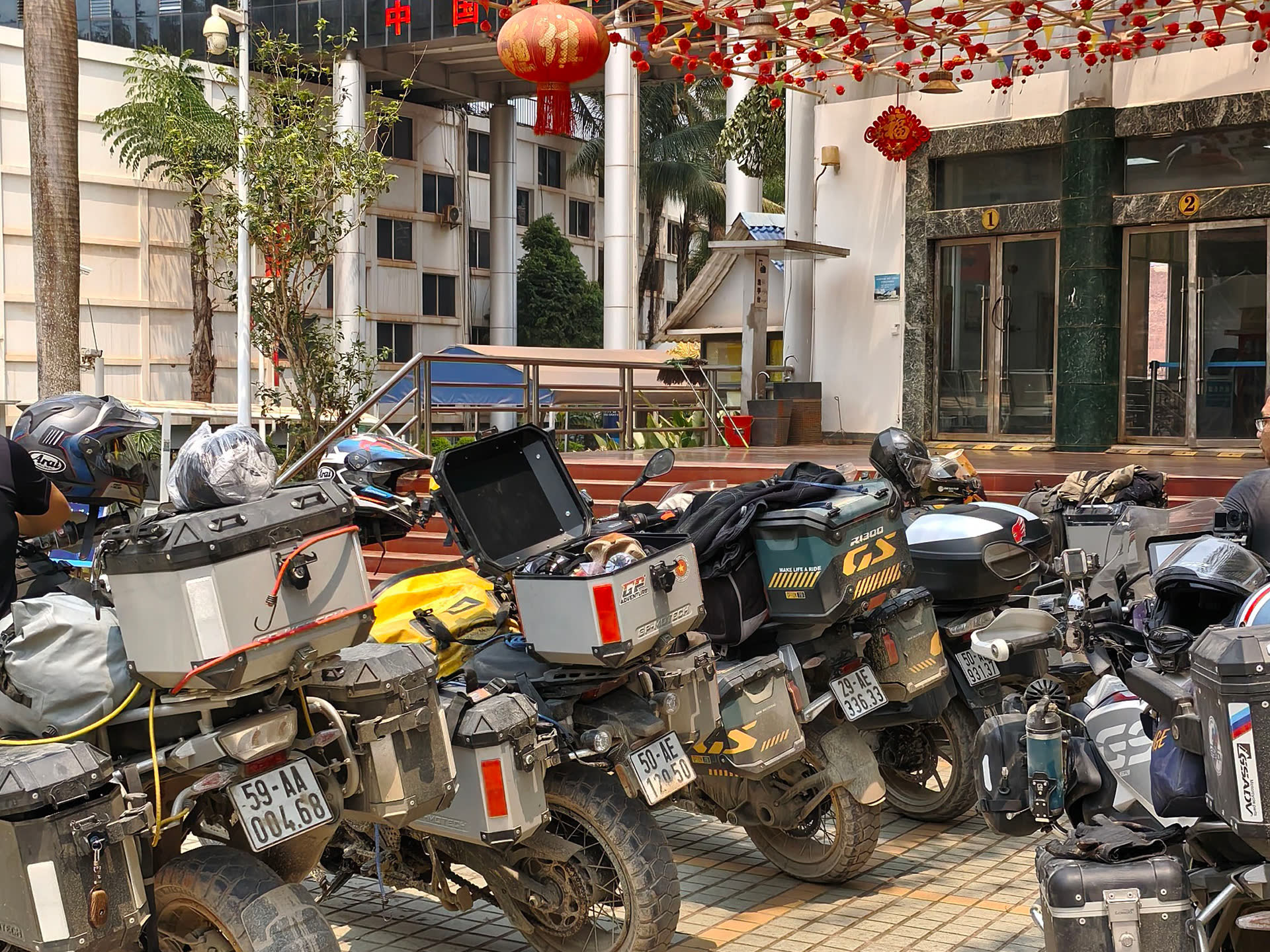
There is something quietly theatrical about a row of motorcycles waiting under traditional red lanterns, and this photograph captures it well: a Vietnamese convoy drawn up neatly in front of a lantern-hung gateway, riders and machines together before the day's run. Group entries like this are increasingly common, and they work a little differently from a single bike crossing alone, so it is worth explaining how a convoy actually moves through the formalities.
A convoy is not simply a collection of independent riders who happen to travel together. To enter China cleanly, the group has to be organised as a group, with the paperwork, the guarantees and the route handled in a coordinated way rather than bike by bike at the barrier.
1. The plates on every bike
Each motorcycle in the convoy is a foreign vehicle and needs its own China temporary entry plate, displayed alongside the original Vietnamese registration. There is no single group plate that covers everyone; the authority to ride is per machine. The home plates stay on, and the temporary plates make the bikes legal on Chinese roads.
Each is valid for three months, and the group's itinerary should be built so every bike exits before the paperwork runs out. When a convoy is coordinated centrally, keeping those dates aligned is straightforward, because everyone follows the same route and the same schedule.
2. Why the group still needs one agency
The riders cannot split up and process themselves individually at the border. A licensed travel agency has to bring the convoy in, make the customs declarations for the vehicles and provide the guarantee. In a group entry this is actually more efficient, because the agency handles the whole set of declarations together and the riders move through as a managed group.
The agency meets the same qualifying requirements, including the quality guarantee deposit and operating history, and acts as the bonded, responsible party for the vehicles while they are in the country. That is the structure that allows the temporary plates to be issued across the group.
3. How the costs work across a convoy
The service fee applies per vehicle, even though the bikes travel together. It covers each bike's customs declaration, the immigration processing, the temporary driving licence, the temporary plate, the route filing, the exit clearance and the practical support at the port.
The customs guarantee is likewise per rider. Under the agency's guarantee, each bike's owner lodges a fixed 10,000 yuan into the corporate account, in place of the larger value-based assessment, with the money arriving three days before entry and returned in full within a few working days after the group exits. The compulsory insurance is arranged before the plates are issued, each rider paying the actual premium, and the inspection fee of around 200 yuan and translation costs apply per machine.
4. Licences for every rider
Each rider needs a Chinese temporary driving licence in the right motorcycle category, because the international permit is not recognised and the Vietnamese licence alone is insufficient even translated. The agency arranges the full set for the group. It helps to finalise the rider list early, because a late change means a fresh licence and a reshuffle of the paperwork.
5. Moving a group around the country
A well-organised convoy is a pleasure on the open road, and Yunnan's winding mountain routes suit a line of bikes particularly well. Most of China is open in principle, with the usual defined exceptions. The capital needs its own entry permit. Tibet requires a full-time guide and a Tibet permit, with a longer lead time. Some border zones in Xinjiang and Gansu are restricted, and certain high-altitude roads, including parts of the G219 and the new unmanned-area route, are closed to foreign riders. Getting from Xinjiang towards Tibet means looping back to Golmud and the Qinghai-Tibet road.
For a convoy, the route filing matters more than for a solo rider, because the group is expected to follow the filed plan and stay together.
6. The practical side of group travel
Vietnam keeps to the right, as does China, so the riders are already on the familiar side of the road. The main adjustments are local traffic behaviour and the discipline of keeping a sensible formation, with the lead and sweep riders knowing the plan and nobody peeling off independently, which would create problems with the filed route.
7. Documents to gather
Allow around twenty days, longer if Tibet is on the route. For every rider and bike, the agency needs passports and Chinese visas, motorcycle licences, white-background ID photos, the vehicle registrations and ownership papers, the frame and engine numbers, and photographs of the machines. The non-Chinese documents need translations.
Before the trip, check every bike's identifying numbers. Any number altered, ground or welded, or not matching the registration, is a blocker for that machine and can hold up the whole convoy, so it is worth auditing the bikes as a group well before departure.
8. Why the lantern gateway is a fitting image
The photograph is a neat reminder that these trips sit at the junction of tourism and administration. The riders are there to enjoy the roads and the places, but the reason they can line up like this and ride into China is the organised agency entry behind them, the per-bike plates and licences, and the guarantees already in place.
If you ride with a group and have been unsure how a convoy is meant to cross, the answer is that it is very manageable when it is coordinated properly through one agency rather than improvised at the border. Get the rider list and the guarantees settled in the three-day window, keep the group to the filed route and within the three-month plate, and the rest is simply the enjoyment of riding good roads together.