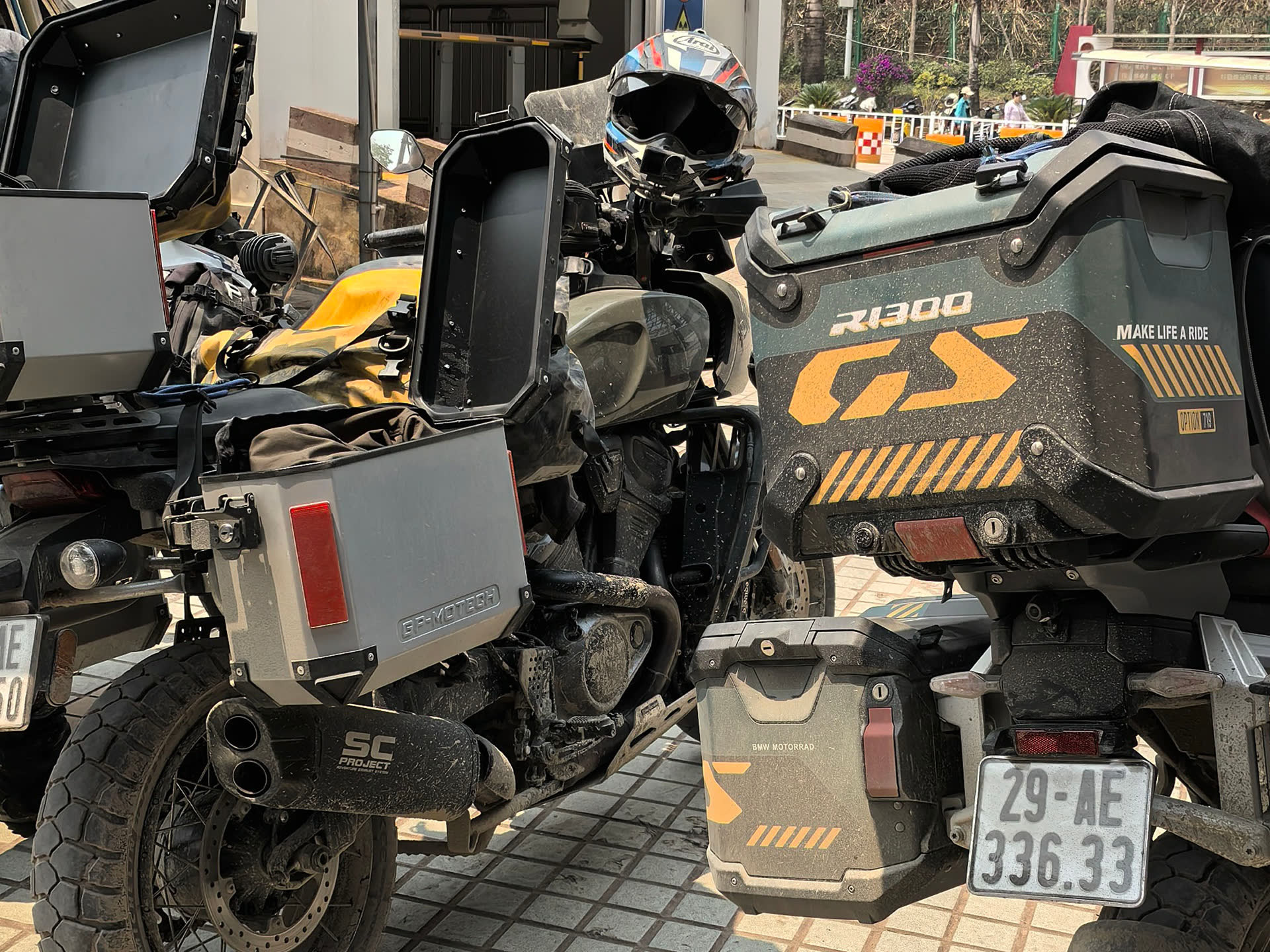
There is a certain posture a big adventure bike adopts when it is genuinely packed for travel rather than posed for a photograph, and the machine in this picture has it. It is a Vietnamese-registered BMW R1300 GS, loaded with proper adventure luggage, sitting ready for a run that will take it across a border and a long way into China. Anyone who has ridden one of these loaded across country will recognise the stance at a glance.
The R1300 GS is the current benchmark big-bore tourer in the adventure class: shaft drive, generous power, electronics that look after a heavily loaded rider, and enough carrying capacity to live on the road for weeks. A Vietnamese owner bringing one north is usually an experienced hand, but even experienced hands need the paperwork side explained, because the bike's sophistication does nothing to simplify the formalities.
1. The plate a foreign motorcycle needs
A motorcycle is treated like any other foreign vehicle. It enters under a temporary entry arrangement and displays a China temporary entry plate alongside the original Vietnamese registration. The home plate stays on the bike; the temporary plate is the authority for riding on Chinese roads during the trip.
It is valid for three months, and that is the figure to plan around. Build the route so the bike exits before the date on the paperwork and the validity never becomes a source of anxiety near the end of a long tour.
2. Riders cannot just cross on their own
This catches out solo riders more than anyone, because motorcyclists are used to being self-sufficient. The rule remains: a foreign vehicle has to come in through a licensed travel agency that makes the customs declaration and provides the guarantee. There is no separate, simpler channel for a single bike, and the rider's experience or preparation does not change that.
The qualifying agency has to meet a real bar, including a quality guarantee deposit and an operating history, so a bonded organisation is responsible for the vehicle while it is in the country. That structure is what allows the temporary plate to be issued.
3. The costs for a two-wheeled entry
It is worth noting that the service fee bands treat cars, campervans and motorcycles the same rather than charging by size. The fee covers the customs declaration, immigration processing, the temporary driving licence, the temporary plate, route filing, exit clearance and help at the port.
The customs guarantee is separate. Rather than the large share of value customs would otherwise assess, the agency's guarantee means the rider lodges a fixed 10,000 yuan into the agency's corporate account, three days before entry, refunded in full within a few working days after the bike leaves, provided nothing has overrun. The compulsory insurance is arranged before the plate is issued, with the rider paying the actual premium, and there is an inspection fee of around 200 yuan and separate translation costs.
4. The temporary motorcycle licence
China does not recognise the international driving permit, so the Vietnamese motorcycle licence alone is not enough even with a translation. A Chinese temporary driving licence, with the appropriate motorcycle category, is arranged through the agency. If more than one rider is travelling and they may share or swap bikes, each needs to be named correctly from the outset.
5. Where a big GS shines
A loaded R1300 GS is comfortable on the expressways and equally capable on the long, winding mountain roads that Yunnan and the high country specialise in. Most of China is open in principle, with defined exceptions. The capital needs its own entry permit. Tibet requires a full-time guide and a Tibet permit, and the lead time is longer. Certain border zones in Xinjiang and Gansu are restricted, and a few high-altitude roads, including parts of the G219 and the new unmanned-area route, are closed to foreign riders. Moving between Xinjiang and Tibet means looping back to Golmud and the Qinghai-Tibet road.
For a well-ridden GS, the practical touring routes are vast, and the bike is more than equal to the tarmac and the altitude.
6. Right-hand traffic and the rider
Vietnam drives on the right, so the rider is already accustomed to the same side of the road used in China, which keeps the transition simple. Right-hand-drive concerns do not apply to a motorcycle, and the main adjustments are simply local traffic habits and the way Chinese drivers behave on the expressways.
7. The documents to prepare
Allow around twenty days, longer if Tibet is involved. The agency needs the passport and Chinese visa, the motorcycle licence, a white-background ID photo, the bike's registration and ownership papers, the engine or frame number as appropriate, and photographs of the motorcycle. The non-Chinese documents need translations.
Check the frame and engine numbers before setting off. Any number that has been ground, altered or welded, or that does not match the registration, is a genuine blocker. A standard, unmodified BMW with consistent paperwork is a straightforward case.
8. Why the luggage matters
Looking at the photograph, the luggage is not decorative. Proper panniers and a top box keep the weight low and secure, weatherproof the rider's kit, and leave the bike balanced enough to handle the long days. It also means the documents, the temporary plate paperwork and the licence can be carried somewhere dry and immediately reachable for checkpoints.
If you ride a big adventure bike and have been wondering whether a loaded GS is a sensible machine to bring into China, the answer is yes, provided the agency and the formalities are arranged well ahead. The bike is capable of far more than the route will ask of it. Get the guarantee moved in the three-day window, keep the trip within the three-month plate, and the riding itself is the rewarding part.