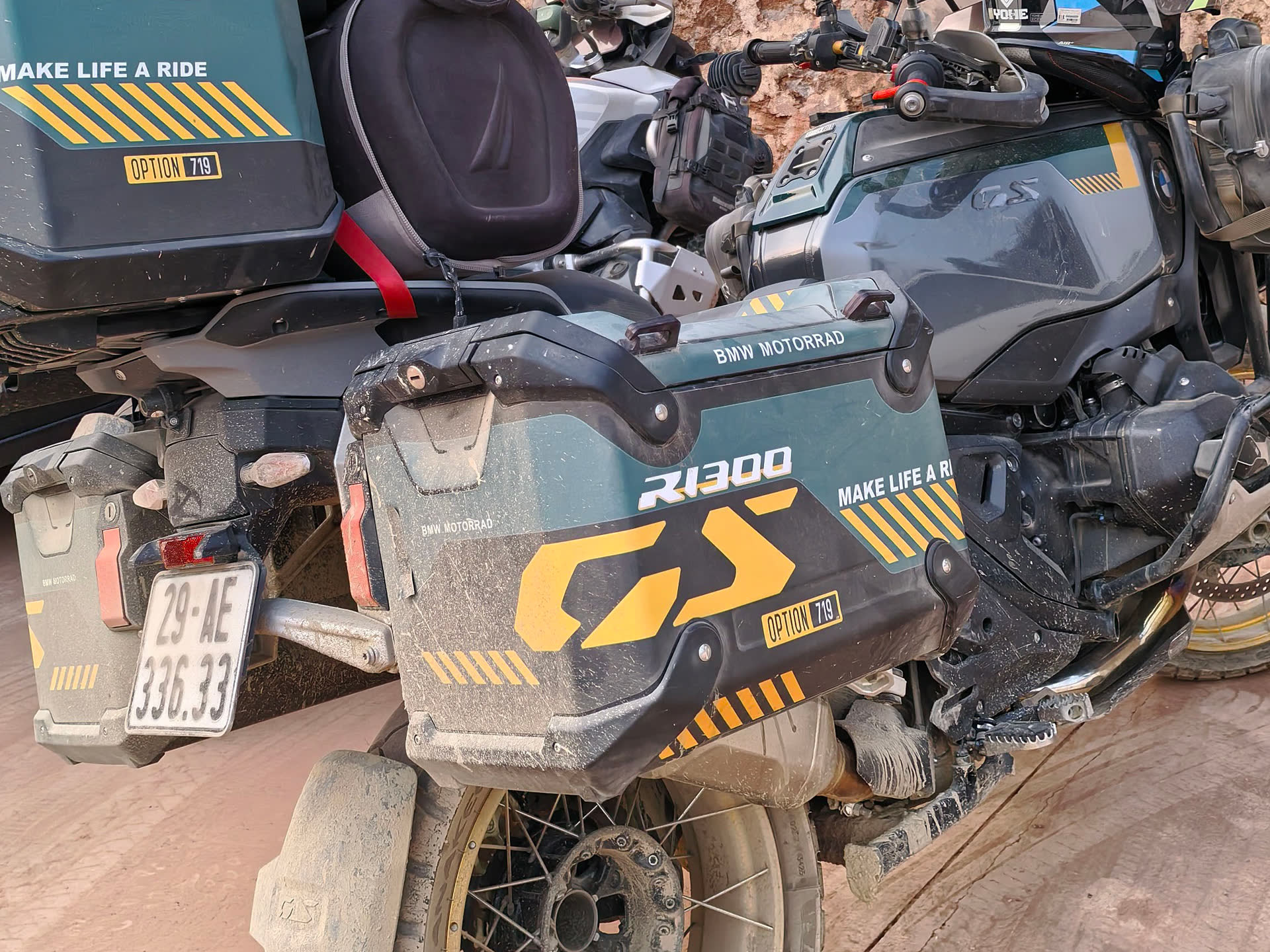
There is a particular look a big adventure bike gets when it has genuinely been worked off-road, and the R1300 GS in this photograph has it: a fine coating of pale dust over everything, the unmistakable patina of a day spent on loose surfaces rather than polished tarmac. It is a useful image because it shows what these machines are really for, and it raises a practical question worth answering: does taking a foreign-registered bike off the sealed road affect how it enters or how it is treated?
The short answer is that the entry formalities are the same, but there are sensible things to understand about where you can go and how the paperwork frames the route.
1. The temporary plate is unchanged
The dust does not alter the legal position. This is a foreign motorcycle entering under the temporary entry scheme, displaying a China temporary entry plate alongside the original Vietnamese registration, which stays on the bike. The temporary plate is the authority for riding on Chinese roads, whether those roads are paved expressways or rougher tracks.
It is valid for three months, and that is the figure to plan around. The whole route, including any off-road sections, should sit within that window so the bike exits before the paperwork runs out.
2. The agency is still required
A rider cannot bring even a highly capable off-road machine through the border alone. A licensed travel agency makes the customs declaration and provides the guarantee. The bike's ability to handle rough ground does not create a separate self-service channel; the entry is managed through the agency regardless of how the rider intends to use the machine once inside.
The agency meets the usual qualifying bar, including a quality guarantee deposit and an operating history, and stands as the bonded, responsible party for the bike while it is in the country.
3. The costs
The service fee bands treat motorcycles the same as cars and campervans. The fee covers the customs declaration, the immigration processing, the temporary driving licence, the temporary plate, the route filing, the exit clearance and the support at the port. The customs guarantee is separate: under the agency's guarantee, the rider lodges a fixed 10,000 yuan into the corporate account in place of the larger value-based assessment, three days before entry, refunded in full within a few working days after the bike leaves.
The compulsory insurance is arranged before the plate is issued, with the rider paying the actual premium, and the inspection fee of around 200 yuan and the translation costs apply.
4. The temporary licence
The international driving permit is not recognised in China, so the Vietnamese licence alone is not enough even with a translation. A Chinese temporary driving licence in the correct motorcycle category is arranged through the agency. Any second rider who might take the controls needs to be named from the start.
5. Where off-road riding fits within the rules
This is the important part. A GS is quite capable of leaving the tarmac, and there are plenty of legitimate dirt tracks, rural roads and adventure routes within the open areas. But the filed route and the restricted zones still matter. The capital needs its own entry permit. Tibet requires a full-time guide and a Tibet permit, with a longer lead time. Some border zones in Xinjiang and Gansu are restricted, and certain high-altitude roads, including parts of the G219 and the new unmanned-area route, are closed to foreign visitors. Getting from Xinjiang towards Tibet means looping back to Golmud and the Qinghai-Tibet road.
The practical approach is to keep any off-road exploration within the areas the route filing allows and well away from the restricted border-adjacent zones. The agency can advise on which adventure routes are open rather than guessing.
6. Riding on the right
Vietnam keeps to the right, as does China, so the rider is already on the familiar side of the road. On loose surfaces, the main adjustment is simply reading unfamiliar terrain and giving local traffic, especially trucks and farm vehicles, plenty of room.
7. Documents and the condition of the bike
Allow around twenty days, longer if Tibet is involved. The agency needs the passport and Chinese visa, the motorcycle licence, a white-background ID photo, the registration and ownership papers, the frame and engine numbers, and photographs of the bike. The non-Chinese documents need translations.
The dust is harmless, but the identifying numbers underneath it matter. Check the frame and engine numbers before travelling, because any number altered, ground or welded, or not matching the registration, is a blocker. A standard R1300 GS with consistent paperwork is a routine case.
8. Why the dust is a good sign
A clean bike in a photograph can be a pose; a dusty one is evidence of a real ride. The picture shows the machine doing what it was engineered to do, and the reason that is legal is the temporary entry arrangement, the plate and the agency guarantee working in the background.
If you ride a big adventure bike and want to explore some of the rougher routes rather than stay on the expressways, the bike is certainly up to it. Just arrange the entry through the proper agency, keep the off-road sections within the open areas and the filed route, lodge the guarantee in the three-day window, and respect the three-month plate. Then the dust at the end of the day is simply the mark of a ride worth taking.
After a day on loose surfaces, it is worth taking a few minutes to look the bike over before the next stage. Check that the chain is still correctly tensioned and lubricated, since dust and grit work their way into it quickly, and clear any build-up from around the brakes and the wheels. Make sure the luggage has not shifted and the straps are still secure, and confirm the lights and indicators are clear of the day's coating. A quick check of tyre condition and pressure is time well spent, because a slow puncture picked up on a rough track is far easier to spot in daylight at a stop than on the road in the dark. These small habits keep a heavily used adventure bike reliable right through the tour.