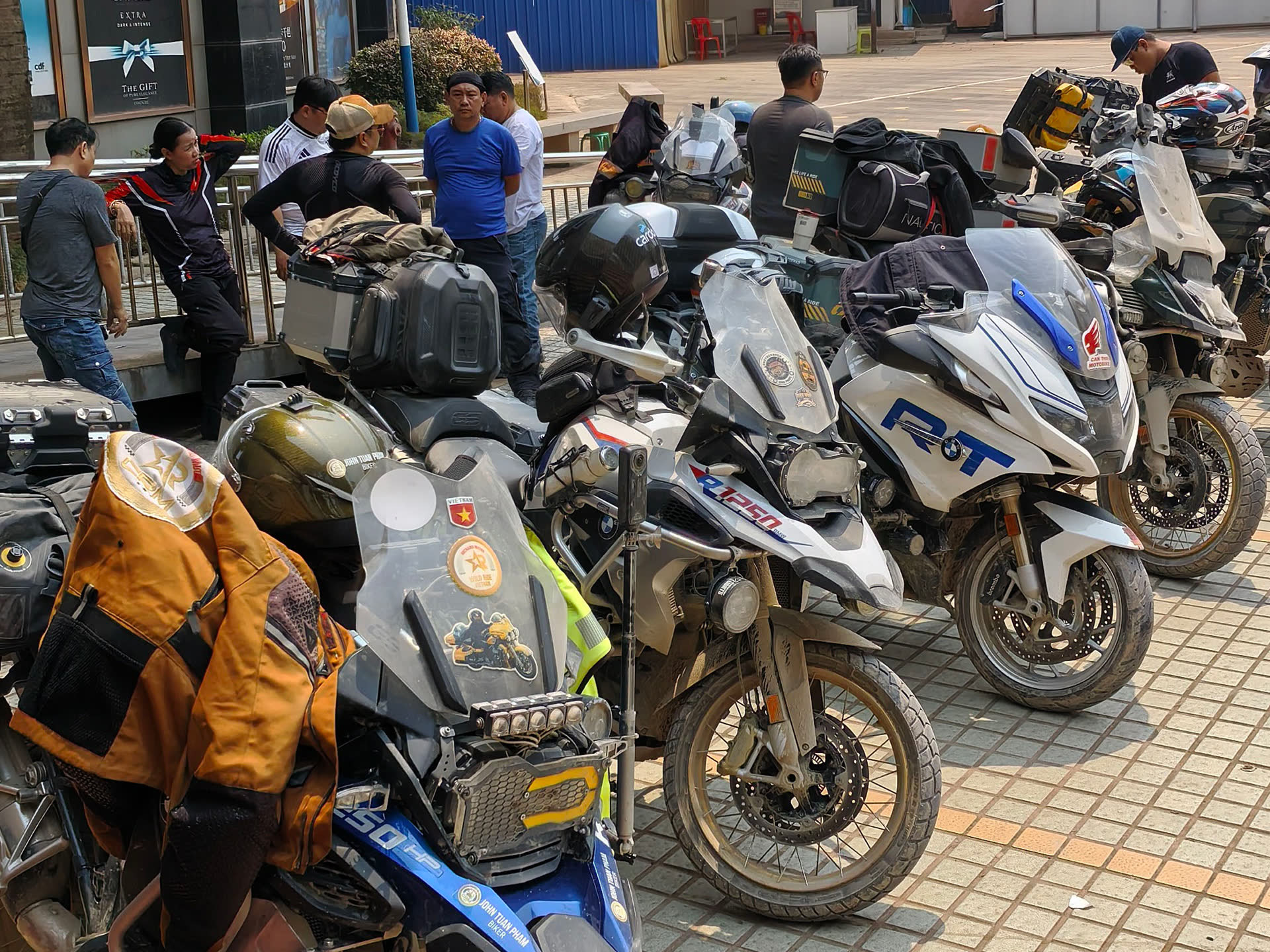
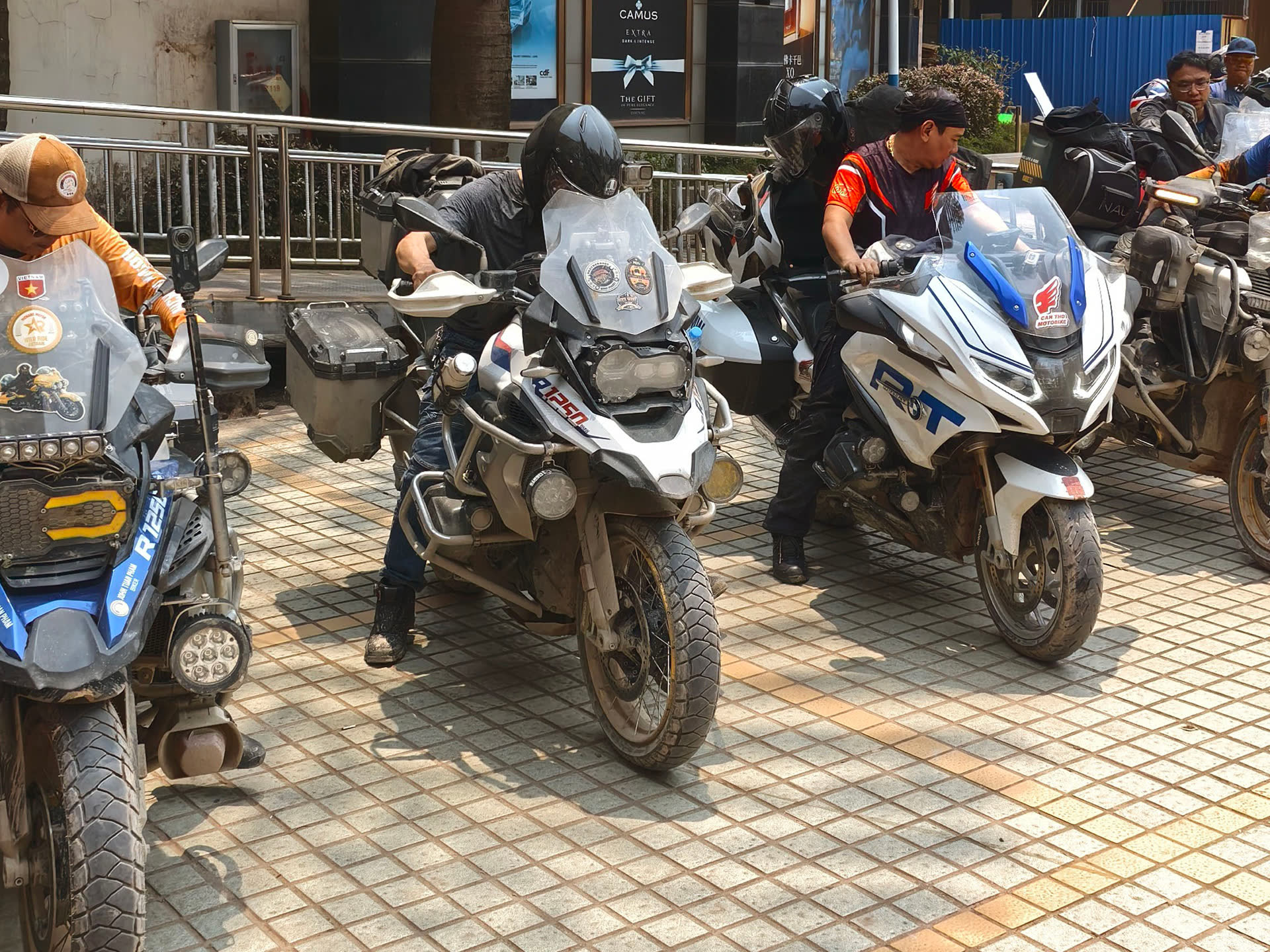
A good hotel car park on a tour route is where the real social side of a group ride happens, and these two photographs capture it: Vietnamese riders on BMW R1250 and RT tourers gathered at the hotel, machines parked, riders comparing notes after the day's run. The distinction between the bikes is worth a word, because they represent the two sides of BMW's touring family.
The R1250 GS is the adventure-oriented machine, built to handle rough ground as well as the road, while the RT is the dedicated road tourer, faired and comfortable for eating up long expressway miles in a relaxed posture. Seeing them together shows that riders choose different tools for the same broad ambition of touring across China.
1. The plates on every motorcycle
Each bike is a foreign vehicle in its own right and displays a China temporary entry plate alongside its original Vietnamese registration, which stays on the machine. There is no shared plate for the group; the authority to ride is per motorcycle.
Each plate is valid for three months, and that is the figure to plan around. Since the riders are following the same tour and staying at the same hotels, keeping the dates aligned is straightforward, and every bike should exit before the paperwork runs out.
2. Why the agency handles the group
The riders cannot process the bikes themselves at the border. A licensed travel agency makes the customs declarations and provides the guarantee, handling the group as a coordinated entry rather than a set of separate attempts.
The agency meets the usual qualifying requirements, including the quality guarantee deposit and operating history, and acts as the bonded, responsible party for the bikes while they are in the country. That structure is what allows the temporary plates to be issued.
3. The costs across the group
The service fee applies per motorcycle and covers each bike's customs declaration, the immigration processing, the temporary driving licence, the temporary plate, the route filing, the exit clearance and the support at the port. The customs guarantee is separate. Under the agency's guarantee, each rider lodges a fixed 10,000 yuan into the corporate account in place of the larger value-based assessment, three days before entry, with the money returned in full within a few working days after the group exits.
The compulsory insurance is arranged before each plate is issued, with the rider paying the actual premium, and the inspection fee of around 200 yuan and the translation costs apply per machine.
4. The temporary licences
Each rider needs a Chinese temporary driving licence in the correct motorcycle category, because the international permit is not recognised and the Vietnamese licence alone is insufficient even with a translation. The agency arranges the full set. The rider list should be settled early, because a late change means fresh paperwork.
5. Where the two bikes are in their element
The RT riders are happiest on the long, smooth expressways and good national roads, where the fairing and the relaxed riding position make the miles easy. The R1250 GS riders have the same road ability plus the option of rougher tracks and adventure routes. Most of China is open in principle, with the usual defined exceptions. The capital needs its own entry permit. Tibet requires a full-time guide and a Tibet permit, with a longer lead time. Some border zones in Xinjiang and Gansu are restricted, and certain high-altitude roads, including parts of the G219 and the new unmanned-area route, are closed to foreign riders. Getting from Xinjiang towards Tibet means looping back to Golmud and the Qinghai-Tibet road.
For a mixed group, the filed route tends to follow roads that suit every machine, so the RT bikes are not taken beyond their comfortable limits.
6. The practical side of group travel
Vietnam keeps to the right, as does China, so the riders are already on the familiar side of the road. The hotel gatherings are where the day's route is discussed, tyre pressures and chains are checked, and the group confirms the plan for the morning. Staying together and following the filed route keeps the entry in good order.
7. Documents to prepare
Allow around twenty days, longer if Tibet is involved. For every rider and bike, the agency needs the passport and Chinese visa, the motorcycle licence, a white-background ID photo, the registration and ownership papers, the frame and engine numbers, and photographs of the machine. The non-Chinese documents need translations.
Check the identifying numbers on every bike before travelling. Any number altered, ground or welded, or not matching the registration, is a blocker for that machine. Standard, well-maintained BMWs with consistent paperwork are routine cases.
8. Why the hotel scene is part of the story
The photographs are a reminder that these trips are not only about the viewpoints and the passes. A good deal of the pleasure is the evening gathering, the shared meals and the conversation among riders who have chosen different bikes but the same journey. The reason they can all park here and ride on is the agency entry, the per-bike plates and licences, and the guarantees arranged well before the border.
If you ride either an RT or a GS and have wondered how the two fit into the same group tour, the answer is that they complement each other well when the route is planned around the whole group. Get the guarantees in during the three-day window, keep to the filed route and the three-month plate, and the evenings at the hotel will be as much a part of the trip as the riding itself.
When the group parks up for the night, it is worth choosing a hotel with secure parking for the bikes rather than leaving them on an open street, and a quick word with the staff will usually confirm where the group can line the machines up safely. Take any valuables and the travel documents out of the panniers, and if the weather is wet, give the chains a light check and lubrication before the morning so the bikes are ready to roll. The hotel gatherings are also a good moment to confirm the next day's fuel stops and the route, so the whole group leaves in the morning knowing the plan rather than sorting it out at the roadside.