Not every border photograph is taken against a dramatic mountain backdrop. This one is refreshingly ordinary: a pair of Vietnamese BMW adventure bikes parked beside scaffolding on a working street, the kind of unglamorous stop that makes up most of a real tour. That everyday setting is worth keeping, because it shows these machines being used as ordinary transport rather than treated as trophies.
Two big BMW adventure bikes travelling together point to riders who know the machinery and the roads. The scaffolding and the street suggest a maintenance stop, a supply run or simply a pause in a town on the route. Whatever the reason, the entry formalities for the bikes are identical to those for any other foreign vehicle.
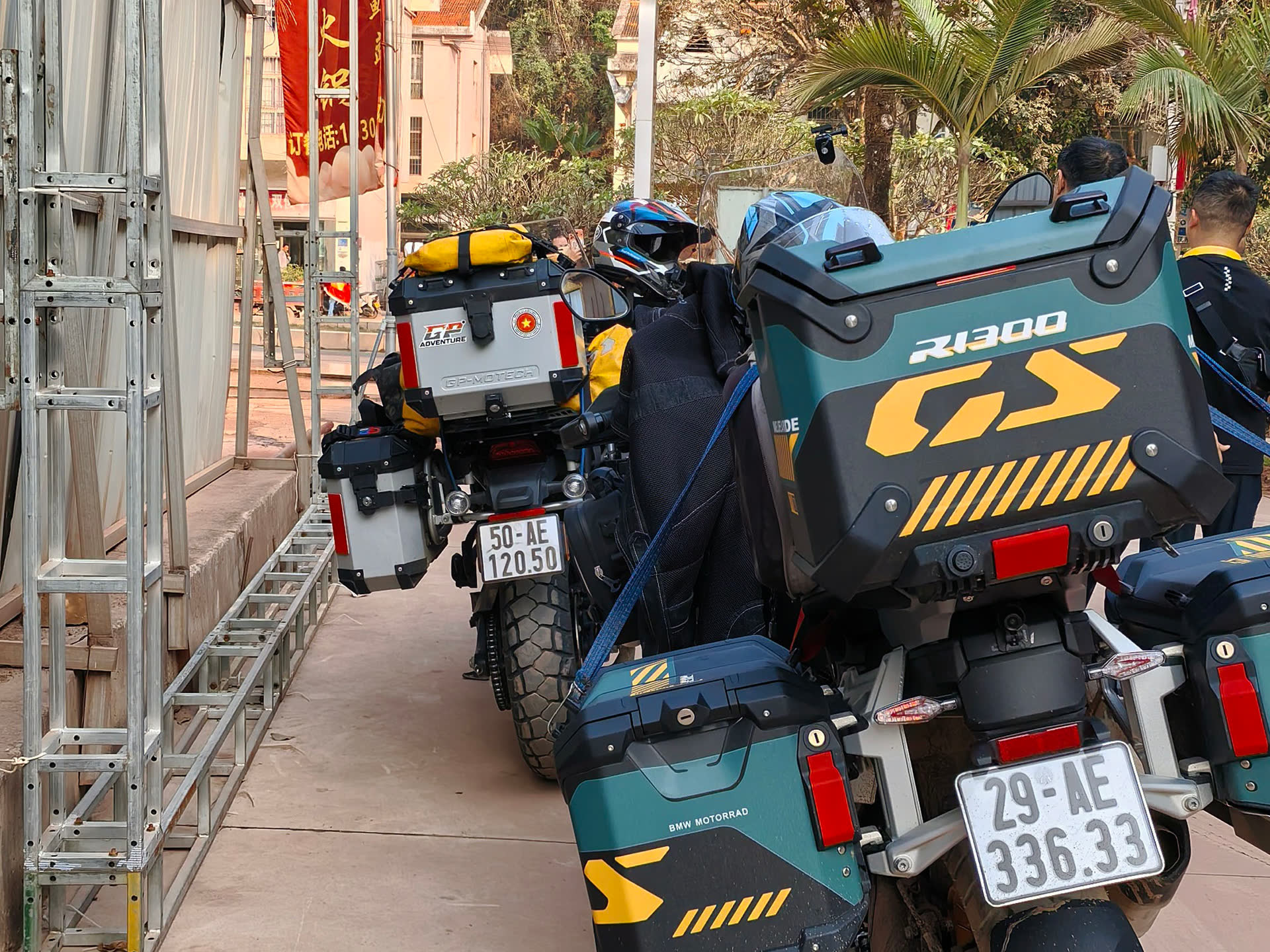
1. The plates each bike needs
Every motorcycle is a foreign vehicle in its own right and displays a China temporary entry plate alongside the original Vietnamese registration, which stays on the machine. There is no shared plate; the authority to ride is per bike.
Each plate is valid for three months, and that is the figure to build the itinerary around. With two riders following the same route, keeping the dates aligned is simple, and the bikes should exit before the paperwork runs out.
2. Why the agency handles the pair
The riders cannot process the bikes themselves at the border. A licensed travel agency makes the customs declarations and provides the guarantee, handling the two machines together as a coordinated entry rather than two improvised attempts.
The agency meets the usual qualifying requirements, including the quality guarantee deposit and operating history, and acts as the bonded, responsible party for the bikes while they are in the country. That structure is what allows the temporary plates to be issued.
3. The costs for two motorcycles
The service fee applies per bike and covers the customs declaration, the immigration processing, the temporary driving licence, the temporary plate, the route filing, the exit clearance and the support at the port. The customs guarantee is separate. Under the agency's guarantee, each rider lodges a fixed 10,000 yuan into the corporate account in place of the larger value-based assessment, three days before entry, with the money returned in full within a few working days after the bikes exit.
The compulsory insurance is arranged before the plates are issued, with each rider paying the actual premium, and the inspection fee of around 200 yuan and the translation costs apply per machine.
4. The temporary licences
Each rider needs a Chinese temporary driving licence in the correct motorcycle category, because the international permit is not recognised and the Vietnamese licence alone is insufficient even with a translation. The agency arranges both. If the riders may swap bikes during the trip, it is worth making sure the paperwork covers that from the outset.
5. Where these bikes are in their element
Big BMW adventure bikes are comfortable on the expressways and well suited to the long mountain roads of Yunnan and the high country. Most of China is open in principle, with the usual defined exceptions. The capital needs its own entry permit. Tibet requires a full-time guide and a Tibet permit, with a longer lead time. Some border zones in Xinjiang and Gansu are restricted, and certain high-altitude roads, including parts of the G219 and the new unmanned-area route, are closed to foreign riders. Getting from Xinjiang towards Tibet means looping back to Golmud and the Qinghai-Tibet road.
6. The ordinary realities of the road
The scaffolding in the photograph is a reminder that tours include routine stops as well as viewpoints. Tyre pressures are checked, chains are adjusted, supplies are bought, and the bikes are parked on ordinary streets among ordinary traffic. Vietnam keeps to the right, as does China, so the riders are already on the familiar side of the road, and the main adjustments are local traffic habits.
7. Documents to prepare
Allow around twenty days, longer if Tibet is involved. For each rider and bike, the agency needs the passport and Chinese visa, the motorcycle licence, a white-background ID photo, the registration and ownership papers, the frame and engine numbers, and photographs of the machine. The non-Chinese documents need translations.
Before travelling, check the identifying numbers on both bikes. Any number altered, ground or welded, or not matching the registration, is a blocker for that machine. Standard, well-maintained BMWs with consistent paperwork are straightforward cases.
8. Why the plain setting matters
There is a temptation to present every overland trip as a sequence of spectacular locations, but the truth is that most of it is ordinary streets, practical stops and steady riding. The bikes in this photograph are simply being used, and the reason they can be parked here and ridden on is the temporary entry arrangement, the plates and the agency guarantee working quietly in the background.
If you travel with a companion on similar machines, the entry is very manageable when it is coordinated through one agency. Get the guarantees in place during the three-day window, keep to the filed route and the three-month plate, and the ordinary, enjoyable business of riding through the towns and the mountains can take its course.
When two bikes travel together, a few simple habits keep the trip smooth. Agree on hand signals and, where the bikes are fitted with them, check the intercoms before setting off, and settle a fixed meeting point for any stretch where traffic might separate you. Keep a sensible following distance rather than riding on each other's rear wheel, especially on the loose surfaces and wet corners that the region is known for. It is also sensible for each rider to carry a copy of the other's documents and the agency's number, so that if one machine is delayed or stopped, the other can explain the situation and get help rather than waiting alone at the next town.