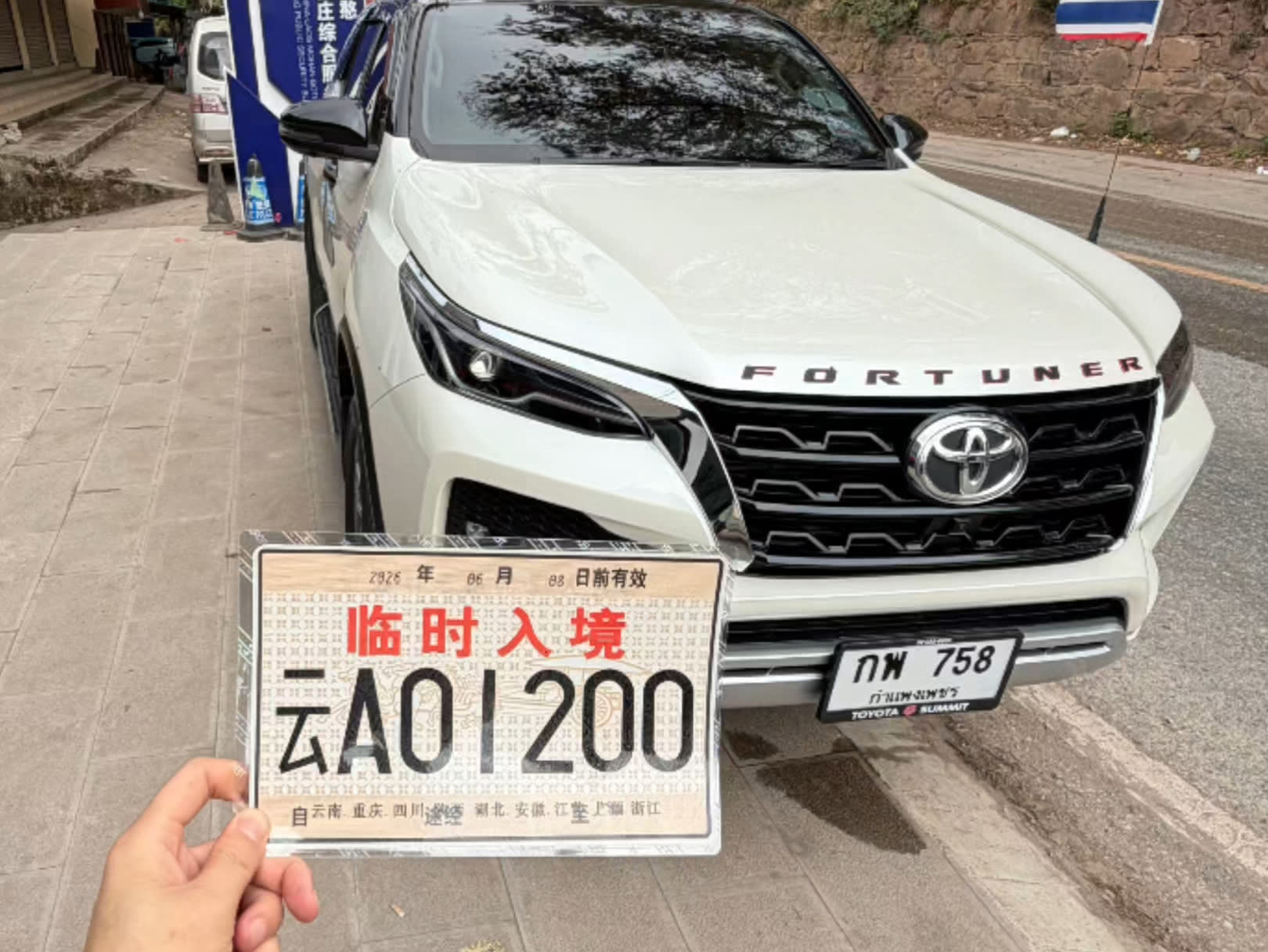
The Fortuner needs little introduction around the southern borders, and these two photographs show a Thai-registered example near Mohan with its temporary entry plate in place. Mohan is the land crossing that connects China with Laos, and it is the natural gateway for a great deal of Thai and Lao traffic, so a vehicle photographed here is a useful way to explain how a common family SUV actually enters.
The Fortuner is the SUV relation of the Hilux, built on the same tough underpinnings and favoured across the region for its blend of seven-seat practicality and genuine durability on poor roads. A Thai owner bringing one up through Mohan is usually on a family tour or a small group trip, and the process is well established.
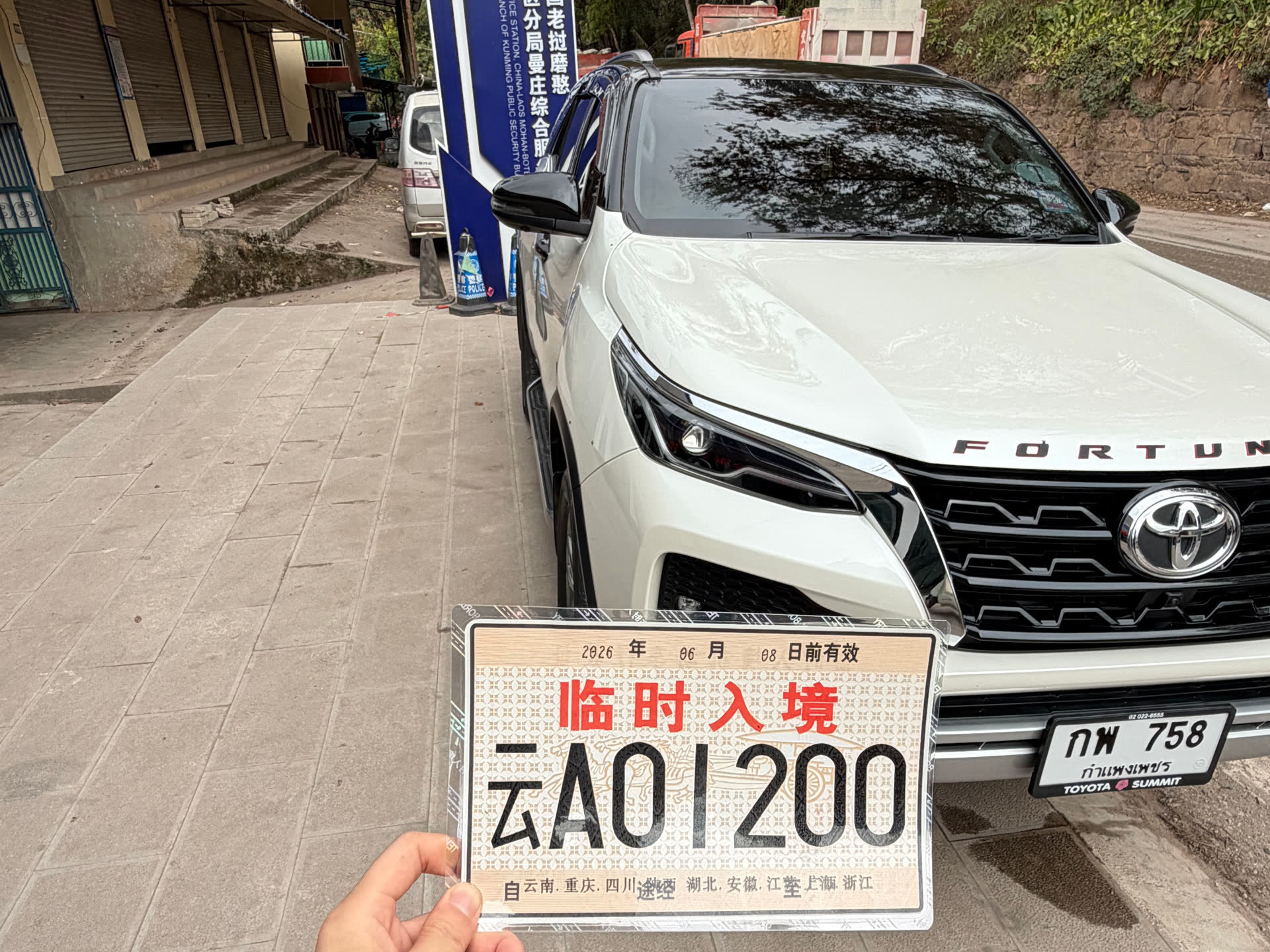
1. The temporary plate at the border
The plate on the front is a China temporary entry plate, issued under the temporary entry arrangement. It sits alongside the original Thai registration, which stays on the vehicle, and it is the authority for driving on Chinese roads during the visit.
It is valid for three months, and that is the figure to plan around. A route that begins at Mohan should be timed so the car exits, whether back through Mohan or another port, before the paperwork runs out.
2. The agency and the Mohan crossing
A foreign vehicle cannot be brought through Mohan by its owner acting alone. A licensed travel agency has to make the customs declaration and provide the guarantee. This is the standard position at the southern crossings, and it applies to a family SUV just as it does to any other vehicle.
The agency meets the usual qualifying requirements, including the quality guarantee deposit and operating history, and acts as the bonded, responsible party for the car while it is in the country. That structure is what allows the temporary plate to be issued.
3. The costs for entering through Mohan
The service fee covers the customs declaration, the immigration processing at the port, the temporary driving licence, the temporary plate, the route filing, the exit clearance and the practical support on the ground. The customs guarantee is separate: under the agency's guarantee, the owner lodges a fixed 10,000 yuan into the corporate account in place of the larger value-based assessment, three days before entry, refunded in full within a few working days after the car leaves.
The compulsory insurance is arranged before the plate is issued, with the owner paying the actual premium, and the inspection fee of around 200 yuan and the translation costs apply. Fuel, tolls and the rest are the traveller's own.
4. The temporary driving licence
The international driving permit is not recognised in China, so the Thai licence alone is not enough even with a translation. A Chinese temporary driving licence is arranged through the agency. If more than one person will share the driving on a family trip, both should be named when the paperwork is prepared.
5. Where a Fortuner is particularly useful
The Fortuner's strength is that it handles the smooth expressways comfortably and does not baulk at the rougher provincial roads and tracks that lead to villages, viewpoints and remoter stops. Most of China is open in principle, with the usual defined exceptions. The capital needs its own entry permit. Tibet requires a full-time guide and a Tibet permit, with a longer lead time. Some border zones in Xinjiang and Gansu are restricted, and certain high-altitude roads, including parts of the G219 and the new unmanned-area route, are closed to foreign visitors. Getting from Xinjiang towards Tibet means looping back to Golmud and the Qinghai-Tibet road.
For the typical Mohan entry, the trip stays in Yunnan and the neighbouring provinces, where the Fortuner's balance of comfort and ruggedness is exactly right.
6. Right-hand drive
Thailand drives on the left, so this is a right-hand-drive car. It is accepted at Mohan and the other ports with the same fees and no surcharge, and the only adjustment is on the driver, who has to remember that traffic in China keeps to the right. In a high-seating SUV with good visibility, that habit settles quickly.
7. The documents to gather
Allow around twenty days, longer if Tibet is involved. The agency needs the passports and Chinese visas, the driving licences, white-background ID photos, the registration and ownership papers, the engine number, and front, rear and side photographs of the vehicle. The non-Chinese documents need translations.
Check the identifying numbers before travelling. Any frame number altered, ground or welded, or not matching the registration, is a blocker. A standard, unmodified Fortuner with consistent paperwork is a routine, familiar case.
8. Why Mohan and the Fortuner make a natural pair
The photographs capture a common, sensible combination: a durable family SUV at the gateway that handles more of this regional traffic than anywhere else. There is nothing unusual to resolve and nothing precarious about the entry. The temporary plate goes on, the route is filed, and the car gets on with the tour.
If you are planning to bring a similar vehicle through Mohan, the message is that this is a well-trodden, predictable path when it is arranged through the proper agency. Get the guarantee moved in the three-day window, keep the trip within the three-month plate, and the Fortuner will take the family and the luggage wherever the route leads without fuss.
On a family trip, it is worth planning the driving days around the passengers rather than treating the car like a long-haul truck. The mountain roads in this part of Yunnan are winding, and shorter stages with regular breaks keep everyone fresh, particularly where children are in the back rows. Keep the travel documents, the temporary plate paperwork and the agency's contact details in the cabin rather than buried in the rear luggage, so they are immediately to hand at a checkpoint. A little thought given to where the group will stop for the night also removes the pressure of hunting for a suitable hotel after a long day behind the wheel.