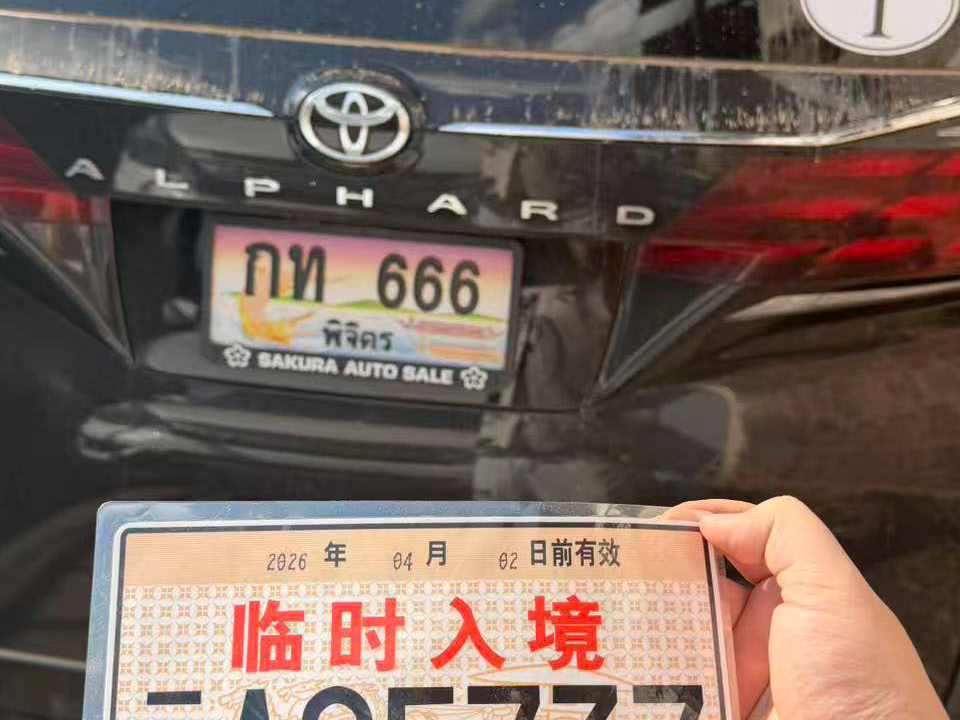
If you have ever lingered around the arrivals side of a land border in the upper Mekong, you will know the moment I mean. The trucks and the battered pickups have thundered through, and then something rather more refined glides up to the barrier: a long, glossy black Toyota Alphard on Thai plates, windows tinted, its paintwork still carrying the deep shine of a proper hand wash. That is the scene in these two photographs, and it is worth talking about, because people tend to picture foreign-registered cars in China as dusty off-roaders and forget just how many arrive as sensible family and business MPVs.
The Alphard is, across much of East and Southeast Asia, the default choice for moving people in comfort. It is not a driver's car in the sporting sense. It is a lounge on wheels, built for quiet motorways and long transfers, with captain's chairs in the middle row and enough sound deadening to make a border crossing feel like a library. When a Thai owner decides to bring one up into Yunnan and beyond, they are usually doing one of two things: carrying a family on a slow touring holiday, or moving a small group of colleagues between meetings. Either way, the paperwork is the same, and it is worth understanding before you roll up to the gate.
1. What the plate on the nose actually is
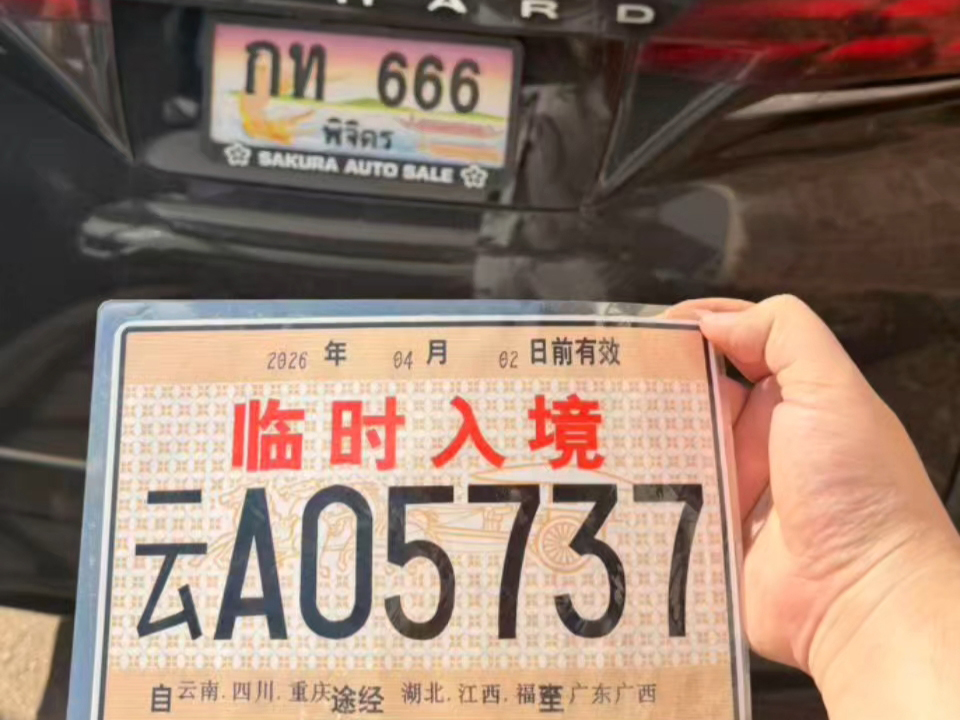
The first thing to notice in the photograph is the plate sitting at the front alongside the original Thai registration. It is not a permanent Chinese number, and it does not replace the home plate. It is a China temporary entry plate, issued specifically for a foreign-registered vehicle that has been brought in under a customs temporary entry arrangement. The original Thai plates stay on the car; the temporary plate is the authority the traffic police here want to see while the vehicle is moving on Chinese roads.
It carries a fixed validity of three months, and that is the number I would always give a client. People ask, quite reasonably, whether it can be stretched if they decide to stay a little longer, but that is not something I write into a guide or an email. Plan around the three months from the outset, build an itinerary that finishes with the car leaving again before the date on the paperwork, and you will not be chasing your tail near the end of the trip.
2. Why you cannot simply drive one in yourself
This is the part that catches out the independent travellers, and the Alphard owner is often the sort of person who is used to arranging everything themselves. The rule is clear: a foreign vehicle entering China has to be brought in through a licensed travel agency that holds the right qualifications and provides the customs guarantee. An individual cannot turn up at the border and complete the temporary entry declaration on their own. It is not a question of patience with forms, or speaking the language. The system is built around the agency being the responsible party while the car is in the country.
A qualified agency has to meet a meaningful bar, including a quality guarantee deposit lodged with the tourism authority and a solid operating history. That is not red tape for its own sake. It means there is a named, bonded organisation answerable for the vehicle while it is inside, which is precisely what allows a privately owned foreign MPV to be driven around on a temporary plate in the first place.
3. How the money actually works
I find it helps to separate the costs, because people confuse the customs guarantee with the agency service fee, and they are different things.
The service fee is what the agency charges for doing the work: the customs declaration, the immigration side of the crossing, the temporary driving licence, the temporary plate, the route filing, the exit clearance and the hands-on help at the port itself. The customs guarantee is a separate matter. Customs notionally assess a vehicle at a substantial proportion of its value, but with the agency's guarantee in place the owner only has to lodge a fixed sum of 10,000 yuan. It goes into the agency's corporate account, it needs to have arrived three clear days before the crossing, and it is returned in full within a few working days after the vehicle has left the country again, provided nothing has overrun and there are no outstanding matters.
On top of that there is the compulsory insurance, which has to be in place before the temporary plate can be issued. The agency arranges it ahead of entry and the client pays the actual cost. There is a vehicle inspection fee of around 200 yuan that applies to every car, and any document translation is charged separately. Fuel, tolls, hotels and meals are the traveller's own, as you would expect.
4. The temporary driving licence
China does not recognise the international driving permit, so the person behind the wheel cannot rely on their Thai licence alone, even with a translation. A Chinese temporary driving licence has to be arranged, and the agency handles that as part of the package. It is worth sorting out who is actually going to drive before you start, because the licence is tied to named drivers. If two people intend to share the long motorway stretches, name both at the paperwork stage rather than discovering the second driver is not covered halfway through the trip.
5. Where an Alphard can and cannot go
A comfortable MPV like this is in its element on the paved national expressways and the good provincial roads, and that is where most owners keep it. The whole country is open in principle, but there are a few sensible exceptions to know about. Reaching Beijing requires the separate entry permit for the capital. Travelling into Tibet means a full-time guide and the Tibet travel permit, and the formalities need longer to arrange. Some border-adjacent zones in Xinjiang and Gansu are restricted, and a couple of specific high-altitude routes are simply not open to foreign visitors, including sections of the G219 and the new unmanned-area road; if you want to get from Xinjiang down towards Tibet, the proper way is to loop back to Golmud and use the Qinghai-Tibet route.
For the typical Alphard itinerary, this is academic. Most families potter around Yunnan, run up to the classic towns, and keep the car on the kind of smooth tarmac it was designed for.
6. Right-hand drive is not a problem
Thailand drives on the left, so the Alphard is a right-hand-drive car. I am often asked whether that is an issue at Chinese ports. It is not. Right-hand-drive vehicles are accepted at the crossings, with the same paperwork and the same fees as a left-hand-drive car, and there is no extra charge. The only adjustment is on the driver, who now has to remember that traffic here keeps to the right. On a big, well-mannered MPV with good mirrors, that comes quickly.
7. A practical word on the documents
The paperwork for a vehicle like this generally wants to be in hand around twenty days before travel, longer if Tibet is involved. The agency will need the passports and Chinese visas, the driving licences, passport-style photos on a white background, the vehicle registration and ownership documents, the engine number if it is not printed on the registration, and clear photographs of the vehicle from front, rear and side. Anything other than the Chinese licence itself needs a Chinese translation.
If any of the identifying numbers on the car have been altered, ground down or welded, or if the frame number does not match the registration, that is a genuine blocker and worth resolving at home rather than at the border. A clean, standard, well-looked-after Alphard with matching paperwork sails through.
8. Why the black MPV is a sensible choice
Looking at the photographs again, the appeal is obvious. It is unflashy, it is comfortable, and it does not draw attention. A family can load the luggage behind the third row, keep the climate control steady, and spend a month on the road without ever feeling cramped. At the end of the trip, the car exits through the correct port, the guarantee comes back, and the temporary plate and licence have done their job.
If you own something similar and have been wondering whether a comfortable road-focused MPV is suitable for a China tour rather than a lifted four-wheel drive, the answer is yes. Get the agency and the paperwork lined up early, lodge the guarantee in good time, and the car itself is the easy part. There is nothing in that black Alphard the border has not seen a hundred times before.