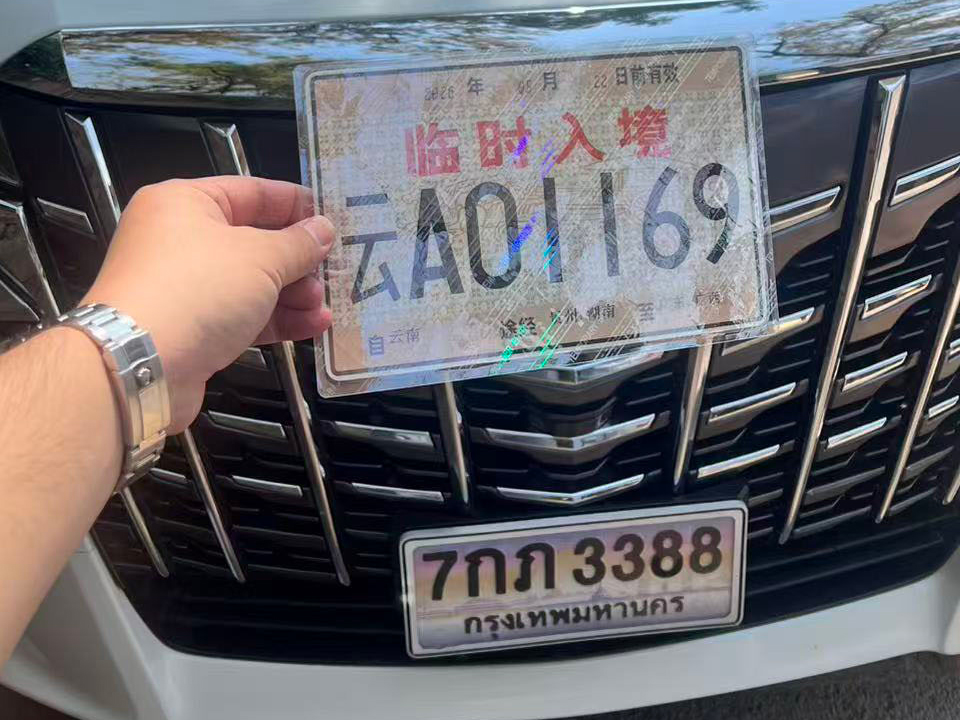
The first thing you notice in this photograph is the plate on the grille. It is not the original Thai registration, which is still present elsewhere on the car, but a Chinese temporary entry plate issued in Yunnan and fixed to the front of the vehicle. Where a plate is mounted and what the characters on it mean might sound like a small detail, but it tells you a great deal about how temporary import works in practice. This piece looks at why that plate is on the grille, what the Yunnan marking represents, and the process that puts it there.
Drivers new to cross-border trips often treat the plate as a sticker they collect and forget. It is more than that. It is the visible sign that the vehicle has been lawfully declared and permitted onto Chinese roads, and the way it is displayed matters at every checkpoint the car passes. So it is worth starting with the physical object itself.
1. Why the temporary plate is displayed on the front
A temporarily imported vehicle has to show its Chinese temporary entry plate while it is being driven, which is why you see it mounted prominently on the grille rather than tucked away. The original foreign plate remains on the car as well, so the two sit together: the home registration identifies the vehicle's origin, while the temporary plate grants it permission to be here. Keeping both visible is the normal arrangement rather than a problem.
The plate is backed by declaration paperwork that matches it to the vehicle's identification numbers and the entry record. If an officer stops the car, the plate and the documents need to line up. That is why the mounting is taken seriously; a plate that is not properly displayed can cause delays even when the underlying declaration is entirely in order.
2. What the Yunnan marking on the plate means
The plate in the photo is a Yunnan temporary entry plate, and that regional character is not decorative. Temporary plates are issued through the local vehicle management authority connected to the entry process, and the marking reflects where the vehicle entered and was declared. For cars coming overland through the southern land route, Yunnan is the natural entry province, so a Yunnan-issued temporary plate is exactly what you would expect.
A common misunderstanding is that a plate issued in one province somehow limits where the car can travel. It does not work that way. A properly issued temporary entry plate allows the vehicle to move through the country along the filed route, including well beyond Yunnan. The regional marking tells you where the formalities were handled, not that the car is confined to that province. The real limits come from the validity window and from specific restricted areas, not from the plate's place of issue.
3. The three-month validity and how it shapes the trip
The temporary plate is issued with a validity of three months. That period is the legal window for the vehicle to remain in China, and the dates printed on the paperwork are the ones that count. A sensible itinerary is built around those dates from the start, with the exit crossing planned in good time rather than left open.
It is tempting to treat the dates as flexible, but a temporarily imported vehicle that overstays creates genuine problems at checkpoints and at the border when leaving. The cleanest trips are the ones where the route, the stops and the exit all fit comfortably inside the window, with a little margin rather than cutting it to the last day.
4. The temporary licence that accompanies the plate
The plate authorises the vehicle, but the driver still needs separate permission. China does not rely on an international driving permit in the way many visitors assume, so a foreign driver needs a Chinese temporary driving licence for the correct vehicle class. The home licence is used as a supporting document, together with a Chinese translation, but the temporary licence is the actual authority to drive during the visit.
The two are arranged together through the same entry process, which is why they should be thought of as a package rather than separate chores. The plate without the correct licence, or the licence without the plate, leaves the setup incomplete. Both need to be in hand before the car leaves the border area.
5. Why a licensed agency is required
A foreign vehicle cannot be self-declared at the gate. The entry has to be handled by a licensed travel agency with the proper outbound-tourism qualifications and the required quality deposit lodged with the authorities. The agency acts as the guarantor for the vehicle, prepares the customs declaration and arranges the temporary plate and temporary licence.
The logic is that customs need a responsible party on the Chinese side who can account for the vehicle and confirm it leaves again on schedule. An individual arriving without that arrangement cannot complete the crossing, no matter how good the car is. A competent agency also knows the current document formats and the correct way to display the plate, which prevents avoidable hold-ups.
6. Deposit, insurance and the practical costs
The costs are clearer when kept separate. The customs deposit is refundable: the owner pays a fixed 10,000 yuan into the agency's corporate account, and it must have cleared at least three days before the crossing. Once the vehicle leaves on time and with no outstanding issues, the deposit is returned in full, usually within three to five working days. The payment receipt belongs with the rest of the folder.
Insurance is compulsory and has to be in place before the temporary plate is issued, since the car cannot be driven without it. The agency arranges it ahead of entry and the owner pays the actual cost. A vehicle inspection fee of around 200 yuan applies across the board, and translation costs may add a little. The service fee covers the declaration, immigration steps, temporary licence and plate, route filing and the handling at the port.
7. Living with the plate on the road
Once the journey begins, the plate earns its keep. At checkpoints, officers check that the car matches the plate and the declaration and that the driver matches the temporary licence. It is a routine process, and staying calm and handing over the documents is usually the whole interaction. The agency can be contacted remotely if anything needs confirming.
Drivers heading into the western plateau need to remember that restricted areas and border zones are a separate matter from the plate. Tibet requires separate permits and a guide, and some stretches are not open to foreign visitors regardless of the registration. Where there is no clear current answer, the reliable move is to check with the agency and trust what the printed permits state.
The plate on the grille in this photograph is the visible end of a careful process: a vehicle declared through a licensed agency, a three-month temporary entry plate correctly displayed, and a matching temporary licence for the driver. Understand what the regional marking means and keep the documents ready, and the journey through China runs far more smoothly than most first-time drivers expect.