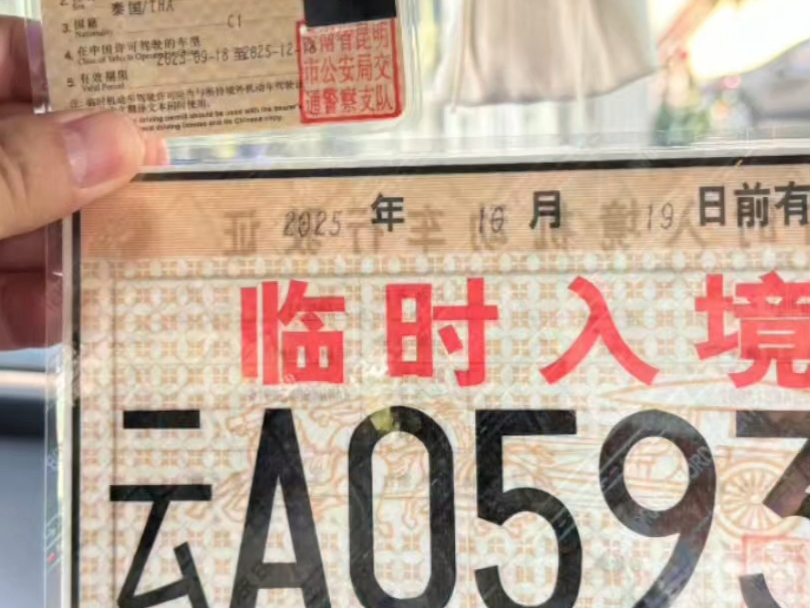
There is a moment in every border crossing when the paperwork comes out of the folder and spreads across the table, and this photo captures it. A Chinese temporary entry plate document sits next to a Thai driving licence, and to an outsider the two can look like part of the same thing. They are not. Each piece of paper does a different job, and understanding which is which saves a lot of confusion when you are preparing to bring a vehicle into China. This piece is a plain-English walk through the documents in the photograph and the ones that sit alongside them.
The reason this matters is simple. Most problems at the border are not about the vehicle. They are about a document that is missing, out of date, printed in the wrong language or simply misunderstood. The drivers who cross smoothly are usually the ones who knew what every sheet of paper was for before they arrived. So let us start with the two items in the picture and work outwards.
1. The temporary entry plate document
The Chinese temporary entry plate is the permission for the vehicle itself to be on Chinese roads. A foreign registration on its own does not grant that. When the customs declaration is completed, the vehicle is issued the temporary plate, which is displayed on the car or motorcycle and backed by the paperwork shown here. It is the vehicle's legal authority to move through the country, and it is tied to the specific vehicle, its identification numbers and the entry record.
The plate is issued with a validity of three months. That is the window in which the vehicle is permitted to remain, and the dates on the document are the ones that matter when planning. The route, the time spent in each region and the exit crossing all need to fit inside it. Treating those dates as flexible is a genuine mistake, because overstaying with a temporarily imported vehicle causes trouble both at checkpoints and when leaving.
2. The Thai driving licence and the Chinese temporary licence
The Thai driving licence in the photo establishes that the person is a qualified driver at home. It is an important supporting document, but on its own it does not authorise someone to drive inside China. China does not operate on the international-permit assumption many travellers bring with them, so a foreign driver also needs a Chinese temporary driving licence, matched to the class of vehicle being brought in.
The distinction is worth dwelling on. The home licence proves ability and feeds into the application; the Chinese temporary licence is the actual legal permission to drive on these roads during the visit. Both are part of the package, along with a Chinese translation of the foreign licence, since the supporting paperwork generally needs to be in Chinese. The temporary licence is arranged through the same entry process as the plate rather than collected independently on the day.
3. The other documents sitting behind these two
The photo only shows the headline items, but a complete declaration relies on a wider set. For the driver, that means a passport with a valid Chinese visa, a white-background ID photograph and the licence itself. For the vehicle, it means the registration document, the ownership certificate, the engine number, and photographs of the front, rear and sides. Where the registration certificate does not print the engine number, a photograph of the engine bay is used instead.
Vehicles over a certain age may need an additional inspection certificate, and after entry they can be required to pass a check at the vehicle management office. Almost every foreign-language document needs a Chinese translation, which is why getting the package prepared professionally is far easier than assembling it at the last minute. The exact requirements vary a little with the port and the vehicle, so relying on a current checklist rather than memory is sensible.
4. Why a licensed agency holds the declaration together
A foreign vehicle cannot simply be declared by its owner at the gate. The entry has to run through a licensed travel agency with the proper outbound-tourism qualifications and the required quality deposit in place. The agency is the guarantor for the vehicle while it is in China, and it is responsible for preparing the customs declaration and arranging both the temporary plate and the temporary licence.
From the customs point of view this makes sense. They need a responsible party on the Chinese side who can account for the vehicle and confirm it leaves on schedule. A driver who arrives without that arrangement cannot complete the crossing, regardless of how well prepared the personal documents are. An experienced agency also knows the current document formats, which is where many self-attempted declarations fall over.
5. The deposit, insurance and fees behind the paperwork
It helps to separate the costs rather than treating them as one lump sum.
The customs deposit is refundable. In practice the owner pays a fixed deposit of 10,000 yuan into the agency's corporate account, and it must have cleared at least three days before the crossing so the declaration can proceed. Once the vehicle leaves on time and with no outstanding issues, the deposit is returned in full, usually within three to five working days. It is not a fee that disappears, and the payment receipt should be kept with the rest of the folder.
Insurance is compulsory. The traffic cover has to be in place before the temporary plate is issued, because the vehicle cannot be driven without it. The agency arranges this before entry and the owner pays the actual cost. A vehicle inspection fee of around 200 yuan also applies across the board, and translation costs may add a little. The service fee itself covers the declaration, immigration steps, temporary licence and plate, route filing and the handling at the port.
6. Keeping the documents usable on the road
Once the trip is underway, the paperwork does not go back into a suitcase. It is worth keeping the temporary plate paperwork, the Chinese temporary licence, the insurance and copies of the declaration together in one waterproof folder, because that is exactly what gets asked for at checkpoints. Having it organised keeps a stop short and calm.
At a checkpoint, officers are checking that the person matches the temporary licence and that the vehicle matches the plate and declaration. It is a routine process, not a confrontation, and being polite and ready makes it straightforward. If anything needs confirming, the agency can be contacted remotely to back up the documents.
For longer trips into the plateau or the border regions, the paperwork story gets a little more involved. Tibet needs separate permits and a guide, and some restricted zones are not open to foreign visitors regardless of the plate. Where there is no clear current answer, the reliable move is to check with the agency and trust what the printed permits state rather than an outdated forum post.
The close-up in the photograph is really a picture of preparation. Each document has a clear job: the plate authorises the vehicle, the home licence supports the driver, and the Chinese temporary licence authorises the driving. Get those straight in your mind before you travel, keep them together on the road, and the border crossing becomes a calm step rather than the stressful part of the journey.