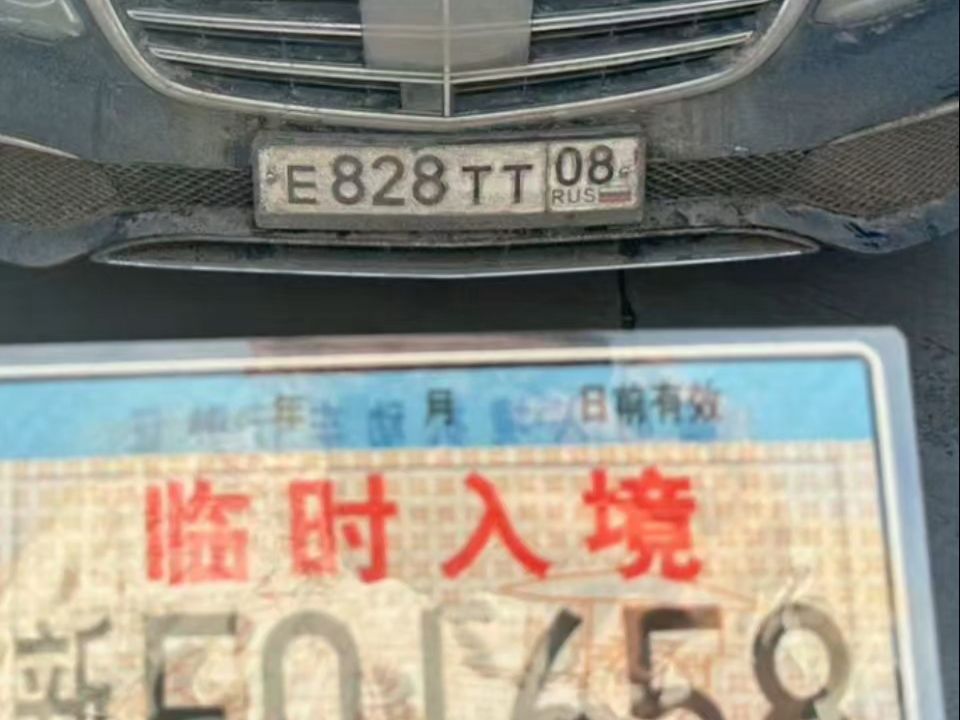
The car in this photograph is Russian-registered and now displays a Xinjiang temporary entry plate, marking it as another vehicle that has come in through the western land route rather than the southern border. Russian drivers have a long history of overland travel into China, and the entry process handles their vehicles alongside the Central Asian traffic moving through the same ports. This piece looks at how a Russian-registered car is brought in, what the temporary plate means, and the formalities that sit behind it.
The western entry points, with Khorgos the most prominent, serve the broad region that stretches back into Russia and the Central Asian states. A Russian driver may cover a considerable distance before reaching the Chinese frontier, so the Chinese leg is one stage of a longer journey rather than a short hop from a neighbouring country. The car in the photo has completed that entry and carries the plate that legally allows it onto Chinese roads.
1. The temporary entry plate
As with every foreign vehicle, the Russian registration alone does not permit the car to drive inside China. Once the customs declaration is completed at the port, the vehicle is issued a Chinese temporary entry plate, which is displayed while it is in the country. The original Russian plate remains on the car as well, so the two appear together as they do in the photograph.
The temporary plate is issued with a validity of three months, and the dates on the accompanying paperwork define how long the vehicle may remain. The route across Xinjiang and into the rest of China, along with the planned exit, needs to fit within that window. There is no separate rule for Russian vehicles; the same three-month temporary plate applies to them as to cars from any other country.
2. The temporary driving licence
The driver needs a Chinese temporary driving licence for the correct vehicle class, because China does not rely on an international driving permit in the way many visitors assume. The Russian home licence is used as a supporting document, together with a Chinese translation, but the temporary licence is the actual authority to drive during the visit.
It is arranged alongside the plate through the same entry process, so the two are treated as a package. Both need to be in hand before the car leaves the port area, and getting the documents and translations prepared in advance keeps the crossing smooth after a long overland approach.
3. Why a licensed agency is required
A foreign vehicle cannot be self-declared at the border. The entry has to run through a licensed travel agency with the proper outbound-tourism qualifications and the required quality deposit lodged with the authorities. The agency acts as the guarantor for the vehicle, prepares the customs declaration and arranges the temporary plate and temporary licence.
The reason is that customs need a responsible party on the Chinese side who can account for the car and confirm it leaves again on schedule. This requirement applies at the western ports just as firmly as elsewhere, and a competent agency knows the current document formats and prevents the technical errors that hold entries up. For a driver who has already crossed several regions, that reliability is genuinely valuable.
4. The deposit, insurance and costs
The financial side follows the standard structure. The customs deposit is refundable: the owner pays a fixed 10,000 yuan into the agency's corporate account, and it must have cleared at least three days before the crossing so the declaration can proceed. Once the vehicle leaves on time and with no outstanding issues, the deposit is returned in full, usually within three to five working days.
Insurance is compulsory and has to be in place before the temporary plate is issued, with the agency arranging it ahead of entry and the owner paying the actual cost. A vehicle inspection fee of around 200 yuan applies across the board, and translation costs may add a little. The service fee covers the customs declaration, the immigration steps, the temporary licence and plate, the route filing and the handling at the port.
5. Driving on from the western entry
Once the formalities are complete, the car faces the characteristic roads of Xinjiang, where the distances are long and the landscapes open. The main adjustment is one of scale; planning fuel and rest stops around the larger gaps between towns matters more than in the denser eastern provinces. A well-prepared car handles the extended highway stages comfortably.
Checkpoints are a routine part of travel in the region, and they are nothing to worry about when the paperwork is in order. Officers check that the driver matches the temporary licence and that the car matches the plate and declaration. A calm handover of the folder is usually the whole interaction, and the agency can be contacted remotely if anything needs confirming.
The restricted-area rules are especially relevant in the west. Some border zones are not open to foreign visitors, and certain remote stretches cannot be included regardless of the vehicle. For anyone aiming to move from Xinjiang toward Tibet, the permitted routing has to be followed, and where there is no clear current answer, the agency and the printed permits are the reliable source rather than an old online thread.
6. The consistency of the entry process
The Russian car in this photograph is a useful reminder that the rules do not vary by nationality of registration. A vehicle from Russia goes through the same declaration, receives the same three-month temporary plate and temporary licence, and works with the same licensed agency as a car from Kyrgyzstan, Laos or Thailand.
The differences are practical ones, such as the port used, the distance travelled and the documents needing translation. Once those are handled, the car follows its filed route like any other. That consistency is helpful for overland drivers, because the same reliable process applies no matter where the journey began.
The Russian-registered car with its Xinjiang plate is the visible result of a well-established western entry: a licensed agency preparing the declaration, a three-month temporary plate correctly displayed, and a matching temporary licence for the driver. Understand the port process and plan the long distances in advance, and a familiar car can carry you smoothly into China and across the wide roads ahead.