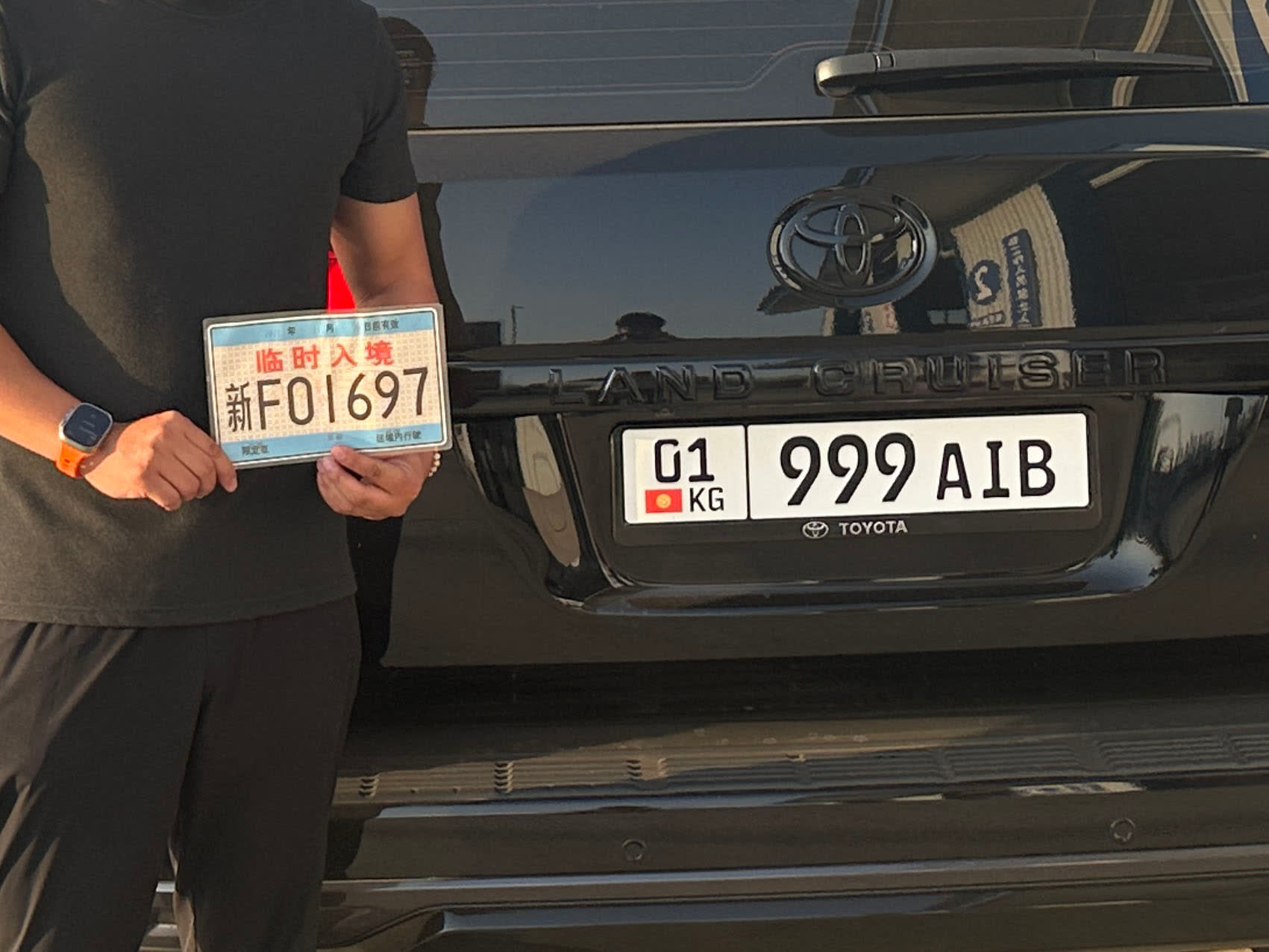
The vehicle in this photograph is a Kyrgyz-registered Land Cruiser, now displaying a Xinjiang temporary entry plate, which places it firmly at the western end of the entry system rather than the southern border. It has come through the Khorgos land port on the China-Kazakhstan frontier, the gateway for the steady overland traffic moving between Central Asia and western China. Rugged four-wheel-drives are exactly what you would expect on these routes, and the car is a good way to explain how the Khorgos crossing and the Xinjiang plate work.
Khorgos is one of the busiest and most efficiently organised land ports in the country, handling travellers and freight moving both ways across the Central Asian border. Drivers arriving from Kyrgyzstan, Kazakhstan and further afield pass through it, and the roads immediately on the Chinese side run out across the wide landscapes of Xinjiang. The Land Cruiser in the photo has completed that entry and carries the plate that legally allows it to be here.
1. The temporary entry plate
As with any foreign vehicle, the Kyrgyz registration alone does not permit the car to drive inside China. Once the customs declaration is completed at Khorgos, the vehicle is issued a Chinese temporary entry plate, which is displayed while it is in the country. The original Kyrgyz plate remains on the car as well, so the two appear together as they do in the photograph.
The plate is issued with a validity of three months, and the dates on the accompanying paperwork define how long the vehicle may remain. The route across Xinjiang and into the rest of China, along with the planned exit, needs to fit within that window. There is no special rule for Central Asian vehicles; the same three-month temporary plate applies to them as to cars from any other country.
2. The temporary driving licence
The driver needs a Chinese temporary driving licence for the correct vehicle class, because China does not rely on an international driving permit in the way many visitors assume. The Kyrgyz home licence is used as a supporting document, together with a Chinese translation, but the temporary licence is the actual authority to drive during the visit.
It is arranged alongside the plate through the same entry process, so the two are treated as a package. Both need to be in hand before the car leaves the port area, and getting the documents and translations prepared in advance keeps the crossing smooth, especially after a long drive across the border region.
3. Why a licensed agency is still required
A foreign vehicle cannot be self-declared at Khorgos. The entry has to run through a licensed travel agency with the proper outbound-tourism qualifications and the required quality deposit lodged with the authorities. The agency acts as the guarantor for the vehicle, prepares the customs declaration and arranges the temporary plate and temporary licence.
This is the point worth being precise about, because Khorgos is sometimes described as a place where other arrangements are possible. Even here, the vehicle management formalities that allow a car to be legally driven require the licensed agency's involvement and documentation. The reliable, well-trodden path is through the agency, which also knows the current document formats and prevents the technical errors that hold entries up.
4. The deposit, insurance and costs
The financial side follows the standard structure. The customs deposit is refundable: the owner pays a fixed 10,000 yuan into the agency's corporate account, and it must have cleared at least three days before the crossing so the declaration can proceed. Once the vehicle leaves on time and with no outstanding issues, the deposit is returned in full, usually within three to five working days.
Insurance is compulsory and has to be in place before the temporary plate is issued, with the agency arranging it ahead of entry and the owner paying the actual cost. A vehicle inspection fee of around 200 yuan applies across the board, and translation costs may add a little. The service fee covers the customs declaration, the immigration steps, the temporary licence and plate, the route filing and the handling at the port.
5. Driving across Xinjiang
Once the formalities are complete, the Land Cruiser is well matched to the roads ahead. Xinjiang is a region of long distances and open landscapes, and a comfortable, capable four-wheel-drive makes the extended highway stages feel easy. The main adjustment is one of scale; the distances between towns and service areas can be greater than drivers expect, so planning fuel and rest stops in advance matters.
Checkpoints are a routine part of travel in the region, and they are nothing to worry about when the paperwork is in order. Officers check that the driver matches the temporary licence and that the car matches the plate and declaration. A calm handover of the folder is usually the whole interaction, and the agency can be contacted remotely if anything needs confirming.
The restricted-area rules are particularly relevant in the west. Some border zones are not open to foreign visitors, and certain remote stretches cannot be included in a route regardless of the vehicle. For anyone aiming to move from Xinjiang toward Tibet, the permitted routing has to be followed carefully, and where there is no clear current answer, the agency and the printed permits are the reliable source rather than an old online thread.
6. Why the process is the same at either end of the country
The Kyrgyz Land Cruiser in this photograph is a useful reminder that although Khorgos and Mohan are a continent apart and handle different traffic, the core entry process is consistent. A foreign vehicle is declared through a licensed agency, receives a three-month temporary plate and a matching temporary licence, and follows a filed route while the agency acts as guarantor.
What changes is the scenery, the port and the practical preparation, not the underlying rules. That consistency is helpful for overland drivers, because a process learned or arranged for one entry works on the same principles at the other. The regional marking on the Xinjiang plate reflects where the formalities were handled, not a restriction that confines the car to the region.
The Kyrgyz Land Cruiser with its Xinjiang plate is the visible result of a well-established western entry: a licensed agency preparing the declaration, a three-month temporary plate correctly displayed, and a matching temporary licence for the driver. Understand the Khorgos crossing and plan the long Xinjiang distances in advance, and a capable four-wheel-drive can carry you smoothly into China and across the wide roads ahead.