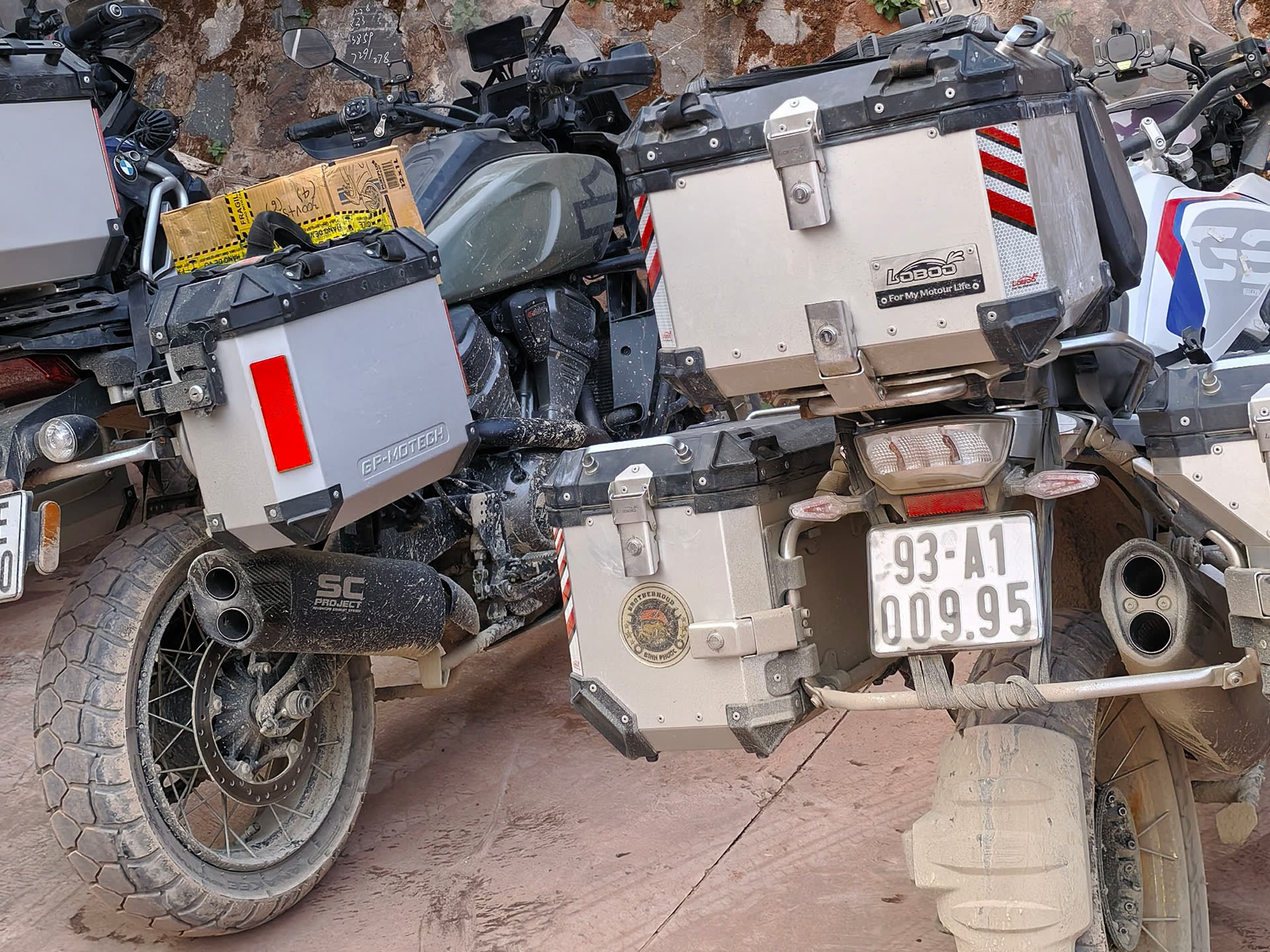
A clean motorcycle in a showroom tells you nothing; a muddy one tells you everything. The bike in this photograph is a Vietnamese adventure tourer caked in the honest grime of a wet road, and the thing that catches the eye is its set of Loboo panniers. This is a working machine that has been somewhere, and the reason it is worth discussing is that the luggage and the mud together tell you the kind of riding it is built for.
Loboo cases are a popular aftermarket choice for riders who want hard, waterproof luggage that survives real conditions rather than glossy weekend rides. When a bike wearing them arrives at a Chinese border, it is usually in the hands of someone covering serious distance, and the entry formalities are the same as for any other foreign motorcycle.
1. The temporary plate for a working bike
The mud does not change the legal position. This is a foreign vehicle entering under the temporary entry scheme, and it displays a China temporary entry plate alongside the original Vietnamese registration, which stays on the bike. The temporary plate is the authority for riding on Chinese roads during the trip.
It is valid for three months, and that is the figure to plan around. A long-distance rider used to open-ended travel should time the route so the bike exits before the paperwork runs out.
2. The agency is still required
Independent riders are the group most likely to ask whether they can cross alone, and the answer is no. A foreign motorcycle has to enter through a licensed travel agency that makes the customs declaration and provides the guarantee. There is no separate channel for a solo bike, and the rider's preparation or equipment does not alter that.
The agency meets the usual qualifying bar, including a quality guarantee deposit and an operating history, and stands as the bonded, responsible party for the bike while it is in the country. That structure is what allows the temporary plate to be issued.
3. The costs for a motorcycle
The service fee bands treat motorcycles the same as cars and campervans rather than charging by size. The fee covers the customs declaration, the immigration processing, the temporary driving licence, the temporary plate, the route filing, the exit clearance and the support at the port.
The customs guarantee is separate. Under the agency's guarantee, the rider lodges a fixed 10,000 yuan into the corporate account in place of the larger value-based assessment, three days before entry, refunded in full within a few working days after the bike leaves. The compulsory insurance is arranged before the plate is issued, with the rider paying the actual premium, and the inspection fee of around 200 yuan and the translation costs apply.
4. The temporary motorcycle licence
The international driving permit is not recognised in China, so the Vietnamese licence alone is not enough even with a translation. A Chinese temporary driving licence in the correct motorcycle category is arranged through the agency. If the trip involves a second rider who might take the controls, that person needs to be named from the start.
5. Where a well-kitted adventure bike fits
A bike with hard panniers is made for the long, varied routes that Yunnan and the wider country offer, from expressways to winding mountain roads. Most of China is open in principle, with the usual defined exceptions. The capital needs its own entry permit. Tibet requires a full-time guide and a Tibet permit, with a longer lead time. Some border zones in Xinjiang and Gansu are restricted, and certain high-altitude roads, including parts of the G219 and the new unmanned-area route, are closed to foreign riders. Getting from Xinjiang towards Tibet means looping back to Golmud and the Qinghai-Tibet road.
The waterproof panniers are genuinely useful on these routes, because the documents, the temporary plate paperwork and the licence can be kept dry and within easy reach at checkpoints, even in the weather that produced the mud in the photograph.
6. Riding on the right
Vietnam keeps to the right, as does China, so the rider is already on the familiar side of the road. The main adjustments are local traffic habits and the behaviour of vehicles on the expressways rather than any change in the side of the road.
7. Documents and the condition of the bike
Allow around twenty days, longer if Tibet is involved. The agency needs the passport and Chinese visa, the motorcycle licence, a white-background ID photo, the registration and ownership papers, the frame and engine numbers, and photographs of the bike. The non-Chinese documents need translations.
The mud is not a problem, but the identifying numbers underneath it matter. Check the frame and engine numbers before travelling, because any number altered, ground or welded, or not matching the registration, is a blocker. A standard bike with aftermarket luggage and consistent paperwork is a routine case.
8. Why the honest dirt is reassuring
The photograph shows a motorcycle used for its intended purpose rather than a polished ornament, and that is the kind of entry officials see frequently and recognise. The panniers are practical touring equipment, the mud is evidence of real travel, and the paperwork is what makes it all legal.
If you ride a similar adventure bike and have wondered whether a well-used, luggage-laden machine is suitable for a China trip, the answer is yes, through the proper agency and with the temporary plate and licence arranged ahead. Get the guarantee moved in the three-day window, keep the trip within the three-month plate, and the bike will carry you through the weather and the miles just as it was built to do.
It is also worth carrying a small toolkit and a few basic spares inside the panniers, because the same remote roads that produce the mud can leave you a long way from a workshop. A puncture repair kit, a tyre-pressure gauge, a length of wire and a spare bulb take up little room and can save a long wait. Keep the agency's contact number to hand as well, so that if a roadside checkpoint raises a question about the temporary plate or the filed route, there is someone who can confirm the paperwork straight away rather than leaving you to explain it in a second language.