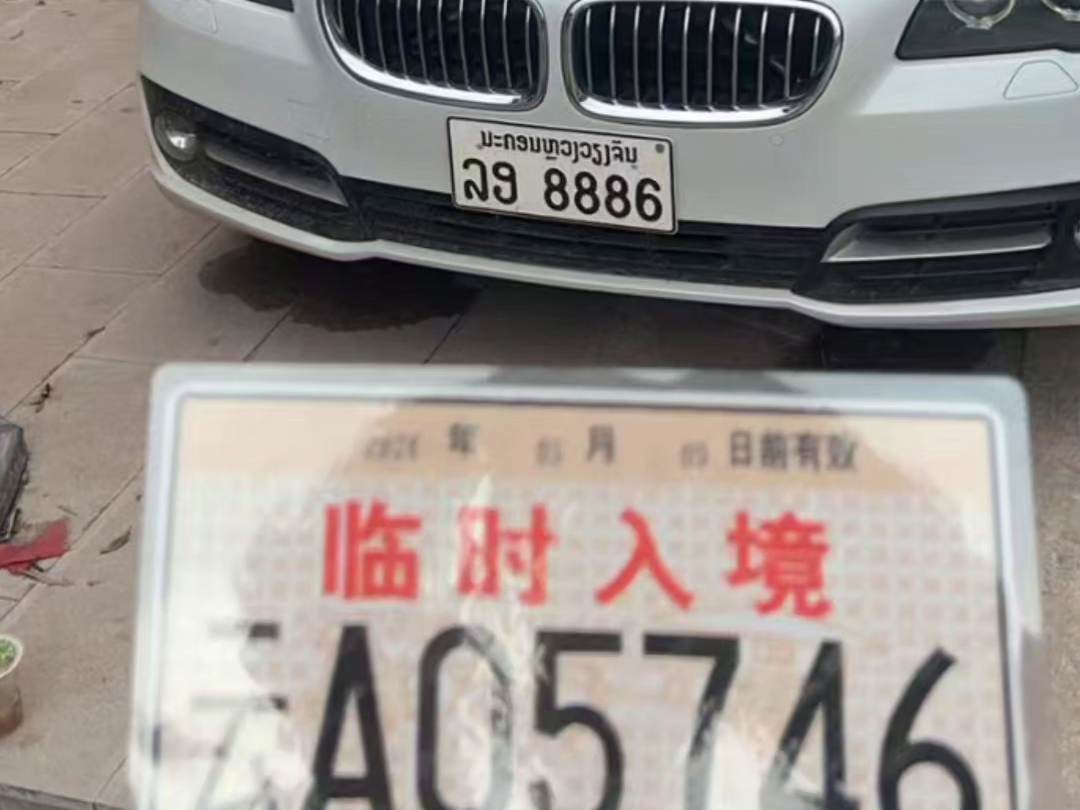
The car in this photograph is a Lao-registered BMW, now displaying a Yunnan temporary entry plate, which tells you almost the whole story at a glance. It has come across the China-Laos border at Mohan, the land port that handles the bulk of traffic moving between the two countries. Premium European cars are common enough in the region, and seeing one on Lao plates rather than Thai ones is a useful reminder that the entry process serves vehicles from every neighbouring country. This piece looks at the Mohan crossing, what the temporary plate means for a Lao-registered car, and the formalities behind it.
Mohan sits directly on the China-Laos boundary and is the natural entry point for traffic coming from the Lao side, including vehicles that may have travelled through more than one country before reaching it. The crossing is well organised and used to a steady flow of cars, motorcycles and commercial traffic, which makes it a reassuring first experience of China for many drivers. The BMW in the photo has already passed through that process and carries the plate to prove it.
1. The temporary entry plate
As with every foreign vehicle, the Lao registration alone does not permit the car to drive around inside China. Once the customs declaration is completed at Mohan, the BMW is issued a Chinese temporary entry plate, which is displayed while the vehicle is in the country. The original Lao plate remains on the car as well, so the two appear together, much as they do in the photograph.
The temporary plate is issued with a validity of three months, and the dates printed on the accompanying paperwork define how long the vehicle may remain. The route through Yunnan and beyond, together with the planned exit, needs to fit within that window. There is no separate rule for Lao-registered vehicles; the same three-month temporary plate applies to them as to cars from any other country.
2. The temporary driving licence
The driver needs a Chinese temporary driving licence for the correct vehicle class, because China does not rely on an international driving permit in the way many visitors assume. The Lao home licence is used as a supporting document, together with a Chinese translation, but the temporary licence is the actual authority to drive during the visit.
It is arranged alongside the plate through the same entry process, so the two are treated as a package rather than separate chores. Both need to be in hand before the car leaves the Mohan area, and preparing the documents and translations in advance keeps the crossing calm rather than rushed.
3. Why a licensed agency is part of the process
A foreign vehicle cannot be self-declared at the border. The entry has to run through a licensed travel agency with the proper outbound-tourism qualifications and the required quality deposit lodged with the authorities. The agency acts as the guarantor for the BMW, prepares the customs declaration and arranges the temporary plate and temporary licence.
The logic is that customs need a responsible party on the Chinese side who can account for the vehicle and confirm it leaves again on schedule. This requirement applies at Mohan just as firmly as at any other port. A competent agency knows the current document formats and can coordinate the timing so a driver arriving from Laos is not held up by an avoidable technical error.
4. The deposit, insurance and costs
The financial side follows the standard structure. The customs deposit is refundable: the owner pays a fixed 10,000 yuan into the agency's corporate account, and it must have cleared at least three days before the crossing so the declaration can proceed. Once the vehicle leaves on time and with no outstanding issues, the deposit is returned in full, usually within three to five working days.
Insurance is compulsory and has to be in place before the temporary plate is issued, with the agency arranging it ahead of entry and the owner paying the actual cost. A vehicle inspection fee of around 200 yuan applies across the board, and translation costs may add a little. The service fee itself covers the customs declaration, the immigration steps, the temporary licence and plate, the route filing and the on-the-ground handling at the port.
5. Driving on from Mohan
Once the formalities are done, the road north from Mohan leads into the hills of Yunnan, and a capable car like the BMW is well suited to the mix of highways and mountain roads. The surfaces are generally good, and the main adjustment for a driver new to China is simply staying attentive to the traffic and the long, winding climbs.
Checkpoints are a routine part of travel away from the cities, and they are nothing to worry about when the paperwork is in order. Officers check that the driver matches the temporary licence and that the car matches the plate and declaration. A calm handover of the documents is usually the whole interaction, and the agency can be contacted remotely if anything needs confirming.
For drivers planning to push further into the western regions, the usual restricted-area rules apply. Tibet requires separate permits and a guide, and some border zones are not open to foreign visitors regardless of the plate. Where there is no clear current answer, the reliable move is to check with the agency and trust what the printed permits state rather than an old online thread.
6. Why the Lao plate matters little to the process
The BMW in this photograph is a useful reminder that the entry rules are built around the vehicle being foreign and temporarily imported, not about which specific country it comes from. A Lao-registered premium car goes through the same declaration, receives the same three-month temporary plate and temporary licence, and works with the same licensed agency as a Thai or Vietnamese vehicle.
The differences are mostly practical, such as the port used and the documents that need translating. Once those are handled, the car is free to follow the filed route like any other. That consistency is helpful for drivers, because the same reliable process applies regardless of which neighbouring country the registration is from.
The Lao BMW with its Yunnan plate is really the end result of a straightforward, well-trodden path: a licensed agency preparing the declaration, a three-month temporary plate correctly displayed, and a matching temporary licence for the driver. Understand the Mohan crossing and get the documents ready before arrival, and a premium car from Laos can carry you smoothly into China and on through the journey ahead.