Not every motorcycle enters a country on its own wheels. The photograph here shows a Lao yellow-plate motorcycle carried in the bed of a pickup, which itself displays a temporary entry plate, and it raises a sensible question about how a transported bike is handled compared with one ridden across the border. The arrangement is more common than you might think, and the paperwork depends on what the motorcycle is going to do once it is inside.
A yellow plate on a Lao motorcycle indicates a particular registration category, and loading the bike onto a pickup is a practical way to move it over long distances, protect it from bad weather, or bring it to a region where the rider intends to use it locally.
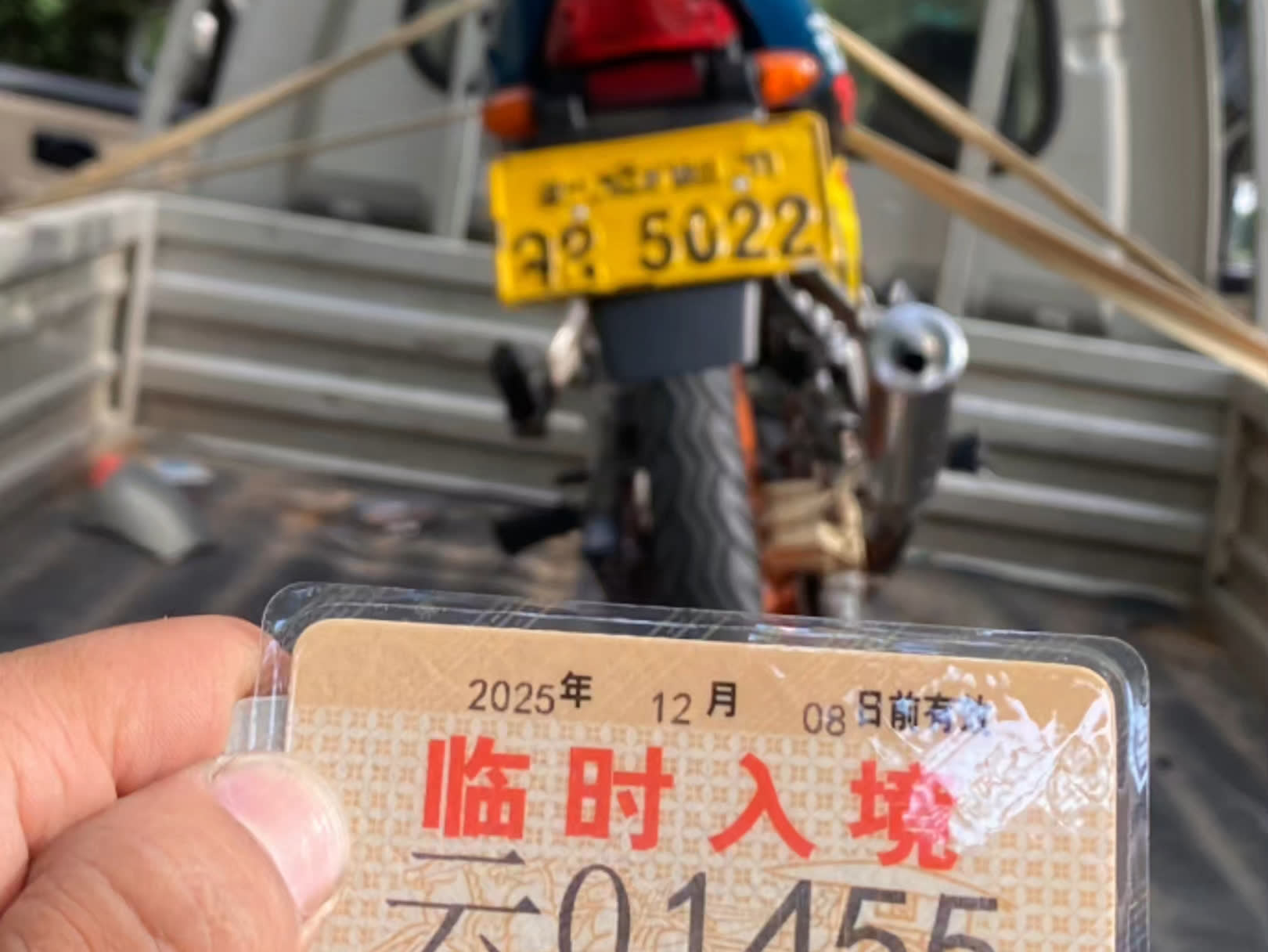
1. The pickup itself is a foreign vehicle
The first thing to get straight is that the truck carrying the bike is itself a foreign vehicle entering under the temporary entry scheme. It displays a China temporary entry plate alongside its original registration, which stays on the vehicle, and that plate is the authority for driving the truck on Chinese roads.
It is valid for three months, and that is the figure to plan around. The route, including the bike in the load, should be timed so the pickup exits before the paperwork runs out.
2. What happens to the motorcycle depends on how it is used
This is the key distinction. If the motorcycle is simply carried as cargo in the bed and never ridden on Chinese roads, it is treated as part of the load rather than as a separately driven vehicle. If the intention is to unload it and ride it on the public roads, then it becomes a foreign vehicle in its own right and needs its own temporary entry plate and the rider a provisional driving licence, arranged through the agency.
It is important to be honest about the plan at the declaration stage rather than presenting a bike as cargo and then riding it, which would create a genuine compliance problem. The agency can advise on which treatment applies and prepare the correct paperwork accordingly.
3. Why the agency is involved
The pickup cannot be brought in by its owner acting alone. A licensed travel agency makes the customs declaration and provides the guarantee, and the same agency handles the motorcycle's status depending on whether it is cargo or a ridden vehicle.
The agency meets the usual qualifying bar, including a quality guarantee deposit and an operating history, and acts as the bonded, responsible party for the vehicles while they are in the country. That structure is what allows the temporary plates to be issued.
4. The costs
The service fee for the pickup covers its customs declaration, the immigration processing, the temporary driving licence for the driver, the temporary plate, the route filing, the exit clearance and the support at the port. If the motorcycle is to be ridden and therefore needs its own entry, that is a separate vehicle with its own fee and its own fixed 10,000 yuan guarantee under the agency's arrangement, lodged three days before entry and refunded in full within a few working days after exit.
The customs guarantee for the truck is handled the same way, and the compulsory insurance is arranged before the plate is issued, with the owner paying the actual premium. The inspection fee of around 200 yuan and the translation costs apply.
5. Securing the load
A practical point worth making is that the motorcycle needs to be properly secured in the pickup bed for the journey, with straps, chocks or a dedicated mount, so it cannot shift or fall. A loose bike in the back is both a safety risk and a problem at inspection. The condition of the load, including the yellow plate and the bike's identifying numbers, should be visible and consistent with the declaration.
6. Driving and the side of the road
Laos keeps to the right, so the pickup is generally a left-hand-drive vehicle matching the Chinese norm, which keeps the transition smooth. If the motorcycle is ridden, the rider is likewise already accustomed to right-hand traffic. The main adjustments are local traffic habits and the behaviour of vehicles on the roads.
7. Documents to prepare
Allow around twenty days. The agency needs the passport and Chinese visa, the driving licence, a white-background ID photo, the pickup's registration and ownership papers, the engine number, and photographs of the vehicle and its load. If the bike is to be ridden, its own registration, ownership papers and frame and engine numbers are also needed, along with the rider's motorcycle licence. The non-Chinese documents need translations.
Check the identifying numbers on both the truck and the bike before travelling. Any number altered, ground or welded, or not matching the registration, is a blocker.
8. Why the carried bike is a sensible arrangement
The photograph shows a practical way to move a motorcycle without racking up miles on it or exposing it to a long, hard ride, and it is entirely legitimate when declared correctly. The important thing is simply to match the paperwork to the real intention: cargo stays cargo, and a bike that will be ridden gets its own proper entry.
If you are thinking of transporting a motorcycle in the back of a pickup rather than riding it to the destination, talk it through with the agency early so the correct treatment is arranged from the start. Get the guarantees in during the three-day window, keep within the three-month plate, and both the truck and the bike will be handled correctly for whatever the trip involves.
It is worth re-checking the straps and the chocks at every stop, not just at the start of the journey, because a motorcycle can work loose over the miles on uneven roads. Give the load a firm shake by hand to confirm nothing moves, and make sure the bike's weight is sitting evenly rather than pressing on one side of the pickup bed. If the journey runs through rain, check that the motorcycle's own electrics and any luggage are protected where they are exposed, even though it is not being ridden. These small checks take a minute and prevent the kind of damage that would spoil the plan before the bike is ever unloaded.