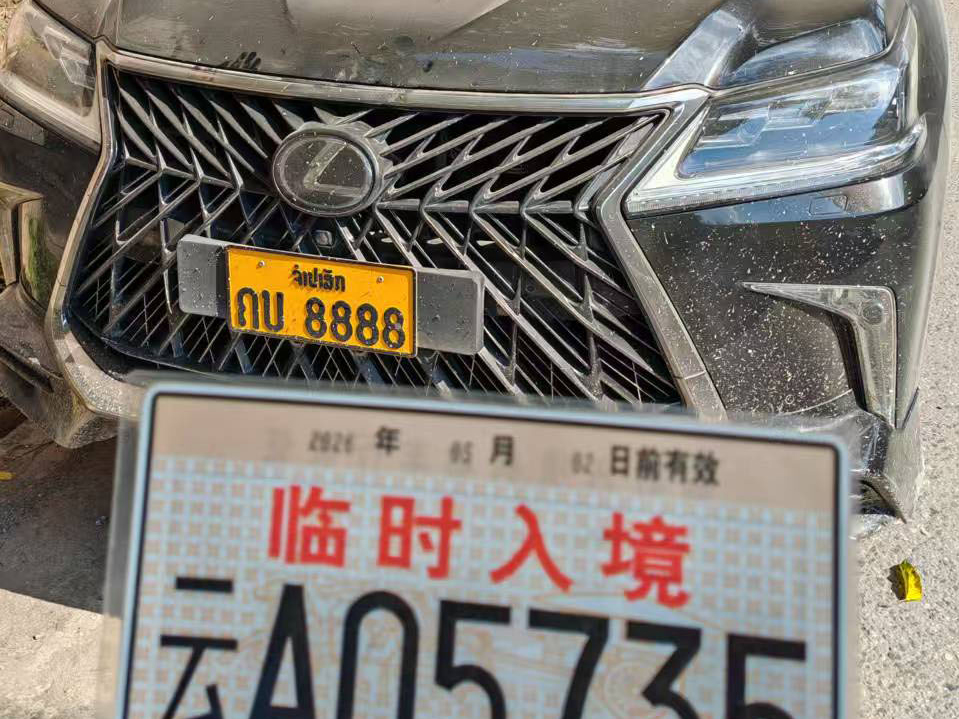
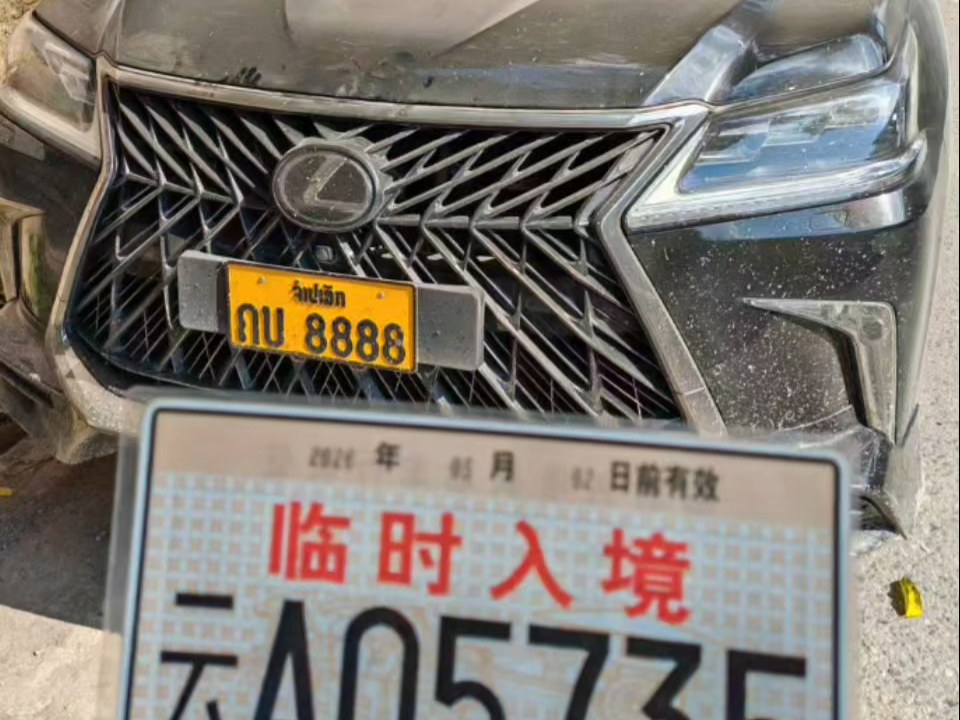
There is a particular kind of vehicle that turns up repeatedly at the southern land crossings, and it is not the rough expedition truck people imagine. It is a well-kept premium saloon or crossover from just over the border, often a Lexus, driven by an owner who values quiet and reliability over ground clearance. The two photographs here show exactly that: a Lao-registered Lexus wearing a Yunnan temporary entry plate, looking entirely at home on the Chinese side.
The route from Laos up into Yunnan is a natural one. The roads connect, the climate is familiar, and for a driver in Vientiane or the northern towns, a touring run into southern China is barely more complicated than a long domestic trip. The complication is purely administrative, and that is what this piece is really about.
1. Reading the plate correctly
The plate you can see on the front is a temporary entry plate, issued for a foreign vehicle under the customs temporary entry scheme. It does not replace the Lao registration. The original plates remain on the vehicle, and the temporary plate is the additional authority that makes it legal to drive on Chinese roads during the visit.
Its validity runs for three months. That is the figure to build a trip around, and the only one I quote. If an itinerary is properly planned so the car exits before the paperwork runs out, there is no reason ever to be worrying about the date near the end.
2. The agency is not optional
I make this point early because it is the single most common misunderstanding. A foreign car cannot be brought into China by its owner acting alone at the border. It has to enter under a licensed travel agency with the proper qualifications, which makes the customs declaration and provides the guarantee. This applies just as much to a quiet Lexus as it does to a convoy of off-roaders.
The requirements a qualifying agency has to meet, including a quality guarantee deposit and a number of years in operation, exist so that there is a bonded, responsible organisation standing behind every foreign vehicle in the country. That structure is what allows temporary plates to be issued at all. Turning up with a folder of documents and a polite manner does not get around it.
3. The two different pots of money
Owners tend to lump everything together as "the cost", but it is clearer to split it.
The agency service fee covers the actual work: customs declaration, immigration processing, the temporary driving licence, the temporary plate, route filing, exit clearance and being guided through the port. The customs guarantee is separate. Customs would otherwise assess the car at a high share of its value, but under the agency's guarantee the owner lodges a flat 10,000 yuan into the agency's corporate account. It must arrive three days before entry, and it is refunded in full within a few working days after the car leaves, provided the stay and the plate have not overrun and there are no outstanding fines or customs matters.
The compulsory insurance is arranged before entry so the temporary plate can be issued, and the client pays the real premium. A vehicle inspection fee of roughly 200 yuan applies to every car, and translation of the paperwork is charged separately. Everything else, from fuel to hotels, is the traveller's own.
4. The licence the driver actually needs
An international driving permit does not work in China, and the Lao licence on its own is not enough even with a translation. A Chinese temporary driving licence has to be arranged, and the agency does that as part of the package. Think in advance about who will drive. If a partner or a friend is going to share the hours, name them when the paperwork is prepared so both are covered rather than just the lead driver.
5. Where a road-focused Lexus fits
A car like this is built for smooth tarmac, and the good news is that China's expressways and main provincial roads are excellent. The country is open in principle, with a handful of defined exceptions. The capital needs its own entry permit. Tibet requires a full-time guide and a Tibet permit, and the lead time is longer. Certain border zones in Xinjiang and Gansu are restricted, and a few specific high-country roads, including parts of the G219 and the new unmanned-area route, are closed to foreign visitors. Travelling between Xinjiang and Tibet properly means looping back to Golmud and taking the Qinghai-Tibet road.
For the typical Lao visitor, none of that is on the schedule. Most keep to Yunnan and the neighbouring provinces, on precisely the kind of paved, well-graded roads a Lexus is built to glide over.
6. Left-hand drive keeps it simple
Laos keeps to the right, so a Lao-registered Lexus is generally a left-hand-drive car, matching the Chinese norm. That makes the transition unusually smooth, with no need to adjust to sitting on the other side. Even when a right-hand-drive vehicle does come through, it is accepted at every port with the same fees and no surcharge, but here the owner already has the more familiar layout.
7. Documents to prepare
Allow around twenty days for the paperwork, more if the route reaches Tibet. The agency will ask for passports and Chinese visas, the driving licences, white-background ID photos, the vehicle registration and ownership papers, the engine number where it is not on the registration, and front, rear and side photographs of the vehicle. The non-Chinese documents need Chinese translations.
It is worth checking the identifying numbers before you travel. Any frame number that has been ground, welded or altered, or that does not match the registration, is a real blocker. A standard, unmodified Lexus with consistent paperwork is the easiest possible case.
8. The quiet, reliable choice
Looking again at the photographs, the logic is clear. The owner has chosen a car that is comfortable, refined and famously dependable, and kept it on the roads where those qualities matter. There is no drama at the border, no special equipment to justify, and nothing for an inspector to puzzle over. The temporary plate goes on, the route is filed, and the car simply gets on with the tour.
If you are in Laos and have been weighing whether a premium road car rather than a four-wheel drive is the right thing to bring north, the evidence in these pictures is that it works well. Line the agency up early, get the guarantee transferred in the three-day window, and let the car do what it does. The border has seen this exact combination many times, and it is a routine, well-trodden path.