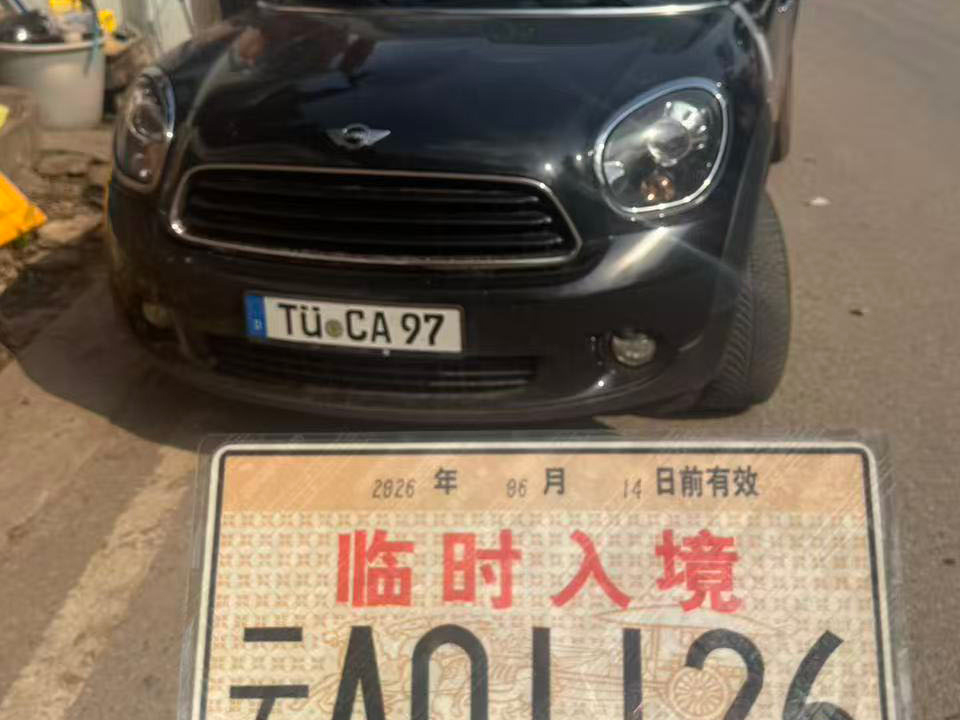
There is something quietly impressive about a small European car turning up in China. The Mini in this photograph carries German registration and a Chinese temporary entry plate, which means it has travelled a very long way to reach this point, rather than being driven over from a neighbouring country. European overland trips are a different proposition from the Southeast Asian crossings most people picture, and this neat little car is a good way to explain how they work, which port they tend to use, and what the temporary plate represents for a vehicle that has crossed a continent.
The first thing to set aside is the idea that only big four-wheel-drives can manage this. A well-prepared compact car on good roads can cover enormous distances easily, and the Mini proves the point. The challenge on a trip like this is rarely the engine size. It is the planning, the paperwork and the sequence of borders along the way. China is simply the final and most formal stage of that journey.
1. How a European car typically reaches China
A European driver heading overland generally approaches from the west, through Central Asia and into China at the Khorgos land port on the Kazakhstan border. That is the natural gateway for traffic coming from Europe, and it is the counterpart to the southern Mohan crossing used by vehicles from Laos, Thailand and Vietnam. The route passes through several countries first, so the paperwork for the whole trip is substantial long before China comes into view.
The Chinese leg still follows the same core rule as every other entry. A foreign-registered vehicle cannot simply drive in on its home plate. Once the declaration is completed, the car is issued a Chinese temporary entry plate, which is the document visible in the photo alongside the original German registration. The home plate identifies where the car comes from; the temporary plate grants it permission to be on Chinese roads.
2. The three-month window on a long journey
The temporary plate is issued with a validity of three months, and for a European traveller that window deserves careful thought. After driving for weeks to reach China, it would be easy to underestimate how much time the country itself deserves. The dates on the paperwork define how long the vehicle may remain, so the route through China and the chosen exit need to be planned to fit inside them.
Some overland drivers enter through one port and leave through another, which is a legitimate arrangement as long as it is declared and the route is filed in advance. The key is that the whole Chinese section, including the exit, sits within the validity window. Overstaying a temporary import creates real problems at checkpoints and at the border, so building in a margin is far wiser than running to the last day.
3. The temporary driving licence for a European driver
As with the plate, the driver's own licence is not the final word. China does not rely on an international driving permit in the way many European travellers assume, so a foreign driver needs a Chinese temporary driving licence matching the vehicle class. The German licence is used as a supporting document, together with a Chinese translation, but the temporary licence is the actual legal permission to drive while in the country.
It is arranged through the same entry process as the plate, so the two should be treated as a package. For a small car like the Mini, the relevant category is straightforward, but the documents still need to be correct and complete before the vehicle leaves the port area. Getting the translation and the paperwork ready in advance spares a long, tired delay at the end of an already epic drive.
4. Why a licensed Chinese agency is still essential
Even a driver who has handled half a dozen borders on the way across Asia cannot self-declare a foreign vehicle in China. The entry has to be handled by a licensed travel agency with the proper outbound-tourism qualifications and the required quality deposit in place. The agency acts as the guarantor for the vehicle, prepares the customs declaration and arranges the temporary plate and temporary licence.
The reason is consistent across every port. Customs need a responsible party on the Chinese side who can account for the vehicle and confirm it leaves again on schedule. Khorgos is a busy, well-organised crossing, but the requirement for a licensed agency remains. An experienced operator also knows the current document formats and can coordinate the timing so a traveller arriving from a long haul is not stuck sorting out avoidable errors.
5. Deposit, insurance and the costs
The money side works the same way regardless of where the vehicle began. The customs deposit is refundable: the owner pays a fixed 10,000 yuan into the agency's corporate account, and it needs to have cleared at least three days before the crossing so the declaration can proceed. After the car leaves on time and with no outstanding issues, the deposit is returned in full, usually within three to five working days.
Insurance is compulsory and has to be in place before the temporary plate is issued. The agency arranges it ahead of entry and the owner pays the actual cost, with additional third-party cover available for those who want more protection on a long trip. A vehicle inspection fee of around 200 yuan applies across the board, and translation costs may add a little. The service fee covers the declaration, immigration steps, temporary licence and plate, route filing and the handling at the port.
6. Driving a small car across China
Once the formalities are done, the Mini is quite at home on the national highway network. The roads are well surfaced and the service areas frequent, which suits a compact car and makes the long distances comfortable. The main adjustment for a European driver is the scale of the country and the discipline of planning fuel and rest stops around longer stretches than those at home.
Checkpoints are routine, especially in the western regions, and they are nothing to worry about when the paperwork is in order. Officers check that the driver matches the temporary licence and that the car matches the plate and declaration. A calm handover of the folder is usually the whole interaction, and the agency can be reached remotely if anything needs confirming.
Restricted areas remain a separate consideration. Some border zones are not open to foreign visitors, and Tibet requires separate permits and a guide. For a driver already on a long overland route, checking these requirements early avoids a late detour. Where there is no clear current answer, the reliable move is to rely on the agency and the printed permits rather than an old online thread.
The Mini in this photograph is a reminder that overland travel into China is not reserved for large expedition trucks. A small, well-prepared car, a correctly issued temporary plate and licence, and a properly arranged declaration through a licensed agency are all it takes. Treat the Chinese leg as a planned part of the journey rather than an afterthought, and even a compact European car can cross the country with confidence.