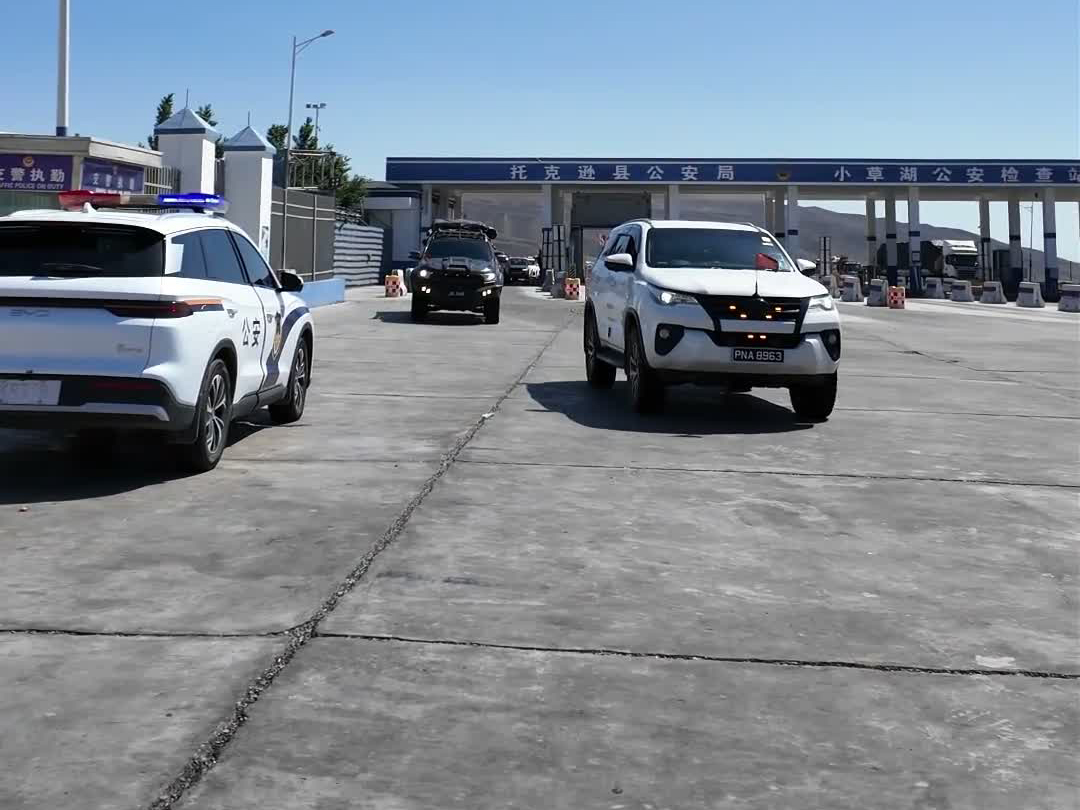
This photo shows a white Toyota Fortuner, plate PNA 8963, moving through a wide checkpoint lane, auxiliary lights added, a white police car on the left with blue and red lights and Public Security on it, and a large blue sign above reading Tuokexun County Public Security Bureau, Xiaocaohu Public Security Checkpoint, blue sky, concrete ground, distant hills. It's a typical Xinjiang checkpoint.
On a self-drive trip in Xinjiang, the checkpoints are the places you'll pass again and again, and the visitors from elsewhere are often unused to it at first, wondering why they have to stop and be checked yet again. I've been through many times and I want to tell you the way of it, and why you should cooperate calmly.
Roughly, the checkpoints do this. They check the identity of the people, the passports and visas shown and sometimes registered, and the vehicle papers, the temporary plate and the temporary licence, confirming that you and the vehicle are legal. Some places ask where you've come from and where you're going and take a simple note of the route. The process isn't complicated; it just needs you to stop and cooperate.
I should be clear about the change in my own attitude. The first time I was checked often in Xinjiang, I was a touch impatient, thinking it delayed the riding and quietly grumbling. Later I understood the checkpoints aren't aimed at the tourists; they're part of keeping the safety and order across this wide region, and it's because of that management that the local security and road order are secure. Once I'd worked that out, I passed through with no resistance at all, and the order of it felt reassuring.
I'd also say how to cooperate most smoothly. Have the papers ready to hand rather than searching the bag when the officer reaches you. Answer what's asked, briefly and truthfully, where from and where to, said openly without nervousness or evasion. Keep the manner calm and follow the guidance, stopping, opening the window and showing the papers as asked. If the language fails, don't panic; the travel agency can prepare the communication beforehand and issue a letter where needed, and I always have that arrangement, so I'm on solid ground.
I've seen a rather comical case. A rider on his first trip saw the checkpoint and the police car and grew nervous himself, looking flustered and answering haltingly. The officers were doing a routine check, but seeing him like that they asked a few more questions and looked a little longer, and it took more time. In fact there was nothing wrong with him at all; his own nerves did it. I told him later that the calmer and more open you are, the smoother it goes; with nothing to hide, why panic?
The white Fortuner in the photo is driven steadily along the lane in a relaxed posture, which is the right state. The police car is on duty and the staff are each at their work, and the whole scene is orderly, with no tension or opposition, just an ordinary daily check.
I'd also remind you of a practical point. Xinjiang is wide, and the checkpoints can be a fair distance apart, with the checks taking time, so when you plan the route, build the stops in and don't fill the daily mileage too full, lest a queue at a checkpoint leave you reaching the lodging after dark. I've spoken of the lesson of riding on in the dark, and leaving a margin matters particularly here.
My English friend, more given to complaining than I am, had his complaints about the checkpoints at first. After the whole trip he told me instead that the checks made him feel safe, even on the remote stretches, and he was settled. Two old men discussing it on the road ended in the same view: a sense of safety doesn't come from nowhere; it rests on a whole set of management, seen and unseen.
When I was young I set freedom and rules against each other and thought more checks meant constraint. I don't see it that way now. The freedom that lets you travel far at ease is built precisely on good order, and a freedom without order often means chaos and risk. That's something I've slowly understood across the years and the miles.
The Xiaocaohu checkpoint in the photo stands under the blue sky, ordinary and quiet. A vehicle from far away is passing through it steadily and going on toward the wider views of Xinjiang. Cooperate, understand, stay composed, and you'll run this magnificent country at ease and enjoy it fully.