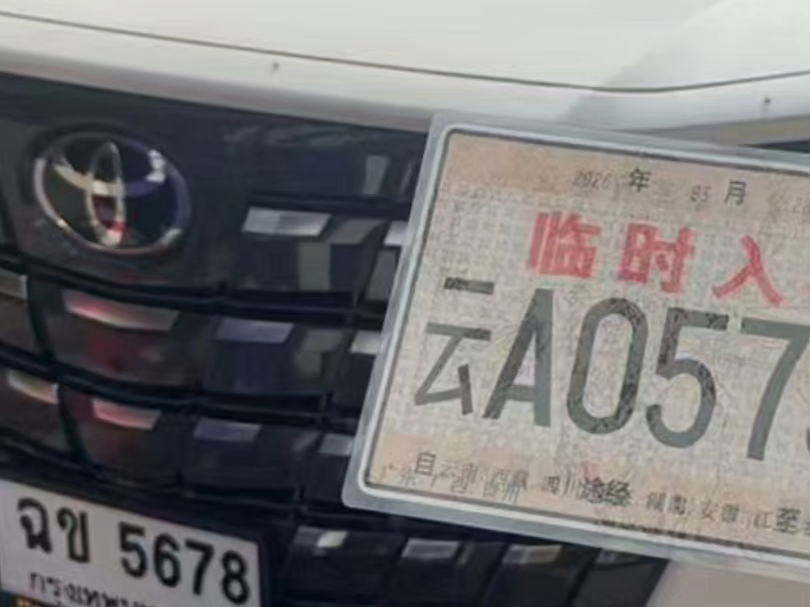
This photograph shows a Thai-registered Toyota with a Yunnan temporary entry plate, and the detail worth focusing on is one that worries a lot of Southeast Asian drivers: the steering wheel is on the right. Thailand drives on the left, so its cars are right-hand drive, while China keeps to the right and its traffic is built around left-hand-drive vehicles. A fair number of owners wonder whether that difference even allows their car into the country. The short answer is yes, and this Toyota is a practical example. Here is how right-hand-drive entry actually works.
It is easy to assume a vehicle built for the opposite side of the road would be turned away, but the rules are more straightforward than people fear. Right-hand-drive cars are permitted for temporary entry, the same ports accept them, and the costs are the same as for a left-hand-drive vehicle. What changes is not the paperwork but the way the driver needs to think once on the road. So let us cover the formalities first and the driving after.
1. The temporary plate applies to right-hand-drive cars too
The Toyota in the photo has been issued a Chinese temporary entry plate in exactly the way a left-hand-drive car would be. A foreign registration alone is not enough to drive inside China, so once the declaration is completed the vehicle receives its temporary plate, which is displayed while the car is in the country. The original Thai plate remains on the vehicle as well, and the two sit together as they do in the picture.
The plate is issued with a validity of three months, and the dates on the accompanying paperwork govern how long the car may remain. The route and the exit crossing need to fit inside that window, regardless of which side the steering wheel is on. There is no separate, shorter period for right-hand-drive vehicles; the same three-month rule applies.
2. The temporary driving licence
The driver still needs a Chinese temporary driving licence for the correct vehicle class, because China does not rely on an international driving permit in the way many visitors expect. The Thai home licence is a supporting document and needs a Chinese translation, but the temporary licence is the actual authority to drive during the visit. It is arranged alongside the plate through the same entry process.
There is no special restriction attached to the licence simply because the car is right-hand drive. The same qualification covers it, and the driver needs both the plate and the temporary licence in hand before leaving the port area. Getting the documents prepared in advance is just as important here as for any other vehicle.
3. Why a licensed agency is required
A foreign vehicle cannot be self-declared at the border, whether it is right or left hand drive. The entry has to run through a licensed travel agency with the proper outbound-tourism qualifications and the required quality deposit lodged with the authorities. The agency acts as the guarantor for the vehicle, prepares the customs declaration and arranges the temporary plate and temporary licence.
This is a requirement rather than an optional extra, because customs need a responsible party on the Chinese side who can account for the car and confirm it leaves again on schedule. A good agency will also reassure right-hand-drive owners and walk them through the practical adjustments, since the driving side is the part that genuinely needs attention.
4. The real adjustment: driving on the right
This is where the owner of a right-hand-drive car needs to focus. The formalities are unchanged, but the driving itself feels different. In China, traffic keeps to the right, and the driver is sitting on the side of the car closer to the centre line rather than the verge. The instinct built over years of left-hand traffic does not simply switch off, so a deliberate, calm approach is needed, especially in the first few days.
Overtaking is the manoeuvre that needs the most care, because the driver's view of the road ahead is from the opposite side. On a two-lane road, hanging back, making sure the view ahead is genuinely clear, and avoiding rushed passes is far safer than relying on reflex. Many drivers find it helpful to have a passenger watching the road ahead and calling out when the way is clear. Junctions, roundabouts and the habit of which way to look before pulling out also take a little conscious thought.
Wipers and indicator stalks are often swapped between the two layouts too, which is a minor but common source of confusion. None of this is a reason not to bring the car; it is simply a reason to take the first few hundred kilometres gently until the new rhythm feels normal.
5. Deposit, insurance and the costs
The financial side is identical to any other temporary entry. The customs deposit is refundable: the owner pays a fixed 10,000 yuan into the agency's corporate account, and it must have cleared at least three days before the crossing. Once the car leaves on time and with no outstanding issues, the deposit is returned in full, usually within three to five working days.
Insurance is compulsory and has to be in place before the temporary plate is issued, with the agency arranging it ahead of entry and the owner paying the actual cost. A vehicle inspection fee of around 200 yuan applies across the board, and translation costs may add a little. Crucially, there is no extra charge for bringing a right-hand-drive vehicle; the fees are the same as for a left-hand-drive car.
6. Checkpoints and longer routes
At checkpoints, officers are checking that the driver matches the temporary licence and that the car matches the plate and declaration, not which side the steering wheel is on. It is a routine process, and staying calm and handing over the documents is usually the whole interaction. The agency can be contacted remotely if anything needs confirming.
For drivers heading into the western plateau, the usual restricted-area rules still apply. Tibet needs separate permits and a guide, and some border zones are not open to foreign visitors regardless of the vehicle. Where there is no clear current answer, the reliable move is to check with the agency and trust what the printed permits state.
The Toyota in this photograph is a useful reminder that a right-hand-drive car is not a barrier to entry. It is accepted at the same ports, at the same cost, with the same three-month plate and temporary licence. The genuine work is on the driving side, in taking the switch to right-hand traffic seriously and easing into it rather than trusting old reflexes. Get that adjustment right, and a familiar Thai car can carry you comfortably across China.