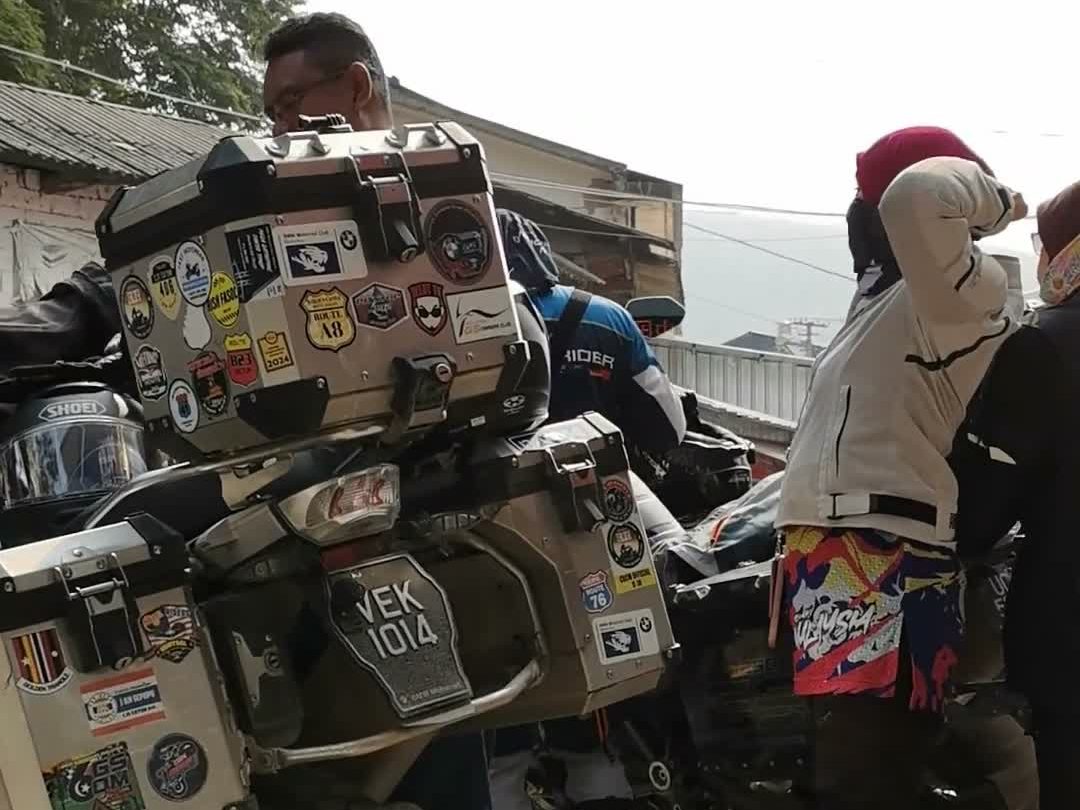
This photo has an aluminium pannier almost at the centre, covered thickly with stickers of every shape, colour and pattern, round marks, one with the year 2024, route maps, and brand and rally badges. The plate VEK 1014 hangs below, and a rider in a bright jacket with MALAYSIA on the back stands nearby, simple houses and distant hills behind.
I've mentioned stickers here and there in the earlier pieces, and I want to give this one a proper telling, because in my view a pannier covered in stickers isn't decoration at all. It's a travel log laid open, and the kind that can't be faked.
Look closely and the stickers weren't put on at one time or in one place. The wear differs, some edges curled and some still bright, which means they were gathered one by one across different journeys and places. Each often ties to a specific moment: the formalities done at a border, a rally at a camp, a souvenir from a small shop, or a swap with a friend met on the road.
I have an old pannier myself, with me over ten years, the stickers layered, some half-covered by later ones and some worn past reading. I can point to them one by one and say where and in which year, what the weather was and who I met; the one I swapped with a Japanese rider, with no shared language, saying goodbye through the exchange; the one I bought bored in a small town while waiting for a part when the bike had failed. To anyone else it's a pile of bright paper; to me it's most of my life.
I should tell a true little episode. Once at a rest stop a young rider looked at my pannier for a long time and asked which sticker mattered most. I thought and pointed to a small worn, unremarkable mark. It was from my first long ride, when I was young and first took the bike abroad, nervous and excited. I said it wasn't because it looked good; it was because it reminded me that all these roads began with that one gathering of courage.
I didn't put these on when I was young, and I thought them showy, as I've said. What changed me was an older rider. His pannier was full, and in my young pride I was a touch scornful and asked what use the things were. He didn't mind and simply pointed and told me the stories behind a few, and then he said when you reach my age you'll understand; the memory fades, but these small things help you keep the days. I didn't much attend to it then, and years later, when my own pannier was full, I understood.
The Malaysian rider in the photo, with a pannier like this, has plainly covered a good many roads and seen a good deal. I notice the arrangement, dense but with a natural order built up over a long time, not a posed display. You can't fake that by buying a pile and sticking them on; anyone with an eye knows the true experience from the false decoration.
I'd also say the stickers are a language and a friendship among riders. On the road, swapping them is like exchanging cards and stories, and a small mark from another's country carries the memory of the place. I've several in my pannier given by friends of different countries, and each time I see them I recall their faces and the days we rode together. A light bit of paper, and a heavy weight in it.
The old rule bears repeating, of course. However fond you are of stickers, nothing that touches on China's sovereignty or territory, because that's the red line, and I check the whole bike before every entry. The ordinary souvenir and rally marks and route maps are fine, kept for the memory.
The pannier in the photo hangs quiet on the bike in the sun, like a silent storyteller. Its owner may not say much, but if you know how to look, the pannier has already told all the stories. The roads age and the people grow old, and these small warm bits of paper keep the shining days for you.