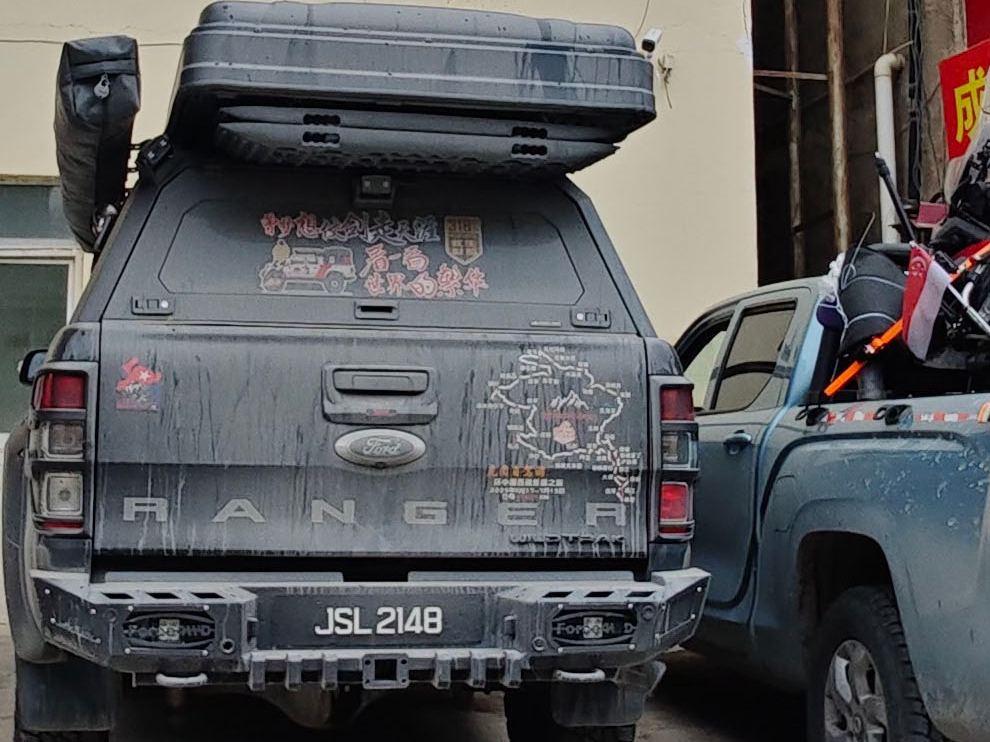
Some vehicles tell you their whole story at a glance, and this overland Ford Ranger is one of them. It is Singapore-registered, fitted with a roof tent and a collection of route stickers, and it has plainly come a very long way to reach the roads of China. This is the genuine overland traveller's build, and the formalities for bringing such a vehicle through are worth walking through, because the journey behind it is usually substantial.
A Ranger like this is a practical overland platform: a tough ladder frame, a load bed carrying gear and fuel, and a roof tent that turns any safe pull-off into a campsite. The route stickers are the traveller's habit, marking borders crossed and trips completed. A Singaporean owner who has driven this far is a serious overlander, but the entry rules still apply in full.
1. What the temporary entry plate is for
However far the vehicle has travelled, once it reaches China it is a foreign vehicle entering under the temporary entry scheme. It displays a China temporary entry plate alongside the original Singapore registration, which stays on the truck. The temporary plate is the authority for driving on Chinese roads during the visit.
It carries a three-month validity, and that is the figure to plan around. For an overlander used to open-ended travel, this is an important discipline: the route in and the route out need to be timed so the truck exits before the plate runs out.
2. Even a seasoned overlander uses an agency
People who have crossed many borders independently often assume China is another self-service crossing, and it is not. A foreign vehicle has to enter through a licensed travel agency that makes the customs declaration and provides the guarantee. There is no exemption for a well-travelled vehicle or an experienced driver, and the sophistication of the build does not change the requirement.
The agency meets the usual qualifying bar, including a quality guarantee deposit and an operating history, and stands as the bonded, responsible party for the truck while it is in the country. That structure is what allows the temporary plate to be issued.
3. The costs for a vehicle like this
The service fee covers the customs declaration, the immigration processing, the temporary driving licence, the temporary plate, the route filing, the exit clearance and the support at the port. The customs guarantee is separate: instead of the large share of the vehicle's value that customs would otherwise assess, the agency's guarantee means the owner lodges a fixed 10,000 yuan into the corporate account, three days before entry, refunded in full within a few working days after the truck leaves.
The compulsory insurance is arranged before the plate is issued, with the owner paying the actual premium, and there is an inspection fee of around 200 yuan and separate translation costs. For an overlander carrying extra fuel and equipment, it is worth being clear about what is on board during the declaration.
4. The driving licence
The international driving permit is not recognised in China, so the Singapore licence alone is not enough even with a translation. A Chinese temporary driving licence is arranged through the agency. If the overland trip involves more than one named driver sharing the long haul, both should be listed when the paperwork is prepared.
5. Where an overland truck can go
A Ranger with a roof tent is built for exactly the kind of wide-ranging route China offers, but the defined exceptions still apply. The capital needs its own entry permit. Tibet requires a full-time guide and a Tibet permit, with a longer lead time. Certain border zones in Xinjiang and Gansu are restricted, and a few high-altitude roads, including parts of the G219 and the new unmanned-area route, are closed to foreign visitors. Travelling between Xinjiang and Tibet means looping back to Golmud and the Qinghai-Tibet road.
The filed route matters for a vehicle like this, because the temptation is to wander. The agency files the plan, and the trip should keep to it.
6. Right-hand drive and the switch
Singapore drives on the left, so this is a right-hand-drive truck. Right-hand-drive vehicles are accepted at every port, with the same fees and no surcharge, but the driver has to adjust to right-hand traffic across a large vehicle. Given the owner's experience, that is usually a minor point, but it deserves conscious attention on the first few days and at junctions.
7. Documents and the vehicle's gear
Allow around twenty days, longer if Tibet is involved. The agency needs the passport and Chinese visa, the driving licence, a white-background ID photo, the vehicle registration and ownership papers, the engine number, and photographs of the truck. The non-Chinese documents need translations.
Check the identifying numbers before the long approach. Any frame number altered, ground or welded, or not matching the registration, is a blocker. It is also worth making sure the modifications, roof rack and tent are standard touring equipment rather than anything that raises a compliance question.
8. Why the stickers say something useful
The route stickers on the door are a reminder that this is a vehicle genuinely used for travel rather than a show build, and border officials tend to recognise the difference. A well-organised overland truck with consistent paperwork and a clear declaration is a respectable, routine case even though it has come far.
If you are planning a long overland approach and wondering whether a self-built truck with a roof tent can enter China, the answer is yes, through the proper agency and with the temporary plate and licence arranged ahead. Get the guarantee transferred in the three-day window, respect the three-month plate and the filed route, and the country opens up as another leg of the journey rather than a barrier.