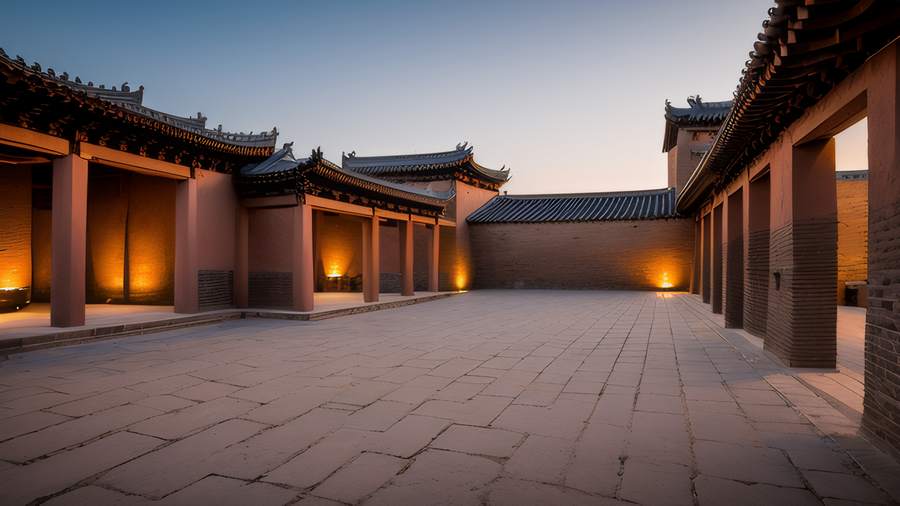
This route is written for a foreign-registered car driven by its owner, and it works just as well for Renting a Car in China as a Foreigner: nine days, 840 km, an average of 93 km per calendar day and about 140 km on moving days. It is a Foreign Car Entry Self-Drive built around buildings — a walled bank town, a tenth-century hall, a glazed tower, a cliff monastery and a river port that the road left behind. Fuel, parking and road quality are easy throughout; the two mountain approaches to Hukou and Qikou are the only sections that ask for attention.
Trip overview
- Pingyao walled city, Rishengchang bank, county yamen and city wall — two nights
- Shuanglin Temple's painted clay halls, two kilometres outside the wall
- Hongdong: the Migratory Ancestor tree and Guangsheng Temple's glazed pagoda
- Hukou: the whole Yellow River squeezed into a gorge and dropped
- Mount Mian's cliff terraces and the double-storey tunnels of Zhangbi fort
- Qikou dry-and-wet port, Liijiashan's stacked stone houses, loess gullies
Nine days, three of them without a key, and the longest drive is 200 km.
Day 1 · Taiyuan — Pingyao, 100 km
Road
South on the Jingkun expressway, exit at the Pingyao sign, then a wide avenue to the car parks outside the wall. One hour, flat and obvious.
Sights
Park the car and spend the first afternoon inside the wall on foot. Pingyao's street grid has not moved: the main axis runs east to west, market lanes branch off it, and the whole city is small enough to cross in forty minutes. It is a working street rather than a film set — courtyard doors open onto shops selling cold beef, lacquerware and shoes, and residents carry coal past the ticket offices before eight. Climb the city wall at the south gate and walk a length before you begin the indoor sites, so the scale settles: a rammed-earth core faced with brick, worn parapet steps, watch towers at the corners recorded in the Ming registers. Buy the combined ticket rather than single entries; it covers eleven sites and you will use most of them, and the queue at each gate is faster with one scan.
Food
Cold sliced Pingyao beef, a bowl of oat noodles with tomato and egg, pickled cucumber.
Where to stay
Inside the wall, in a converted courtyard house with a heated kang bed.
Day 2 · Pingyao sightseeing, 0 km
Road
No driving. Leave the car in the outer lot and walk the whole day.
Sights
Today belongs to the banking street. Rishengchang began as a dye shop and took in its first draft in the 1820s, and the floor plan explains why the idea worked: a counter room for customers at the front, a private courtyard for partners behind it, and a vault sunk under the floor with a listening post beside it. Money moved as paper on a system of ciphers, seals and staggered countersigns, so a Shanxi house could settle a debt in Sichuan without sending a single ingot. Then walk the rest of the street slowly: rival banks with narrower frontages, an escort agency that once guarded cash convoys, and the county yamen with its court yard, prison cells and the remains of a Ming-Qing legal garden. In the afternoon go two kilometres out to Shuanglin Temple. Its halls stand floor to ceiling with painted clay — guardians, donors, celestial beings, a thousand small faces — which survived because the temple sat outside the wall and was never emptied out.
Food
Noodle shop by the west gate; pounded meat in gravy, walnut cake to take back to the courtyard.
Where to stay
Same courtyard house, second night.
Day 3 · Pingyao — Hongdong, 140 km
Road
Continue south on the expressway past Linfen, take the Hongdong exit. Two hours, motorway all the way, one service area worth stopping at.
Sights
Hongdong sits on the Fen river plain, and its first claim on family memory stands beside the railway: the Pagoda Tree courtyard. Under the Ming court, between the fourteenth and fifteenth centuries, households were moved out of Shanxi in organised groups and assembled beside an old locust tree by a pagoda. The tree in the yard today is a later growth beside the site of the original; the ceremony gate, the clan halls and the walls of inscribed surnames were rebuilt around that memory. It reads like a tourist site and behaves like a shrine — people come hunting a village name, and staff will look in a register for you. Late afternoon, drive to Guangsheng Temple at the northern foot of Huashan, in upper and lower halves. The upper temple carries the Flying Rainbow pagoda: thirteen storeys of glazed tile from the sixteenth century, yellow and green still bright enough to look restored. In the lower temple's abbot hall a fourteenth-century wall painting shows a stage performance with actors, an audience and a banner naming the troupe — one of the earliest pictures of Chinese theatre.
Food
Steamed bread shapes cut for festivals, river fish, a bowl of sour cabbage soup.
Where to stay
Hongdong county town, or Linfen if you want more hotel choice.
Day 4 · Hongdong sightseeing, 0 km
Road
A walking day; optional short drive to smaller halls east of town.
Sights
Use the second morning to finish Guangsheng properly, because the pagoda is only a third of it. Go round the halls in order and the same three things keep returning: Yuan-dynasty walls whose figures stand almost free of the plaster, a twelfth-century printed canon brought here from the Jin court, and stone steloes recording who paid for which hall and when. If you have appetite left, drive out to the smaller temple halls east of the county town, where roof beams are older than most church roofs in Europe and nobody has painted over them. Return to the Pagoda Tree courtyard in the low late-afternoon light: the offering tables, the reconstructed gate and the surname wall are quietest then, and you can trace a name or two before the coaches leave.
Food
Linfen-style hand-pulled noodles, dried tofu, a plate of stewed lamb on the bone.
Where to stay
Same hotel, second night.
Day 5 · Hongdong — Hukou, 135 km
Road
South-west toward Yichuan, then a provincial road down into the gorge. Two hours, the last stretch cut into loess terraces; fill the tank in the county town.
Sights
You hear Hukou before you see it. The Yellow River, several thousand cubic metres a second in flood, narrows into a channel some tens of metres wide between canyon walls and drops. From the Shanxi viewing decks you look down into a boiling rock pot, spray rising toward the cliff top, a low roar that swallows a conversation standing three metres apart. Two seasons give two rivers: in the July flood the channel disappears under brown water, while in the dry months the flow runs between exposed ribs of rock and you can walk close to the lip. Shaanxi has its own scenic area on the far bank with separate tickets and a different angle — from there the water falls away from you rather than toward you, which is the better photograph if you have the afternoon. Barriers exist because the rock lip is undercut; do not lean past them for the spray.
Food
Ridge-side kitchens: millet porridge, lamb stew, river carp fried whole. Simple tables, quick service.
Where to stay
Inside the scenic area, or back in Yichuan county town.
Day 6 · Hukou — Jiexiu, 200 km
Road
The longest day. Back onto the expressway north-east, exit for Jiexiu. Three hours, motorway, one fuel stop.
Sights
Mount Mian rises out of the plain above Jiexiu with temple platforms bolted into the cliff face. The mountain is tied to the cold-food custom: a retainer who died in a fire here, a ruler who then had fires put out across Shanxi, and a festival that later merged into Qingming. You spend the day on the shuttle circuit that links the numbered terraces, walking up stone steps between them — halls set into shallow caves, a display of hanging coffins in one gully, a gilded complex stacked up the middle face. In the evening drive to Zhangbi, a few kilometres off the main road: a rammed-earth wall encloses a hilltop with a temple at each end, and under the lanes runs a two-storey tunnel system attributed to Sui and Tang garrisons, with trap doors, air shafts and an arrow slit that still looks down the street. You can walk part of it with a torch.
Food
Fried grain cake, oat noodles in mushroom gravy, small family restaurants at the mountain gate.
Where to stay
Zhangbi village guesthouse, or a Jiexiu hotel with parking.
Day 7 · Jiexiu — Qikou, 105 km
Road
North-east onto the expressway, then the river road to Linxian's Qikou. Two hours, the last hour along the bank with wide views and no barrier at several landings.
Sights
Qikou is the reason this loop is worth nine days rather than six. Until the early twentieth century the Yellow River carried grain and salt in flat-bottomed boats, and the first cataract above the town forced every load out of the water: goods came ashore here and went north by mule, which made Qikou a dry-and-wet port and made its merchants rich. The street still slopes up from the landing in the same shape, with boatmen's temples, guild halls and shop fronts whose door planks lift out of grooves. The stone houses are stacked up the hillside behind the street, terraced so that a rooftop is the lane above. Send a late afternoon to the village of Liijiashan a few kilometres inland, built on a loess ridge in stepped stone, and to the gully country around it — a landscape of cut earth walls, jujube trees and a river the colour of milk tea, which a generation of painters came here to draw.
Food
Linxian jujubes, wheat rolls, stewed chicken with sour cabbage; eat where the tables are full.
Where to stay
A courtyard guesthouse on Qikou's upper street.
Day 8 · Qikou sightseeing, 0 km
Road
Walk-round day; a short drive to viewpoints above the gullies if the light is good.
Sights
Give the morning to the town itself: the Heilong temple above the bend, with its stage facing the river, the guild halls behind the shop fronts, and the landing steps worn concave by two centuries of porterage. Read the plaques — merchants from Shanxi, Shaanxi and Henan traded here, and the temple repairs were paid for by subscription. Then take the side lanes upward until the roofs thin out and the loess begins, and walk the ridge path toward Liijiashan. Down in the gullies it is cool and the fields are small and green; on the ridge the wind removes everything but sound. If there is haze, stay in the lanes and photograph door frames, stone-carved lintels, and an old grain scale mounted on a wall. The river here is not a scenic attraction so much as a working edge — the water level, the exposed gravel bars, the mooring rings in stone, all legible in an afternoon.
Food
Lamb noodles, millet porridge with pickles, a pastry with jujube paste.
Where to stay
Same guesthouse, second night.
Day 9 · Qikou — Taiyuan, 160 km
Road
Back to the expressway and east to Taiyuan; two to three hours, descending from loess country onto the plain.
Sights
The last day is a return, not a sight list. From the ridge the road drops through gully country, terraces, then a long straight approach to the plain, and by late morning the river is behind you. Stop once at a service area for tea and a walk, and again if you want to buy dried jujubes and oat flour for the road. Taiyuan is the right place to finish a Shanxi loop: if you have hours left before a train or a border crossing, the provincial museum holds the state of Jin bronzes and North Dynasties tomb murals, and the Jici Temple halls south of the city carry wooden brackets from the tenth and eleventh centuries that no photograph prepares you for. Evening: eat noodles beside a hot broth, sleep, and settle the fuel receipt before you hand the car over.
Food
Taiyuan: over-oil pork, aged vinegar on everything, a last bowl of oat noodles.
Where to stay
Taiyuan, near the station or the expressway you arrived on.
Practical tips
- The combined Pingyao ticket covers eleven indoor sites over three days; keep your passport handy for the register at each gate.
- Hukou sells tickets separately on the Shanxi and Shaanxi sides. Cross at the bridge only if both scenic areas are open that day.
- Guangsheng Temple's pagoda interior may be closed to climbing; the exterior and the lower temple murals are the real reason to stop.
- Zhangbi's underground tunnels are low, dim and uneven. Take a torch and wear shoes with grip.
- Mount Mian runs shuttle buses between terraces; allow a full day, and expect stone steps rather than ramps.
- Qikou's lanes are stepped and unpaved in places; a small wheeled suitcase is a mistake. This route is made for a Foreign Car Entry Self-Drive, and Renting a Car in China as a Foreigner gives you the same freedom with no car to import.
About this route
About this route: 9 days, 840 km, starting and ending in Taiyuan. Longest drive 200 km, three days with no driving at all. Distances were logged from road signs and trip records; entrance rules and shuttle timetables change with the season.
Figures in this article are actual logged distances checked against road signs. Pingyao's combined ticket, Hukou's two-side tickets and Mount Mian's shuttle follow each scenic area's posted notice and shift with the season.
Route notes by Zara, Yunnan Province International Travel Agency (Group) Co., Ltd.