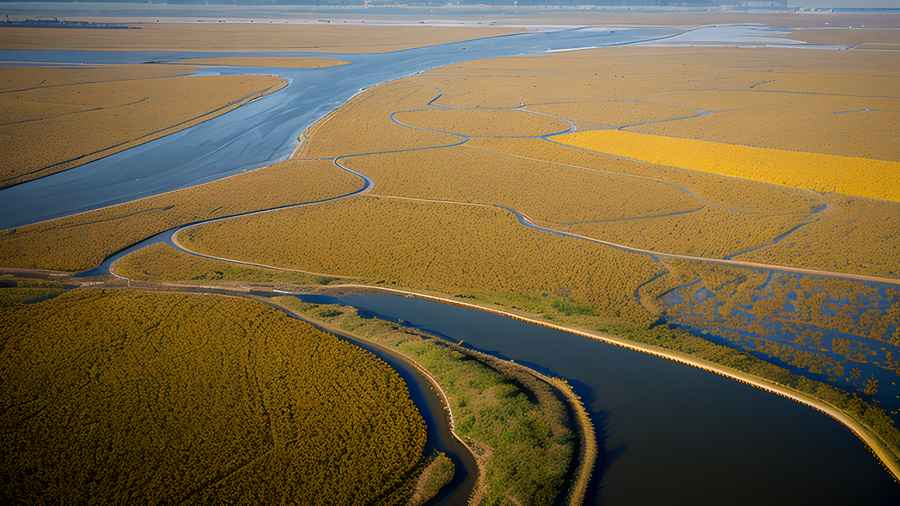
North Shandong is flat and wide, and the roads are fast because there is nothing to climb. Jinan to Binzhou is a hundred and seventy kilometres north-east; Binzhou to the river mouth a hundred and twenty, the last thirty through reed beds; the mouth to Zibo a hundred and thirty south; Zibo to Tai'an a hundred and five; and Tai'an back to Jinan ninety. Two days are zero, at the delta and at the mountain. The delta is the strange part: a road that ends at a mud flat, a visitor centre in the middle of nothing, and birds everywhere in the right season.
Trip overview
- 615 km in seven days: 170, 120, 0, 130, 105, 0, 90
- Springs, a delta of reeds and mud, a pottery town, a holy mountain
- Flat, fast roads; the delta road is narrow and ends at the water
- September to November is the season; summer is hot and the delta is mosquito-ridden
Do not rush the delta. It is not a scenic spot in the usual sense, and the point of the drive out there is the emptiness, which needs an afternoon rather than an hour.
D1、Jinan—Binzhou 170KM
Road
A hundred and seventy kilometres north-east, expressway all the way, two hours, one toll section. Traffic out of Jinan is heavy before nine.
Sights
Jinan in the morning: the springs in the old city, the pool where the water comes up in beads, and the lane of willows along the moat. Then north to Binzhou, and the town's old quarter in the afternoon, with the brick houses and the church on the corner, and the river embankment where the locals walk in the evening.
Food
Jinan for lunch: braised pork in a dark sauce, and a bowl of the local noodles. Binzhou in the evening: duck, and a plate of the town's crisp cakes.
Where to stay
Binzhou town centre, with parking; the hotels near the embankment are older but the view is better.
D2、Binzhou—Yellow River Mouth 120KM
Road
A hundred and twenty kilometres east, the last thirty on a narrow road through reed beds with no overtaking places. Two hours, and the gates close at five.
Sights
The delta visitor centre is small and mostly about birds: the migration maps, the stuffed specimens, and the count of what has been seen this year. The boardwalk out into the reeds is the thing to do, and beyond it the mud flat where the river finally reaches the sea, brown water meeting grey.
Food
Lunch at the centre: fish from the ponds, and a soup of the local greens. Dinner back in the nearest town, where the restaurants are plain and the crab is good.
Where to stay
A guesthouse near the delta entrance; there is no hotel inside the reserve.
D3、Yellow River Mouth on foot 0KM
Road
No driving; the car stays at the guesthouse and the day is boardwalk, bird hides and the sea wall.
Sights
The morning at the hides, where the telescope is fixed and the wardens keep a log of sightings. Then the sea wall on foot, with the mud flat below and the wind constant. In the afternoon the salt pans at the edge of the reserve, rectangular pools with white crusts at the rims.
Food
Lunch at the reserve canteen: rice, fish, and pickles. Dinner at the guesthouse, crabs steamed with ginger.
Where to stay
Same guesthouse, second night.
D4、Yellow River Mouth—Zibo 130KM
Road
A hundred and thirty kilometres south, half county road, half expressway, with one stretch of road works. Two and a half hours.
Sights
Zibo is a pottery town with a long history: the kiln museum has the old climbing kilns rebuilt, and the workshop next door lets you watch a bowl being thrown. The old town street is rebuilt but the scale is right, and the food stalls are real.
Food
Lunch at a county-town place on the way: noodles with braised pork. Zibo in the evening: small skewers grilled at the table, and a bowl of the local vinegar.
Where to stay
Zibo, near the kiln museum, with a garage.
D5、Zibo—Tai'an 105KM
Road
A hundred and five kilometres south-west, expressway most of the way, an hour and a half. The last ten kilometres into Tai'an climb towards the mountain.
Sights
The morning at the kiln museum and one more workshop, then the drive. Tai'an in the afternoon: the temple at the foot of the mountain, the stone gate, the courtyard with the old cypresses, and the path that starts the climb.
Food
Lunch in Zibo before leaving: a bowl of the local noodles with tofu. Tai'an in the evening: the town's own dishes, chestnuts and a clear soup.
Where to stay
Tai'an, at the foot of the mountain, with parking; the hotels on the climb have no car access.
D6、Tai'an on foot 0KM
Road
No driving. The mountain is walked, or the cable car is taken; either way the car stays.
Sights
The climb is six hours on foot and two by cable car and path. The stone steps are worn into hollows, the gates come one after another, and the inscriptions on the rock are worth stopping for. At the top, the temple and the view east over the plain, which on a clear day reaches for a hundred kilometres.
Food
On the mountain: noodles and tea at the halfway gate, prices rising with altitude. In the evening, in town, a proper meal of chestnuts and pork.
Where to stay
Same hotel, second night.
D7、Tai'an—Jinan 90KM
Road
Ninety kilometres north, expressway, an hour. One toll.
Sights
A slow morning at the temple before the coaches, then the drive. Jinan in the afternoon: the lake with its pavilions, and the spring pool where the water is clear enough to count the coins on the bottom.
Food
Breakfast in Tai'an: pancakes rolled with scallion, which is the local way. Lunch in Jinan: fish from the lake, and a bowl of the sweet rice wine.
Where to stay
No hotel needed if you leave in the evening.
Practical tips
- The delta road is narrow and has no overtaking places; the gates close at five and the last entry is at four.
- Mosquitoes at the delta in summer are serious. Long sleeves and repellent, even in September.
- The kiln museum in Zibo is closed on Mondays in most years; check before making it the day's stop.
- Tai'an's mountain path is stone and steep; the cable car queues are long after nine in the morning.
- The delta has no fuel for the last forty kilometres. Fill up before turning off the expressway.
- Keep the Foreign Car Entry Self-Drive papers and the Renting a Car in China as a Foreigner contract in the door pocket; checks on this loop are occasional and polite.
About this route
Seven days, 615 km: springs, reeds, kilns, and a mountain of stone steps. The driving is easy; the delta and the climb are where the time goes.
Distances and times are from my own log. Yunnan Province International Travel Agency (Group) Co., Ltd. answers port entry, temporary plate and route questions on weekdays; contact Zara.
Route notes by Zara, Yunnan Province International Travel Agency (Group) Co., Ltd.