Most people pass through this part of the world on their way somewhere else. The loop I drove in four days starts and ends at Xiangshawan, the dune resort a bridge-length north of the river, takes in Ordos and its emptiest, most astonishing piece of urban planning, then pushes west to Bayannur, where the desert has been turned into wheat country with canal engineering that is still running. Distances are 85, 0, 290 and 275 kilometres, so two easy days and one long one. The roads are good: four-lane provincial highways across the Hetao plain, expressway for most of the western run, and the hazard here is not potholes but wind, dust, and the fact that a fuel station may be forty minutes away. If you are weighing Foreign Car Entry Self-Drive, note that the crossings which serve this loop sit a day to the east, so most visitors end up choosing Renting a Car in China as a Foreigner at the Ordos or Hohhot airport instead, with the car picked up and returned where a licensed agency already keeps the paperwork.
Trip overview
- Day 1 – Xiangshawan to Ordos, 85 km: the dunes in the morning, the Genghis Khan Mausoleum at Id Qin at four.
- Day 2 – Ordos, 0 km on the loop: Kangbashi, the empty city that is no longer empty, and the mausoleum complex in full.
- Day 3 – Ordos to Bayannur, 290 km: the river at the head of the canals, then the park lakes of Linhe.
- Day 4 – Bayannur back to Xiangshawan, 275 km: back down the river and over the bridge to the sand.
Total 650 km in four days, an average of 160 km a day. Fill the tank whenever you see a station; on the western stage the gap between them can reach fifty kilometres in the part that is still desert.
Day 1 · Xiangshawan to Ordos, 85 km
Road
Short day. Take the county road south out of the resort, cross the Yellow River at the great bridge and join the expressway south-west toward Id Qin banner: 85 km, about ninety minutes including the crossing. The approach road to the mausoleum is a wide, new, well-signed boulevard. There is a large car park at the visitor centre and you must take the shuttle from there to the gate.
Sights
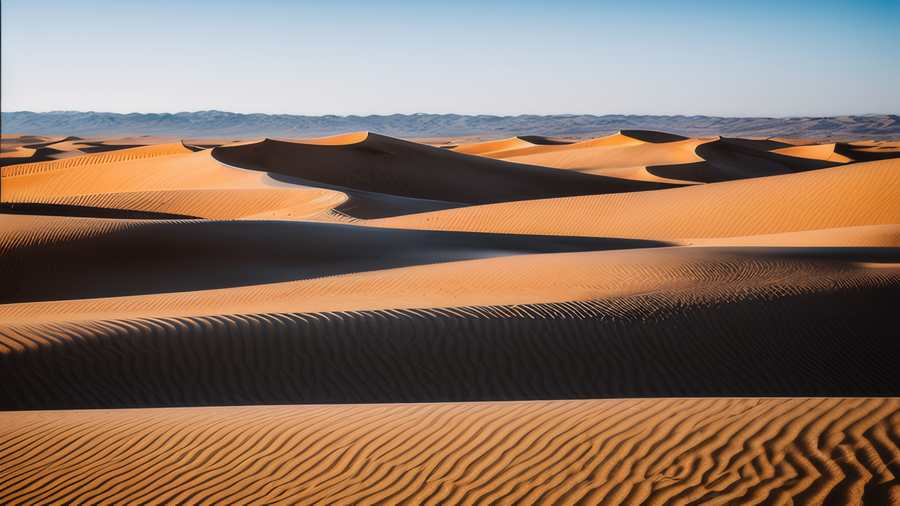
Xiangshawan is the dune field that has been made into a resort, and it earns its name: on a dry, hot day, walking down a face of loose sand produces a low hum that carries for hundreds of metres, a phenomenon recorded here for centuries and mentioned in Qing geographies. The park works on a system of islands, reached by cable car from the sand-gate town, each cluster of buildings sitting in a fold of the dunes. What is genuinely worth doing is not the ride machines but the walk: climbing the ridge behind the resort at seven in the morning, before the tour buses arrive, when the sand is still cool and the shadows show every ripple; and a swim in the water ringed by dunes at four in the afternoon. Then drive south. The Genghis Khan Mausoleum at Id Qin is a memorial, not a grave, since no one knows where he was buried, and its core is the eight white yurts, a portable shrine kept, moved and defended since the thirteenth century by one hereditary family of keepers, the Darhud, who still recite the same oath and still hold the keys. The building you see now was raised in the 1950s and rebuilt in the 1980s: three connected domes on a hill, with a long colonnaded walk in front and walls lined with glazed tiles showing the coronation, the campaigns and the laws. Inside are the shrine rooms with his belt, his bow and a copy of the scripture, and a corridor of murals that amounts to a short history of the steppe in pictures.
Food
Eat Mongolian food properly for the first time today: hand-grabbed lamb, boiled in water and nothing else, cut with a knife at the table, with salt tea and millet fried in butter. Ordos lamb is famous because the animals graze on wormwood and wild onion, which is why the meat has no gamey edge. In the banner towns ask for a bowl of milk tea, and take the small baked bread sold at the counter, which keeps for a day and is the right thing to have in the car.
Where to stay
Stay in Kangbashi, the new district of Ordos, where the hotels are large, cheap and built around a lake; every one of them has surface parking, and at night the fountains on the water run on the hour.
Day 2 · Ordos, 0 km on the loop
Road
No driving to speak of: ten kilometres between the hotel, the museum quarter and the mausoleum, all on wide new roads with enormous empty intersections at nine in the morning. Fuel is easy and the car parks are free.
Sights
Kangbashi is the district that made the phrase ghost city, and it is the most interesting thing on this loop because it is no longer a ghost. Planned in the 2000s on coal and gas money as a regional capital for a million people, it built the civic buildings first and the housing second, and for several years the result was a full-sized capital with nobody in it: avenues, an opera house, a museum shaped like two horse-hoof stools, a skyline of cranes and silence. What changed is that the government moved here, and with it a university, a hospital and the schools; the streets now have traffic lights that matter, there are people walking the lake-side promenade after dinner, and the empty blocks have quietly filled with kindergartens and offices rather than with tourists. Walking it is a real experience: a Chinese city built at capital scale with a fraction of the population, so the plaza in front of Genghis Khan Square is large enough to lose a rainstorm in, and the museum of Mongolian culture is genuinely good, with the saddlery, the silver and the liturgy of the eight white yurts explained properly. Give it the whole afternoon, and if you come in winter, note that the ice lanterns on the lake are set up by hand.
Food
Today's food is breakfast tea and a lunch of Mongolian hot pot, lamb with a bone in, cooked at the table in a copper pot with a chimney. The other Ordos dishes to ask for are thick pulled noodles and a plate of yogurt with crushed nuts, which arrives at the end of a meat meal and cuts through it. Do not eat at the mall; the good kitchens are in the blocks behind the government offices where the staff eat.
Where to stay
Second night in Kangbashi, same hotel. If you want a different view of the lake, ask for a room facing east so that the sunrise comes over the water instead of the office towers.
Day 3 · Ordos to Bayannur, 290 km
Road
The long day. Go west on the expressway toward the river, then take the plain road along the north bank into Linhe. 290 km, roughly three and a half hours of driving. The road is straight and the exits are spaced far apart; the wind comes across in gusts that will move the car if you pass a lorry at speed, so hold the wheel with both hands when you do. Dust can cut visibility on the desert edge in the afternoon; read the warning board at the toll gate before you set off.
Sights
The point of driving west is the Hetao, the bend-country of the Yellow River where the water comes out of the desert gorges and spreads over a flat plain, and where, beginning in the 1850s and then on a huge scale after 1949, canals were cut to carry that water into the sand until it grew wheat, sunflowers and melons. The head of the system is the Shengong works, a low concrete weir running the width of the river with a lock beside it and a monument on the bank; upstream of it the river is a canal and downstream it is still a river, and standing on the weir to watch the water choose which way to go explains more about northern Chinese agriculture than a week of reading. The museum nearby keeps the survey maps, the bronze water gauges cast in the Yongzheng reign and the plough shares dug out of the sand. Then the county roads north-east run past a chain of shallow lakes left by old channels, where the reeds are cut each autumn and migratory birds stop in April: heron, gull and, on the bigger sheets of water, black stork. Linhe itself is a clean small administrative town built on the canal grid, with wide tree-lined streets and a park around the mirror-like lake in its centre, and a wall of mountains to the north where herders of earlier centuries left tens of thousands of carvings on the dark desert varnish of the rock, hunters, camels, suns and stampeding horses, best seen in early light on the western side of the range.
Food
Hetao food is river food and wheat food: carp and catfish from the canals, fried then stewed with dried chilli; a stiff millet porridge with a dollop of lamb fat sunk into it; and the thick hand-pulled noodles of the district with mutton and yellow bean paste. Bayannur is also sunflower country, so the local snack is seeds, roasted and salted, sold by the bowl.
Where to stay
Sleep in Linhe on the lake side, where the hotels are mid-range and the car park sits behind a barrier you can ask the desk to open. The evening walk along the water is the whole entertainment, and it is good.
Day 4 · Bayannur back to Xiangshawan, 275 km
Road
Straight back east along the north bank, then cross to the south side and take the short run north to the sand. 275 km, about three hours and a quarter. Fill up in Linhe before you leave and again at the river toll town; the stretch between the two is long and the stations on it close early.
Sights
Break the drive once. The obvious stop is the river at the bridge town, where the water is the colour of the loess it has carried all summer and the ferry ramps still work beside the bridge. If you have the energy, the small museum in the county seat keeps the bronze rings, knives and horse fittings that nomadic herders buried with their dead along this bank three thousand years ago, which is the other half of the story of this plain: not the farmers who cut the canals but the riders who owned the sand before them. Arriving back at Xiangshawan late in the afternoon gives you the best hour of the day there: the light goes long, the temperature drops and the crowd has left the sand for dinner. If the loop ends with returning the car, book the drop-off for the following morning rather than the same evening, because the desk at the resort closes at nine and the paperwork is slower than you expect.
Food
For the last night, eat the local river fish cooked with wormwood, and the flatbread baked on a griddle and split with minced lamb. Buy a bag of the sand dates sold outside the gate; they are the fruit of this ground and they travel well.
Where to stay
The loop closes at Xiangshawan. The resort's own hotels are worth the extra money on the final night simply because you can be on the sand at six, when nobody else is there.
Practical tips
- Fill the tank on both western days; gaps between stations reach fifty kilometres.
- The shuttle to the Genghis Khan Mausoleum leaves from the visitor centre, not from the gate, so allow for it before you fix a time.
- Kangbashi is best seen at both ends of the day: empty intersections at nine, fountain crowds at eight.
- Cross-wind on the plain road is the real hazard here, not the surface; slow down when you pass lorries.
- Sunrise on the western rock-art mountains beats sunset for the carvings, because the light has to graze the varnish.
- For four days like this, Renting a Car in China as a Foreigner is the practical option; Foreign Car Entry Self-Drive means an extra day to reach a crossing and back.
About this route
Four days is the right length for this loop, and the reason it works is that the three places could hardly be more different: a dune field, a city built on money, and an irrigation plain. The driving is long only on day three, and even then it is easy driving on a good road. If you have a spare day, add the salt lake west of Linhe or stay a second night on the sand. If you have one less, cut the western stage and drive the loop in three days, accepting that the last leg becomes a five-hour run.
Kilometre figures are what this drive measured, checked against exit markers and the fuel log. Opening hours and shuttle arrangements at the mausoleum were confirmed at the desk and change with the season.
Route notes by Zara, Yunnan Province International Travel Agency (Group) Co., Ltd.