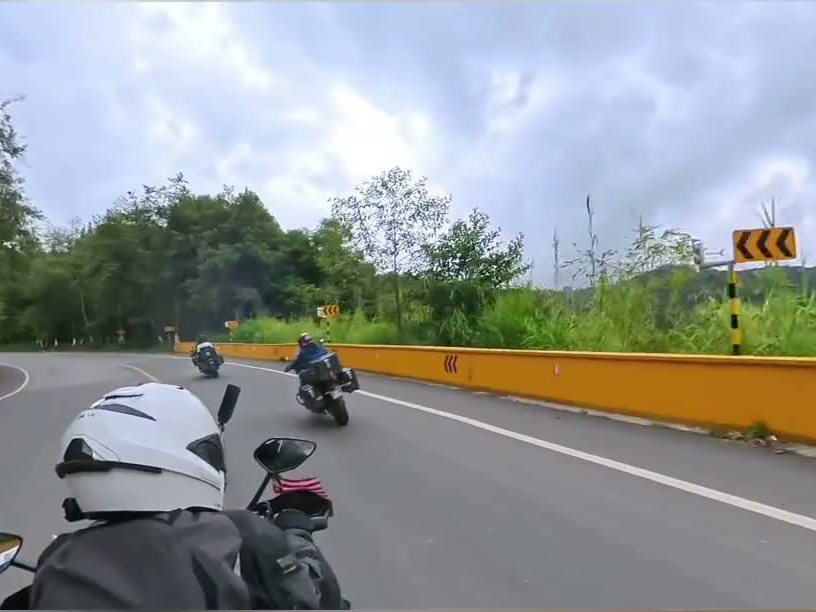
This photo shows a convoy going through a run of corners with yellow-and-black barriers and bend warnings. I've ridden roads like this many times, and I've learned the technique and, more painfully, the cost of ignoring it. There was a time I showed off on a familiar road and my hands were shaking inside my helmet by the end.
The basic technique is the one I teach and still use. Look through the corner to where you want to go, slow before you enter, and carry a smooth, steady line, accelerating gently once you can see the exit. Slow in, fast out, as the saying goes. The speed you carry in should leave you room for the unexpected, because a blind bend can hide anything. The riders who get into trouble are the ones who enter hot and find out mid-corner.
I got that wrong once on a road I knew well. Because I'd ridden it before, I carried more speed than I should, assuming it would be clear. Halfway round I saw something on the surface and had to correct, and the bike wobbled and I only just held it. By the time I'd straightened up my heart was going and my hands were shaking. I'd mistaken familiarity for safety, and the road reminded me they aren't the same.
The barriers in the photo are there for a reason. They mark the edge on the dangerous bends and the drops, and they're a warning to take the corner seriously. I've learned to read them: the tighter the barrier curves, the tighter the bend. I don't treat them as a challenge to ride close to; I treat them as information and keep a safe margin.
On a long downhill, the braking matters. Don't ride the brake all the way down, which overheats it and weakens it; use controlled, firm applications and let the engine do some of the work. In a convoy, keep the spacing through the bends so each rider has room, and don't crowd the bike ahead. I've watched a group bunch up on a descent and create the very risk the spacing is meant to avoid.
I've also learned that the discipline is the same whether the road is new or familiar. The clear, easy corners don't prove anything; the one surprise is what tests you. I no longer show off on a road I know, because I've had the fright that cures it. A calm, smooth rider is faster and safer over a run than a clever one.
The formalities don't change on a bendy road. Temporary plate for three months, temporary licence, insurance, deposit, handled by the travel agency. The bikes in the photo are taking the corners in a convoy, and the barriers are doing their job as a warning. The paperwork being in order doesn't make the bends safe; the technique does.
I've ridden a great many mountain roads, and I've kept the lesson from that one overconfident day. The yellow barriers and the continuous corners ask for respect, and I'd tell any rider to slow in, look through, and leave the showing off out of it. Do that, and the twisty road is one of the real pleasures of riding. Don't, and it'll give you the same fright it gave me.