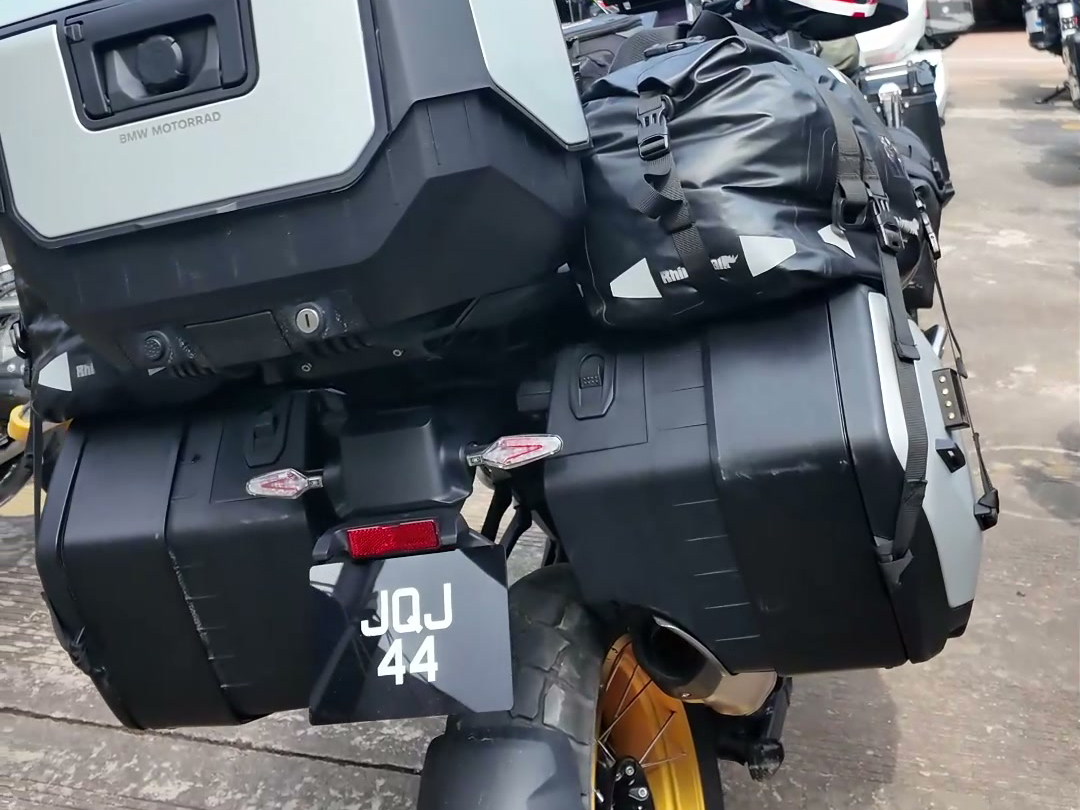
This photo shows a BMW Motorrad aluminium pannier and a waterproof roll bag, plate JQJ 44. I've used every kind of luggage over the years: hard cases, soft bags, tank bags, tail bags, and I've come to my own view. There isn't one right answer; it depends on the trip. But I'll tell you what I do now.
Hard aluminium panniers have clear strengths. They're tough, they protect the bike in a drop, they lock, and they keep the rain out. If you're carrying tools, documents, anything you don't want crushed, hard cases are the place. The downside is weight and cost. Empty, a pair of aluminium panniers already weighs a fair bit, and they're not cheap. They also change the bike's width, so you have to get used to squeezing through gaps.
Soft waterproof bags are the opposite. Light, flexible, you can stuff them full and they compress. They're cheap, and if you're not carrying anything fragile they're perfectly good. The weakness is they don't protect in a drop, and locking them is awkward. I've had a soft bag wear through on a long trip and start leaking, and I had to patch it with tape.
I use both now. Hard panniers for the heavy, valuable, lockable things, and a soft roll bag on top for the light, bulky stuff, sleeping bag, extra layers. That gives me the best of both. The key isn't which bag you use; it's how you distribute the weight. Keep the heavy things low and close to the centre, and the light things up high or further out. Put the weight too high and the bike feels top-heavy, slow to tip into a corner, unsettling.
I learned that the hard way. On one early trip I packed everything I thought I might need, just in case, and loaded the bike like a removal van. Spare parts I never used, clothes for weather that never came, books, all sorts. Going into a corner I felt the bike wallow, the weight shifting, and I got a proper fright. I slowed right down, and at the next stop I spread everything out and got rid of half of it. Lighter, the bike came alive again. Since then I lay out what I plan to take, then remove a third. That's roughly the right amount.
I also pack the bike the night before, not in a rush in the morning, and I check the straps and the mounting points. A loose bag on a motorway is dangerous. I've seen one come off and bounce across the road, and the rider had to pull over in a panic. Take five minutes to secure everything, and re-check after a fuel stop.
The formalities are the same whatever luggage you use. Temporary plate for three months, temporary licence, insurance, deposit, all handled by the travel agency. The bike in the photo is set up sensibly, hard cases low, soft bag on top, nothing hanging loose. That's the look of a rider who's done this before.
I'm older now and I travel lighter. When you're young you want to be ready for everything, and you carry the weight to prove it. Later you understand that the road lets you buy most things as you go, and the skill is in knowing what to leave behind. A well-packed bike is a calm bike, and a calm bike is a safe one.