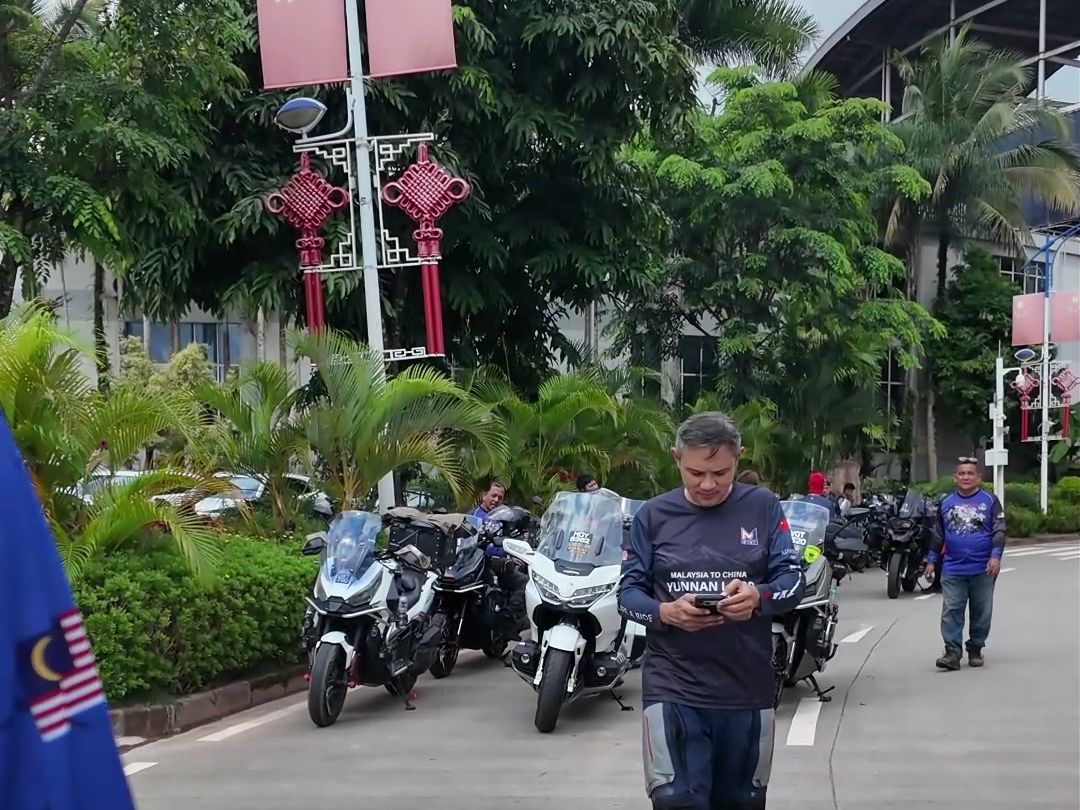
I was leaning against my own car in Jinghong, waiting for the travel agency to bring my papers, when I looked up and saw this lot. A whole crew of Malaysian riders, the backs of their T-shirts printed with MALAYSIA TO CHINA YUNNAN in enormous letters, as if worried anyone might miss the point. I'll admit I was fond of that sort of thing when I was young. Not now. Older now, I prefer to keep it quiet, black and grey, hides the dirt.
Chinese knots hung from the lamp posts, red ones, strings of them, alongside palm trees. That's the temperament of this place: tropical trees next to Chinese red, looks a bit of a jumble, but give it two days and you stop noticing. The lead rider kept staring at his phone, brow furrowed. I guessed he was checking the route, or answering messages in the group chat. Quite a crowd they were, bikes parked in a long line, the engines occasionally giving a little click, that metallic sound of hot metal just after you switch off. I know it well.
I didn't rush over to introduce myself. After twenty-odd years I've learned one thing: don't disturb a convoy the moment it's gathering. That's their most chaotic half hour. Headcounts to sort, passports to collect, someone's tyre pressure is off, someone's intercom isn't fully charged, all petty little things, but let any one of them slip and it becomes a problem on the road. I learned that the first time I led a group. Late nineties, in Europe, at the foot of the Alps, I declared with great confidence that everyone was accounted for. Sixty kilometres down the road, a Belgian had vanished. He'd nipped into a petrol station for a sandwich and none of us had noticed. Going back for him wasted a morning, and the team teased me about it for years. After that I never counted heads by eye. I used the list, reading names one by one, each man answering when called. Clumsy method. It works.
I had a word later with the Malaysian leader. Chinese chap, spoke Mandarin and English, with the odd Malay word thrown in. He told me they'd come north from Kuala Lumpur, through Thailand, across Laos, and finally into China at Mohan. I nodded. I've done that route, in and out of Mohan more than ten times. He asked whether the formalities on the Chinese side were troublesome. I said they aren't if your papers are complete. The trouble is most people's papers aren't.
That wasn't said to frighten him. I've seen too many people whose passports and visas are fine, only to come unstuck on the translation of their vehicle registration, or because they photographed the engine number blurred. China doesn't recognise international driving permits; you need to know that in advance. Once you're in, you have to get a Chinese temporary licence, and the travel agency sorts it for you. Running around doing it yourself just takes the long way round. The temporary plate is valid for three months, that's the line everyone uses, so plan your trip around it and don't cut it to the last day.
Just then the rider who'd been on his phone came over, a touch nervous, and asked whether right-hand-drive vehicles were allowed into China. He was on a motorcycle, so there isn't really a hand of drive to speak of, but I understood he was worried about being used to keeping left. I said on a bike it matters little; just take an extra look at junctions, don't try to be clever the first few days, and stay with the group. The ones who really need to worry about right-hand drive are the car drivers. I have an English friend who brought his right-hand-drive Land Rover in, and on the first day he nearly went the wrong way round a roundabout, broke into a cold sweat. After that he stuck a note on the steering wheel saying keep right, and left it there a full week before peeling it off.
There you are. Old hands don't avoid mistakes, they just know how to recover once made. When I made a fool of myself in the Alps I picked up the habit of the list, and that habit has stayed with me nearly thirty years. I watched the nervousness of these Malaysian lads without calling them out on it. Nervousness is a good sign; it means you care. Once they've actually ridden in through Mohan and spent a few days on Chinese roads, that nervousness turns into something else, something hard to put into words, the kind of thing you'll go home and tell your friends about again and again.
The papers I'd been waiting for arrived. I waved at the leader and wished them a smooth trip. He said thank you. I thought to myself, no need for thanks. Once you've done the journey, you'll understand. The person you ought to thank is yourself, for making the decision.