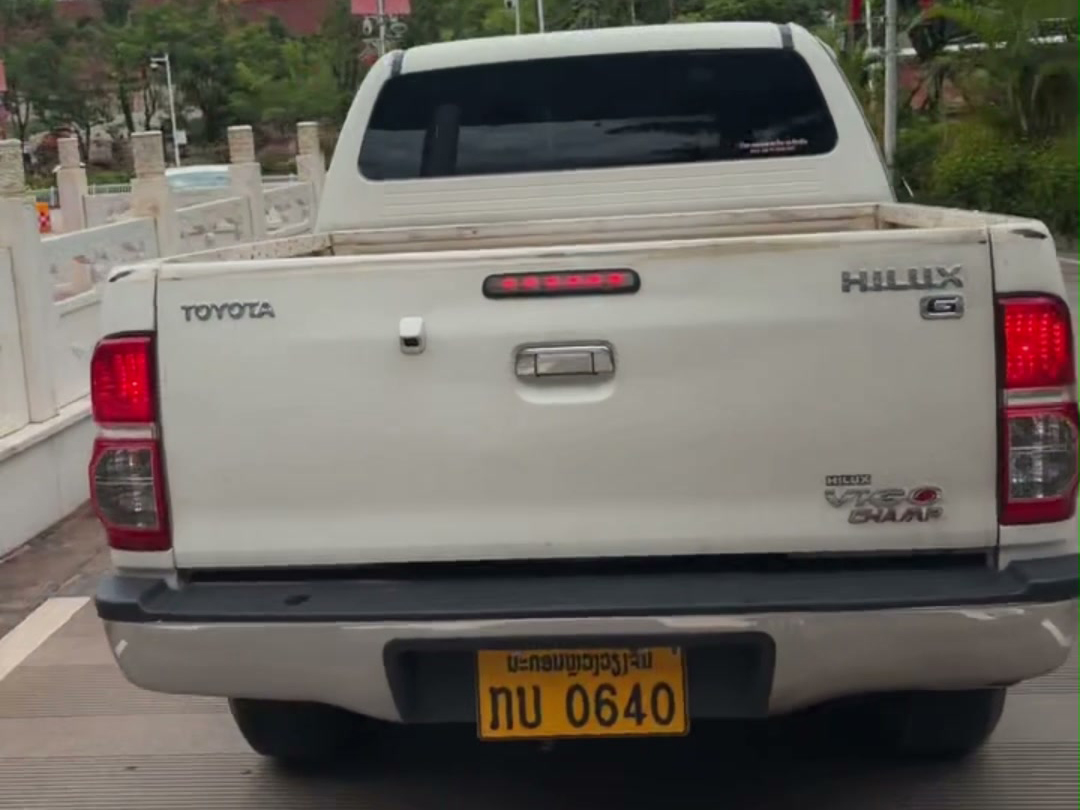
This photo shows a white Lao Toyota Hilux, a Vigo Champ, yellow plate 0640, coming over a bridge. I'd guess it's entering at Mohan, the border with Laos. I've seen any number of these at the port. Tough, simple, easy to fix, and popular across the region.
The question everyone in a right-hand-drive vehicle asks is whether it's allowed into China. Let me give the straight answer: China allows right-hand-drive vehicles to enter temporarily, every port accepts them, and the formalities and fees are the same as for left-hand-drive vehicles, no extra charge. What I'd remind you is that China keeps right, so you need to adjust. On a motorcycle it matters little, but in a car it's a real change, especially at junctions and when overtaking.
I have a Thai friend who drives a right-hand-drive pickup, and he told me a joke on himself. First day in China, he kept reaching for the seatbelt with the wrong hand and turning the wipers on when he meant to signal, because the controls are swapped. He laughed about it, but he also said that for the first two days he took it slowly and didn't overtake. Sensible man. After a week he'd adapted, and by the end he barely noticed.
I've driven both left- and right-hand-drive vehicles in different countries, and here's the thing. The physical mechanics aren't the hard part; the hard part is the habit built into your head. At a roundabout, after a long day, you can drift back to the old instinct without thinking. So I tell people to put a note on the wheel, keep right, and leave it there until they no longer need to read it. There's no shame in it. I've done it myself.
The Hilux in the photo is a working vehicle, mud on it, built for these roads. The formalities don't change because it's right-hand drive. Temporary plate for three months, temporary licence, insurance, deposit, all handled by the travel agency, same price. That's worth knowing, because some people worry they'll be charged extra or turned away. They won't.
I've crossed this bridge myself, and I know the view. Over the river, the border posts, then the Chinese side opens up. The Lao and Chinese borders sit close together, and the whole thing is fairly quick when your papers are in order. The people who come unstuck are the ones missing a translation or carrying something they shouldn't.
Let me also explain the difference plainly, because some people mix it up. Right-hand drive means the steering wheel is on the right, and you keep left, as in Thailand, Laos, Britain, Australia. Left-hand drive means the wheel is on the left, and you keep right, as in China, most of Europe, the United States. The vehicle itself isn't the issue; it's which side of the road you're used to. Bring the wrong one in and you simply adapt, carefully, with a bit of patience.
The white Hilux in the photo is halfway over the bridge, one country behind it and another ahead. Its driver has the same formalities as anyone else, no extra fee, and a bit of adjusting to do. That's all. Done calmly, it's a small thing, and the road on the other side is the reward.