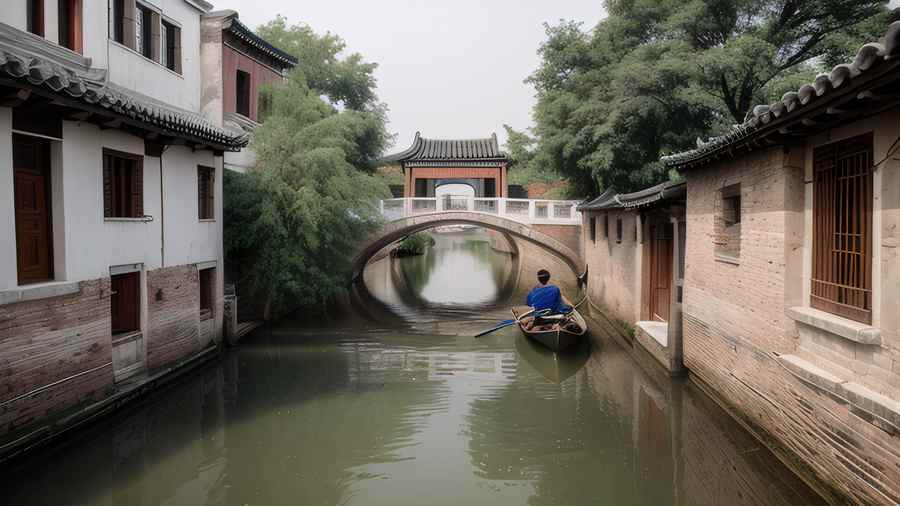
The point of this article is not the distance but the parking, because in the towns south of Suzhou the car is the difficult object. Zhouzhuang and Tongli are both walled medieval settlements with a single ring road and no way through, and Changshu is a working city whose old quarter has been pedestrianised in stages over the last decade. I ran the loop in four days with a compact car and drove 25, 0, 65 and 70 kilometres, which leaves an enormous amount of time to walk, sit in a teahouse and be told to move along by a man with a red flag. The region is the wettest and flattest part of Jiangsu: a plain of canals, ponds and lake edges where the villages grew rich on rice, on shipping and on the exam system, and spent their money on gardens. For Foreign Car Entry Self-Drive, the crossings that reach this plain are three days' drive to the north or west, and the last stretch into the towns is through traffic-engineering that no visitor enjoys; almost everyone comparing the options ends up on Renting a Car in China as a Foreigner in Suzhou or Shanghai, which puts you in the middle of this loop in two hours with nothing to declare at a border.
Trip overview
- Day 1 – Zhouzhuang to Tongli, 25 km: the twin bridges and Shen Hall in the morning, arrival and night walk.
- Day 2 – Tongli, 0 km on the loop: the Retreat and Reflection Garden, the Three Bridges walk, the museum houses.
- Day 3 – Tongli to Changshu, 65 km: across the lake plain to the hill, Yu Shan and the temple at Xingfu.
- Day 4 – Changshu back to Zhouzhuang, 70 km: the square pagoda in the morning, then the run home.
Total 160 km over four days, an average of 40 km a day, and the longest stage is under ninety minutes. Every hotel named here has its own car park; in these towns that is the deciding fact, not the price.
Day 1 · Zhouzhuang to Tongli, 25 km
Road
Leave Zhouzhuang at the west gate car park, which is the one to use if you are arriving from Suzhou, and take the town ring to the lake-side road toward Tongli. 25 km, thirty-five to fifty minutes depending on the day, because the road is a single two-lane strip that passes two other lake villages and slows at every school crossing. Tongli has three car parks, all outside the walls; the north one is closest to the garden and empties first, so aim for the west if you arrive after nine.
Sights
Start in Zhouzhuang itself before you move. It is the most famous water town in China for two reasons: a painting. The first is that its two crossing bridges, the Twin Bridges, were painted by a local artist who had left for New York, and the canvas made the town's image abroad before most Chinese had been to it. The second is that it kept the plan: streets are water, the houses have a door onto a lane and a stair down to a mooring, and the whole settlement sits in the middle of a lake system with a causeway in and a causeway out. To see it properly, walk the Shen Hall complex, a seven-courtyard house built by descendants of the fourteenth-century merchant who financed part of the Nanjing wall, then the Zhang Hall, three hundred years older and smaller, whose inscription describes exactly what you are standing in: a stream running under the threshold and a boat door inside it. Allow the afternoon for the southern lake, where the modern park has rebuilt the paifang and a stage where a Kun opera troupe plays on weekends. Then drive to Tongli, which is Zhouzhuang's quieter neighbour and better value: it is bigger, has more of its population living inside it, and its water is the open nine-mile lake on one side rather than a cul-de-sac.
Food
Zhouzhuang's dish is the braised pork knuckle named after the merchant, served cold in slices with its jelly, with the local river shrimp and a plate of water chestnuts. Eat at the back streets off the main lane and not at the frontage restaurants that have a man outside with a menu. Tongli after dark is the same cooking in a different shape: the same shrimp, the same eel, plus a bowl of water-shield soup, the thick egg-drop and ham broth the towns make for breakfast.
Where to stay
Stay inside the walls at Tongli, at one of the converted merchant houses with a courtyard; they hold a handful of cars in a yard you enter through an alley. Otherwise the lake-front hotel outside the east gate has the biggest car park and a bridge walk to the gate in eight minutes.
Day 2 · Tongli, 0 km on the loop
Road
You do not need the car today. If you want to see the lake islands, the ferry from the south quay takes you to a small islet with three religions on it, and that is the only water movement worth making.
Sights
Tongli's argument for a full day is that it has one of the great gardens of China and that most visitors do not know it is here. The Retreat and Reflection Garden was laid out in 1885 for a dismissed official on a site so narrow that the buildings were turned sideways and the whole composition floats on the water rather than standing behind it: a sequence of halls, a rockery, a boat house at the water's edge, and windows framed so that each opening holds one picture, which is the technique the Suzhou gardens are famous for and which here is done in a space a fraction of their size. It is on the world heritage list as an extension of the classical gardens, and it is worth two slow hours. The rest of the town is the loop the locals still perform for weddings: the Three Bridges, a pair of Song-dynasty arches and a Ming one strung across the same junction, walked in order with a stop at the temple of the local deity who, in the version the guides tell, was a Tang official who refused to take the throne from the emperor and starved himself instead. Add the two big houses, the Ming governor's residence with its jade-bride corridor and the Republican-era newspaper founder's lane, and the small museum of the local literary society; the town produced dozens of scholars and one or two of them changed modern Chinese journalism.
Food
Breakfast at the soup house on the bridge lane, then nothing until lunch, which should be the lake's fish: whitebait fried crisp, a mandarin fish steamed with ham and mushroom, and a dish of the watercress that grows in the channels. At tea time eat the sesame and date cakes the old pastry shops make on the main lane, and finish with a bowl of the almond-and-barley soup that appears at dusk.
Where to stay
Second night in the same courtyard hotel. Ask for a room on the courtyard side rather than the alley side; the lanes fill with trolley wheels at six in the morning.
Day 3 · Tongli to Changshu, 65 km
Road
North across the plain on the big road, then a short expressway section to the city. 65 km, about an hour and ten minutes. The road is straight and heavy with freight, and the section past the lake edge has long stretches of street lighting and none of the other; fuel is cheap and plentiful in Changshu, where the depot near the ring road sells diesel and petrol at the same price.
Sights
Changshu is the old town that was too poor to demolish, and it is the best answer on this loop to the two theatres you have just visited. Its spine is Yu Shan, a low ridge of perhaps four kilometres that comes out of the flat country with its ends in the city, and on it are the things the place has been known for since before the Ming: the tomb of a Bronze Age prince who gave up the throne and his brother's successor, who was a scholar of the Spring and Autumn annals and whose school taught the region's manners for two thousand years; a temple in the hollow of the hill where the water is good and the noodle houses have gathered for centuries; a granite cleft where the rock is cut in vertical strokes by weather and where a stone slab reads the name of the hill; and a set of pavilions at the top that look across a sheet of water called Mirror Lake, where the fishing legend of a Zhou-dynasty prime minister gave the lake its name and where the modern park has planted a flooded forest of bald cypress that turns copper in December. The walk from the temple up to the cleft is an hour and can be done in either direction. In the town below, the square pagoda of the Song dynasty stands in a park of its own, is fifteen storeys and not round, and the museum nearby keeps a group of ancient cypresses that predate it, planted when the city was the seat of a military prefecture.
Food
You came partly for this: the mushroom oil noodle of Xingfu Temple, made with the wild pine mushroom of Yu Shan, fried in oil until the broth turns brown and the smell carries across the courtyard. It has been eaten the same way for four hundred years and it is a bowl of pale noodles in that brown oil with nothing else on it. Alongside it, the beggar's chicken, a bird baked in paper and mud at a temple fair, the duck's blood with glutinous rice, which is a sweet savoury pudding made from the purple rice grown in the county, and the three whites of the lake: fish, shrimp and silverfish, all served pale and steamed.
Where to stay
Sleep in the city between the pagoda and the hill, where the streets are old and the car park behind the wall is real. There is also a good modern hotel at the foot of the east slope, with a lake view across to Mirror Lake and the space to park ten coaches.
Day 4 – Changshu back to Zhouzhuang, 70 km
Road
A direct run south on the plain roads and a short expressway finish. 70 km, an hour and twenty minutes, mostly on wide four-lane sections with lake turns; leave Changshu by eight if you intend to see Zhouzhuang before the coach parties, and park again at the west gate.
Sights
Give Changshu the morning. Walk the old street that runs from the pagoda to the river, where the arcade houses still have their shop fronts and the county's book collectors' houses are behind them; then the hill again, on the east side, for the wall of inscriptions, the cave temple and the view of the city's whole roofline from the pavilion above the temple. If the weather is close, skip the hill and take the short drive to the lake shore instead, where the flooded forest is walkable on boardwalks and the birds are out early. On the road south, stop once at the market town on the causeway, whose street is unchanged since it was a grain landing, and whose soy-sauce shop and noodle house still do the trade's business. Arriving back in Zhouzhuang by midday leaves you the afternoon for the part of the town the day-trippers leave out: the lanes behind the opera stage, the lane that leads to the water-gate, and the lake edge at four with the light coming west.
Food
Lunch on the road, dinner in Zhouzhuang. Order the same knuckle you had on day one now that you know what you are eating, and the roasted duck from the shop that hangs them in the window at four, when the smoke still shows. Buy a paper cone of the lake water chestnuts at the gate.
Where to stay
The loop closes at Zhouzhuang, or where you leave the car. Return it in Suzhou if your onward travel goes west; the agent's desk at the high-speed station can take the car on a weekday evening without a queue, and the train puts you back at the town's gate in half an hour.
Practical tips
- Park outside the walls and walk in: there is no road through either town and the ring fills by ten.
- The Retreat and Reflection Garden is closed on some Mondays for maintenance; check at the ticket window the day before.
- In the towns, the frontage restaurants with a man outside are the ones to avoid; eat where the sign is small.
- Changshu's mushroom noodles are a breakfast food at the temple; the same bowl at four in the afternoon is worse.
- December to February the bald cypress on Mirror Lake is the reason to come; June is the reason not to.
- For a loop this short, Renting a Car in China as a Foreigner is obvious value; Foreign Car Entry Self-Drive costs you a border day for 160 km.
About this route
Four days and 160 kilometres is the least driving I would recommend here and the most I would recommend walking: the towns want to be seen on foot at seven and at nine at night, which is when nobody is on the lanes but the residents. Add a fifth day for Suzhou's museums, or cut the last day and take the evening train. If you are travelling with the water in mind, come in the plum-rain month and accept the wet, or in December for the copper cypresses and the cold-clear light.
Distances are what this drive logged against the map and the toll tickets. Ticket prices, the garden's closure days and the ferry timetable were checked at the gate and change with the season.
Route notes by Zara, Yunnan Province International Travel Agency (Group) Co., Ltd.