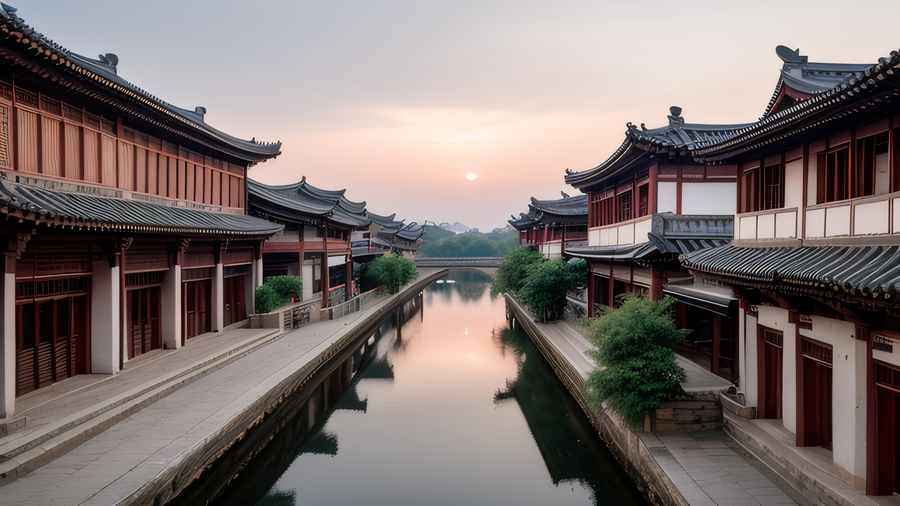
Northern Henan is flat, straight and easy to read from the driver's seat. The Yellow River runs a few dozen kilometres north of Puyang, the land between the towns is wheat and sesame, and the historic sites sit inside or immediately beside the built-up areas, so you rarely leave tarmac. I drove this loop at the end of October with a rental SUV picked up in Zhengzhou. The whole route is 215 km, split 80 km, 50 km and 85 km, which leaves real time in each place rather than a photo stop. The first night is Puyang, a city most foreign itineraries skip; the second is Hebi, where an old canal town keeps a living folk calendar; the third day closes at Anyang, the last Shang capital, and the writing system used across China today started on the fields outside that city. If you are on Foreign Car Entry Self-Drive with your own vehicle border-permit, note that these are inland cities far from any port of entry; you would normally hand the car over to a licensed operator at the crossing and rent locally. Renting a Car in China as a Foreigner is the simpler version of this trip: an airport pickup, papers in the glovebox, and you are on the expressway in half an hour.
Trip overview
- Day 1 – Puyang to Hebi, 80 km: Yunmeng Mountain, then the Xunxian old town and its cliff carvings.
- Day 2 – Hebi to Anyang, 50 km: the Shang palace ruins, the oracle bone pits, Lady Fu Hao's tomb, then the pagoda in the city.
- Day 3 – Anyang back to Puyang, 85 km: the Chinese Characters Museum in the morning, the return leg through Neihuang.
Total 215 km over three days, an average of roughly 70 km a day. Fuel, tolls and parking are modest here, and no stage takes more than 90 minutes of actual driving, which is why this route works well with children or with a driver who is new to Chinese road signs.
Day 1 · Puyang to Hebi, 80 km
Road
Start from the hotel car park in Puyang and take the S26 direct west, then the Tangyin approach road. The bitumen is wide and the traffic is mostly trucks heading for the coal fields, so keep to the right lane and avoid overtaking on the shoulder. Fuel up before leaving town; the next full station is on the expressway service area, and the smaller roadside pumps sell diesel only. Allow one hour door to door for 80 km, then another hour to climb Yunmeng Mountain.
Sights
Yunmeng Mountain sits in the Xunxian district of Hebi and is tied to the name Guiguzi, the Warring States recluse said to have taught Su Qin and Zhang Yi, the two strategists who redrew the map of China by argument alone. The mountain is not high, about 500 m, and the walk follows a series of cut-stone gullies up to the Ghost Valley, where a spring still runs into a pool below the cliff. Carved into the rock face are the large characters that give each bend its name, and there is a small museum of bronze weapons in the lower courtyard. The cliff-side path is iron-railed and steps are uneven in places, so take the cable car up and walk down if the knees are a consideration. Two kilometres downhill is Xunxian old town, one of the few county seats in Henan that still keeps its Ming and Qing street grid: a Drum Tower at the crossing, an archery street, and the Grand Buddha of Dapi Mountain cut into the sandstone cliff, nine storeys of a Maitreya figure that predates most surviving sculptures in the north. In the first lunar month the town runs its Renzi fair, a folk parade of stilt walkers and shadow-boxers that has been documented for centuries.
Food
Xunxian is known for two things on the table: the subao, a sesame-crusted flat loaf split and stuffed with shredded pork and pickled mustard, and the salted duck eggs aged in river mud. In the old town the noodle shops serve a broad wheat noodle in a broth of bone and chilli oil, usually ordered with a plate of cold soy-jelly. Vegetarians can eat well on the mountain, where the temple kitchens serve a soy-based meat analogue with buckwheat pancakes.
Where to stay
Sleep in the Xunxian or Qixian area of Hebi. The newer business hotels sit along the Kanguang Road and have covered parking, which matters if the car is on a long-term rental agreement; confirm the space when booking rather than on arrival. Rooms with twin beds are standard and the price range is well below what the same class would cost in Zhengzhou.
Day 2 · Hebi to Anyang, 50 km
Road
A short hop north on the G4 side road, about 45 minutes. The section through the Anyang county boundary has several pedestrian crossings and no central barrier, so watch for electric three-wheelers turning across your lane. Enter Anyang from the west and go straight to the Yinxu site; the approach lane past the east gate is restricted for larger vehicles, so leave an SUV in the visitor car park rather than trying to reach the museum door.
Sights
Yinxu, the Ruins of Yin, is the last capital of the Shang dynasty and the reason Chinese writing can be traced without a break for more than three thousand years. Between 1899 and 1928, ox scapulae and turtle plastrons carved with divination questions turned up in the fields of Xiaotun village here, and the excavation that followed found the palace and temple area, the royal cemetery and the tomb of Lady Fu Hao, a king's consort buried with more than 400 bronze vessels and a stack of bronze axe-heads shaped like halberds. Only a fraction of the 24 square kilometres is opened; the visitable core is the palace and temple museum, a set of protective halls over the original pit foundations, with the inscribed bones displayed behind glass and the pit outlines marked in the ground. Allow two and a half hours and take the English caption panel for the oracle bone room, because the dating sequence is hard to reconstruct on your own. In the city centre, the Wenfeng Pagoda at Ningansi temple is the oddity: eight storeys of brick, wider at the top than the base, with an inverted-drum storey that gives the silhouette its bell shape. It was rebuilt in 1996 after an earlier collapse and the interior stair is narrow enough to do it in one direction only.
Food
Anyang runs on the hot breakfast bowl called bianfencai: wide sweet-potato vermicelli simmered in a bone broth with cabbage, tofu and minced pork, eaten with a crisp fried dough strip. Further south on Wenfeng Road the dumpling houses serve a steamed pocket of pork and fennel with black vinegar. For dinner, pizha is a starch-and-meat pudding sliced and pan-fried, and the local beer pairs better with it than with anything else on the table.
Where to stay
Stay in central Anyang, near the pagoda, so the museum and the evening food street are both walkable. Hotels along the Zhangde Road have secure yards; if your rental comes with a GPS tracker or a bonded deposit contract, keep the paperwork in the room, not in the glovebox, in case a checkpoint asks for it.
Day 3 · Anyang back to Puyang, 85 km
Road
Do not leave in a hurry. Spend the morning at the Chinese Characters Museum, which is north of the old city and quiet before eleven, then take the S22 east through Neihuang county. The return leg is flat and straight, roughly 70 minutes, with a wide hard shoulder you can actually stop on. The one thing to watch is the heavy agricultural traffic in late afternoon: reaper trailers and three-wheelers loaded with corn move at 30 km/h and do not always show a light.
Sights
The Chinese Characters Museum in Anyang is the national museum of writing, and its building is deliberately shaped like a hand holding a scroll. The permanent hall starts with the Neolithic pot marks found in Henan, moves through the Shang oracle bones and the Western Zhou bronzes, then runs the Qin standardisation of the script and the later calligraphic schools. The display logic is chronological by character form rather than by dynasty, which makes it possible to watch one word change shape over two thousand years; the panels on the oracle bone script give the modern character beside the ancient one. Outside the city, on the way back to Puyang, the Qicheng heritage park marks the spot where the feudal states of the Spring and Autumn period swore their treaties, and a bronze tripod stands on the mound. Puyang's Xishuipo site, inside the city, is where a tomb dated to about 6000 years ago was found with a figure of a dragon and a tiger laid out in clam shells, the earliest such arrangement yet excavated; the site museum shows the pit in situ and is easy to reach in twenty minutes from the centre.
Food
Puyang's signature is the zhuangmo, a thick pan-baked bread layered with pork and spring onion, cut into wedges and eaten hot; the counter near the Qicheng gate has been making it the same way for decades. Along the way in Neihuang, buy a bag of the county's red dates, and in Anyang stop for the sliced donkey meat sandwich if you have not tried it.
Where to stay
The loop closes in Puyang. If the onward drive is north to the Shanxi border, fill up before leaving the city, and take the expressway rather than the river road: the Yellow Bridge on the provincial route is a single lane in each direction and backs up after four in the afternoon.
Practical tips
- The three sites charge separately; buy the Yinxu ticket online with the passport number, because the counter machine only reads the ID card.
- Anyang's old town is a low-emission zone on some days; a rental car registered in another city may be turned away at the cordon, so keep the approach to the hotel on the outer ring.
- Fuel up in Puyang before the first stage; the Hebi mountain road has no station above the valley.
- Xunxian's Drum Tower area is best before nine or after four, when the tour buses have gone and the arcade is just locals.
- Bring a paper copy of the rental agreement. Police checkpoints on the S22 ask for licence, registration and insurance, and the phone battery is not a guarantee.
- On this loop either way of driving in China works: Foreign Car Entry Self-Drive with your own permitted vehicle, or Renting a Car in China as a Foreigner after landing.
About this route
This is a three-day route by design. The driving is short, the sites cluster tightly, and every night is in a city with hotels that take foreign guests, so it suits a first run into inland China rather than a long expedition. The thematic thread is writing and statecraft: a divination archive, a treaty mound and a national museum of characters, all within 215 km of each other. If you want to extend it, the county of Tangyin to the south is where the Yue Fei temple stands, and Lingquan in the west has the roots of the Chan lineage, both reachable as a fourth day without changing the shape of the trip.
Distances in this article are the ones I drove, taken from the trip computer and checked against the road signs; opening hours were confirmed at the gate in late October and can shift for maintenance or a public holiday. Prices are what I paid, not a quotation.
Route notes by Zara, Yunnan Province International Travel Agency (Group) Co., Ltd.