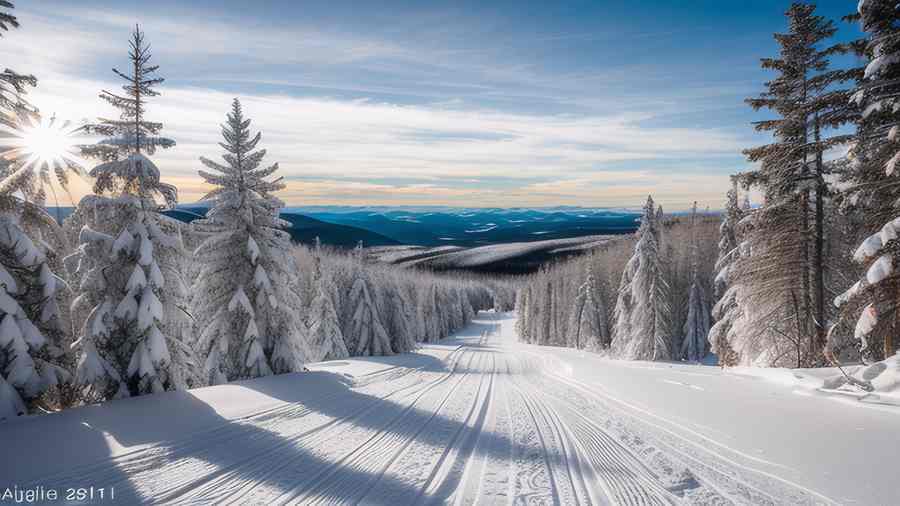
This loop goes east from Harbin into the Zhangguangcai range and back on a different road. I drove it in January, which is the honest season for it: 255 km out, a day on the mountain, 105 km along the old line to Shangzhi, a day at the cap-shaped hill, and 160 km home on the expressway. Everything about it changes with the cold. The daylight lasts eight hours, the surface is packed snow or ice for two-thirds of the year, and the sights are outdoor, so the plan has to be built around ten minutes of walking rather than two. The payoff is a region nothing else in China offers quite the same way: a ski resort that was built for the 1996 Asian winter games and still runs the national championship, a Manchu banner town, an old railway town that grows grapes at the edge of a boreal forest, and a hill that is used as a university's field station. For Foreign Car Entry Self-Drive, the straight word is that winter is unkind to this option: the crossings in Heilongjiang are far north, roads freeze, and a border-permit vehicle stuck at a service station on a minus thirty night is a bad afternoon. Renting a Car in China as a Foreigner at Harbin airport, with winter tyres and the documents sorted by a licensed agency, gives you the same loop at a fraction of the risk.
Trip overview
- Day 1 – Harbin to Yabuli, 255 km: east on the G10, then up the resort valley.
- Day 2 – Yabuli, 0 km on the loop: slopes in the morning, the ridge trail and the spa in the afternoon.
- Day 3 – Yabuli to Shangzhi, 105 km: down the valley past Yimianpo and its vineyard, into the county seat.
- Day 4 – Shangzhi, 0 km on the loop: Maoer Shan, the university plots, the river and the memorials.
- Day 5 – Shangzhi back to Harbin, 160 km: the expressway home with a stop at the reservoir.
Total 520 km over five days, an average of 105 km a day, and the longest stage is under three and a half hours. Fuel up at Harbin, at Yabuli town and in Shangzhi city; the mountain and the valley have stations but they close early in the dark months.
Day 1 · Harbin to Yabuli, 255 km
Road
Take the G10 east out of Harbin and stay on it until the Yabuli exit. 255 km, three and a half hours in good weather and five when the ploughs are out. The expressway is cleared and sanded within hours of a storm, but black ice forms on the bridge decks and in the shade of the cuttings, and the wind that comes off the open plain east of Acheng can lift a light car. Winter tyres are not optional between November and March; chains are carried even by locals. Give yourself an early start, because the last hour climbs and you want the resort before the light goes flat around four.
Sights
Yabuli is China's oldest real ski resort and still its most used. Runs were first cut here for the provincial and national training teams; the resort that hosted the 1996 Asian winter games is the reason the roads, the lifts and the hotels are where they are, and the reason the valley still hosts championships and training camps in winter. What a visitor actually meets is a long, south-facing valley with several independent fields along it, each with its own lifts: a beginner bowl by the lodges where the coaches stand in rows, intermediate faces that run through birch, and the black ridges above the tree line on Da Guokui Shan, the peak the whole resort is built against. The lifts top out just over a thousand metres and the snow is the dry, granular kind that holds on a shaded slope from November to March. Between the fields and the forest there is a marked ridge trail that locals walk in snowshoes; it takes an hour, the view runs the length of the valley, and the snow comes off the trees in gusts that sting.
Food
The resort kitchens run on Northeastern food, which is heavy and correct for the weather: a stew pot of goose or river fish with potatoes and a ring of cornbread around the edge, garlic sausage from the Russian shops in Harbin eaten cold, and cabbage pickled in a barrel with the sour water saved for dumplings. Eat hot at noon; save the cold dishes for the evening with a bowl of tea.
Where to stay
Stay in the resort valley if you are skiing, in Yabuli town if you are not. The valley costs more and puts you on a lift at eight; the town has the cheaper beds, the better kitchens and a fifteen-minute run up the road.
Day 2 · Yabuli, 0 km on the loop
Road
No driving today except the shuttle roads inside the resort, which are graded and sanded. If you want to walk the ridge trail, take the local vehicle to its foot rather than drive; parking at the top is a scraped shelf.
Sights
Morning on the slopes, afternoon on the ridge, evening in the water. The ski fields each sell their own tickets, so decide what you want: the beginner bowls by the lodge block are wide, lit until nine, and served by a magic carpet and an easy chairlift, which is the right place for a first day. The intermediate faces run through young birch and hold their shape to March, and the runs above the tree line on Da Guokui Shan need a hard shell and respect for wind. Equipment is rented at the base and a coach for an hour is cheap by international standards, worth every yuan if you have not been on snow before. Those who do not want to ski have a real day here: the ridge trail, snowshoes at the gate, a tube park below the main lift, and a set of spa pools fed by hot water from the mountain, where you can sit in thirty-eight-degree water with your hair frozen while the snow falls. On a clear January evening the ridge above the resort turns pink for ten minutes, and the photographers stand at the same corner of the parking lot every day.
Food
Eat the local cold dishes at lunch, which are three plates of dressed vegetables, and the hot pot at night. Order the wild greens in sesame oil; the region gathers them in spring and freezes them for the winter. If you can face it, try the frozen pear in the yard outside, which is a hard black ball that thaws into a glass of cold syrup.
Where to stay
Second night in the valley. Ask for a room with a south window and a radiator you can turn down; the resorts overheat and the difference between sleeping and not sleeping is that dial.
Day 3 · Yabuli to Shangzhi, 105 km
Road
Down the valley on the old road that follows the river and the railway, 105 km to Shangzhi city in about two hours and a half. This is the scenic leg in winter: the valley narrows, the line climbs with you, and the villages sit behind fences with snow to the roofline. Slow at the town crossings, where the road surface is ploughed but not sanded and the corners carry a sheet of ice.
Sights
Yimianpo is the reason to take this road. It is a station town from the old Chinese Eastern Railway, built in the 1890s and 1900s when this line was Russian, and its long street still carries the brick and timber buildings of that period: the depot, the water tower, the officers' houses, and a set of gabled station structures that have been repainted rather than demolished. The town also has a vineyard and a winery that has worked since the 1950s, which is a genuine oddity, because it sits at a latitude where grape growing needs winter hardy hybrids and a sheltered slope; the surrounding hills are planted with them, and in October the town smells of fermentation, and in winter you can see the vines laid down in the trench. North of the town, the railway climbs through a set of tunnels and galleries that were cut in the same period, and the road passes them, so that a short walk gives you the whole engineering argument for why this valley was worth a line. Then Shangzhi, named in 1946 for the guerrilla leader Zhao Shangzhi who fought the Japanese in these hills, which is what its museums are about; the county town is a working railway junction and the river runs through it.
Food
Yimianpo's own thing is grape juice and a light red wine made from hybrid grapes, sold at the winery gate, and its restaurants cook the river fish with a little vinegar and a lot of pepper. In Shangzhi eat the grain food: a bowl of the local corn porridge, a millet cake, and the tofu of the region, firm enough to hold its shape in a stew.
Where to stay
Stay in Shangzhi city. The hotels are plain and warm, the car parks are behind gates, and the restaurant row is short enough to reach after dark without driving, which on an ice night is worth more than a better mattress.
Day 4 · Shangzhi, 0 km on the loop
Road
A round trip of about seventy kilometres to Maoer Shan and back on the same road you came in on, or a taxi if the forecast has turned. The mountain road is ploughed; the last two kilometres are steep and shaded, which means they stay iced.
Sights
Maoer Shan, the Cap Hill, is a granite cone a little under a thousand metres tall that stands up alone out of the valley floor, and it is one of the most used outdoor classrooms in the province. It has been a national forest park since the 1990s and a field station for forestry universities, so the paths are marked, the plots are numbered, and you will pass groups of students measuring trees rather than tour parties. The climb is a stone stairway cut along a ridge with a chain in the steep places; from the top the whole valley of the old railway lies under you, and on a clear day the range you came from shows to the east. In winter the stair is iced, the wind off the cone is hard, and the walk takes two hours rather than one. Down at the gate there is a lake that freezes into a skating surface, and a set of farm kitchens. Then the town's own history: the memorial to Zhao Shangzhi and the museum of the county, which between them explain how this line and this land were taken, held and fought over; the river embankment where the locals cut a slide and skate after dark; and a Manchu heritage hall in the county's old banner quarter, with the region's shaman drums, the paper-cutting and the wooden troughs cut from a single log.
Food
Breakfast at the grain shop near the station; lunch at Maoer Shan, where the farm kitchens cook a stew pot with cornbread around the edge and a plate of frozen berries for the table; dinner in the city on braised river fish, millet porridge, and a basket of the steamed corn buns that the county's flour makes heavy and sweet.
Where to stay
Back to the same hotel in Shangzhi. Ask the desk to keep the car uncovered; a tarp is worse than nothing on a frost night, since it freezes to the paint.
Day 5 · Shangzhi to Harbin, 160 km
Road
The expressway west, 160 km, two hours in winter, and the usual four when a storm has closed the road behind the range. The last stretch through the Acheng plain is straight and open, with a crosswind that arrives in gusts; leave the city until the afternoon if you can, or you will share it with commuters.
Sights
Do not drive straight home. Stop at the reservoir that lies short of the city, where the water has fallen for winter and the drawn-down shoreline is a field of ice and mud with birds on it; the road around it is clear, and the walk out on the old breakwater gives you a last view back toward the range. The other half-hour belongs to Acheng, the old town behind the plain, which had a temple, a walled street and a station in the days when this was the road to the sea, and has kept the lane and a couple of the courtyard houses. Then Harbin: the first thing to look for on re-entry is the river, because the city in January is arranged around ice — a frozen water front with sledges, skating, a set of carved blocks and a snow-and-ice park that lights after five; the downtown is warm and the walk back to the airport is short.
Food
Finish in the city you started in: the Russian-style bread, the smoked sausage, and a bowl of dumplings with pork and chive, then a dish of the local noodles dressed with sesame and garlic, which is what the province eats when it comes in from the cold.
Where to stay
The loop closes in Harbin. If you are flying out, hand the car over at the airport desk with an hour to spare; the lot is far from the terminal, the documents take time, and the last thing you want is to argue about a dent at minus twenty-five.
Practical tips
- Between November and March the whole loop is winter driving: snow tyres, a torch, a scraper and a blanket in the car.
- Start every stage before nine; the sun sets around four and the shaded mountain road keeps its ice overnight.
- Keep the tank above half. A tow on a Heilongjiang night is a matter of hours, not minutes.
- Fill in Harbin, Yabuli town and Shangzhi city; the mountain and the valley stations shut early.
- The ski fields sell tickets separately and the ridge walk needs a hard shell; buy for one field, not for the mountain.
- For this loop in this season, Renting a Car in China as a Foreigner is the safer answer than Foreign Car Entry Self-Drive.
About this route
Five days is right for 520 kilometres in winter, because a storm can cost you a morning and a good clear day can cost you an afternoon if you are standing on a ridge. The summer version of this loop is shorter and drier: the ski valley becomes a hiking base with lifts, the reservoir is full, and Yimianpo's vineyard holds its October harvest; take three days and cut the ridge trail. If you come for snow, come in January, when the ice on the river is thick enough to hold the whole city.
Kilometre figures are the ones this drive recorded against the exit boards and the fuel log. Ticket prices, lift opening times and the road state were checked at each gate and change with the weather.
Route notes by Zara, Yunnan Province International Travel Agency (Group) Co., Ltd.