Everyone drives south on Hainan. The G98 ring road fills with cars heading for Boao and Sanya, and the north-west quadrant — Lingao and Chengmai — stays quiet. That is the appeal. The road out of Haikou is a wide four-lane expressway, the towns are small, and the coast here is basalt and mangrove rather than powder sand. I ran this loop in the dry season with a rented crossover and covered it in three easy days: 80 km on the first, 45 km on the second, 60 km home on the last. For a first taste of driving on the island it is close to ideal, because the distances are short and the traffic density drops off a cliff once you leave the capital. If you are here on Foreign Car Entry Self-Drive with your own plate, bear in mind that Hainan is an island: a vehicle brought in through a mainland crossing has to be shipped across the strait, which is rarely worth the cost for a three-day loop. In that case Renting a Car in China as a Foreigner at Meilan airport is the practical option, and the paperwork is a passport, a home licence and a certified translation.
Trip overview
- Day 1 – Haikou to Lingao, 80 km: the lighthouse and landing beach at Cape Lingao, then the Juren waterfall inland.
- Day 2 – Lingao to Chengmai, 45 km: the Chengmai mangrove bay at low tide, then Fushan coffee town.
- Day 3 – Chengmai back to Haikou, 60 km: the old town arcade street in the morning and the drive home after lunch.
Total 185 km over three days, roughly 60 km a day, all on expressway or good provincial road. Fuel is cheap and the parking at every stop here is free and open, which makes this a low-stress route for a driver who has not yet handled Chinese motorway signage.
Day 1 · Haikou to Lingao, 80 km
Road
Leave Haikou on the S21 north-west, the section signed for Lingao and Danzhou. It is 80 km of flat expressway with one toll gate and takes about an hour. Exit at the Lingao turn-off rather than following the ring road: the last 18 km to the cape is a two-lane coastal highway with a hard shoulder you can actually pull onto. Watch for scooter riders who turn across without signalling, and for the small buses that stop in the lane at village markers.
Sights
Cape Lingao is the western arm of Qiongzhou Strait, and on a clear day you can see the lights of Guangdong across roughly twenty kilometres of water. The headland carries a cast-iron lighthouse erected by the French in 1894, still working, thirty metres tall, with a spiral stair and a lens room you can usually look into from the doorway. Below it a stone monument records the 1950 landing, and the beach at the base of the cliff is coarse grey sand with rock pools rather than swimming sand, so go for the water colour and the wind rather than a bath. The headland is landscaped as a park with a museum in a low building at the gate, and the whole visit takes about ninety minutes. Fourteen kilometres inland is the Juren waterfall, on the road toward Duowen. It is not a famous fall: it drops roughly thirty metres over a basalt lip into a gorge lined with banyan and fern, and the pool at the bottom is fed by a stream that runs clear after rain. A concrete path with iron railings reaches the viewing platform; wear shoes with grip, because the spray keeps the last flight of steps slick. Locals swim there in the afternoon. If you have time left in the day, the Lingao county museum near the county seat holds a decent set of Han dynasty bronze drums found in this coastal belt, the type associated with the Lao people of the island.
Food
Lingao is famous on the island for two dishes. The first is suckling pig, salted and roasted over charcoal until the skin cracks; the restaurants along the cape road each have their own pit and you order by weight. The second is tubworm, a fat pale sand-dwelling creature local cooks in a clear broth with ginger and scallion; it tastes like a cross between clam and squid and is considered restorative. Both are heavier than they look, so order half a portion if there are two of you.
Where to stay
Sleep in Lingao county seat. It is a small, cheap town and the newer hotels along Jianshe Road have lift-up barriers and open yards where you can leave an SUV overnight. Stay within ten minutes of the cape road if you want to see the lighthouse at first light, which is the best hour there.
Day 2 · Lingao to Chengmai, 45 km
Road
A short hop south-west on the S304 and then the Danzhou connector. Forty-five kilometres, about 50 minutes, mostly through sugarcane. The Chengmai mangrove area is reached by a signed turn off the coastal road; the final stretch is narrow concrete with no shoulder, so go slowly and expect to yield to villagers on foot.
Sights
The Chengmai wetland on the bay south of the county seat is one of the largest surviving mangrove belts on Hainan's north-west coast: black mud, knee roots, and at high tide water colouring the leaves. A timber boardwalk runs a couple of kilometres into the trees with viewing towers at the bends, and the bird life is the real content — egrets, whimbrels in migration season, and fiddler crabs covering every dry bank between the roots. Timing matters far more here than entrance cost: come within an hour either side of high water, when the boats can run the channels and the trees stand in the sea, or at low water, when the mudflat opens up for the entire width of the bay. Check the tide table posted at the gate; the office will tell you the day's high. Then drive inland to Fushan, a coffee town. Hainan's coffee story is Chinese rather than Vietnamese or Brazilian: seeds reached Fushan in 1933 via overseas returnees from Indonesia, state farms expanded the groves in the 1980s, and today the town's roasters sell a dark, low-acid robusta blend brewed condensed in a small glass cup. The self-driving road through Fushan passes plantation blocks with the fruit in three colours at once, and the coffee museum at the edge of town explains the processing line in a twenty-minute walk.
Food
Fushan's whole identity is the coffee, so drink it black and small. With it, eat qiaotou sweet potato, the purple-fleshed local tuber roasted or steamed and sold by the bag along the road, and Chengmai's balian goose, a white bird from the village of that name served chopped cold with a ginger-scallion oil. If you want a proper dinner, the county seat at Jincheng has a short street of seafood places grilling squid and mantis shrimp on charcoal.
Where to stay
Stay either in Fushan town, above the roasters and very quiet at night, or in the Chengmai development zone near the old-town exit, where the business hotels are larger and the car parks are monitored. The two are twenty minutes apart, so pick by whether you want morning coffee in a plantation town or a gym and a room-service menu.
Day 3 · Chengmai back to Haikou, 60 km
Road
Sixty kilometres on the G98 west section, 45 minutes, then into the capital. Do this after lunch: the return stretch is straight and the traffic from the western port approaches the city late in the afternoon, so an early start or a late start both beat leaving at four.
Sights
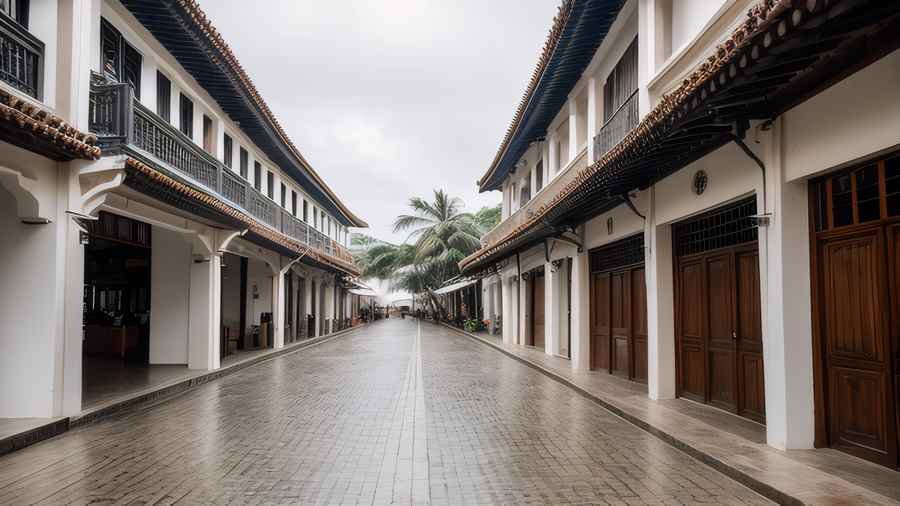
If you have not finished Haikou, spend the closing hours in the Qilou old quarter north of the clock tower. Two thousand arcaded buildings were put up between the 1880s and the 1930s by Hainanese who made money in Southeast Asia and came home to build; the ground floor is a shop front, the upper floors have French casement windows and balustrades, and the stucco carries a mixture of Roman arches, Chinese auspicious carving and Art Deco geometry. Baisha Water Lane is the best short walk, and the teahouses there serve old-style lemon tea and salted mustard tuber, the local pickle. Between the arcade streets sits Longhua Si, a temple rebuilt within the quarter, and the Shangde Hall, an early-Republican cinema kept as an exhibition space. None of this is a paid attraction; the area works best as two unhurried hours with a coffee in hand.
Food
Haikou eats noodles. The bowl to ask for is laoba, rice noodles in a shrimp-and-pork broth topped with peanuts, dried shrimp and chilli oil. Near the arcade street, a plate of qingbuliang — shaved ice with beans, seaweed jelly and coconut milk — solves the heat. Anything labelled hainan fen is safe.
Where to stay
The loop ends in Haikou. If the onward plan is the airport, allow an hour from the old town at midday; Meilan is 25 km east and the ring road through the city is the slow part.
Practical tips
- Hainan's expressways are toll-free, so budget only for fuel; the money you would have spent on tolls goes into the extra tank.
- The island enforces a low-emission regime on certain registration classes; if your rental paperwork is from another province, keep it reachable for the checkpoint on the approach to Haikou.
- Plan Day 2 around the tide, not the clock: the mangrove boardwalk is a different place at high and low water.
- Bring insect repellent for the Juren waterfall path after rain; the banyan roots hold mosquitoes.
- Coffee in Fushan is sold by weight and roasted to order; ask for the ground version if you are flying home with it in the bag.
- Three days here is easy either way: Foreign Car Entry Self-Drive with a permitted vehicle, or Renting a Car in China as a Foreigner at the airport.
About this route
This is a deliberately short loop, aimed at travellers who want to drive on Hainan without paying resort prices or spending half the trip in traffic. The content is coastal and agricultural: a 19th-century lighthouse, a basalt waterfall, a mangrove bay and a coffee town founded by returnees. Add a fourth day and Danzhou, with its Dongpo academy and limestone caves, joins the loop cleanly at 60 km further west. Keep the trip to three days and it functions as an introduction.
Distances were read off the trip computer against the signage on each stage; opening hours and the tide note were checked at the gate in the dry season. Prices mentioned are what was paid, not a quotation, and they move with the season.
Route notes by Zara, Yunnan Province International Travel Agency (Group) Co., Ltd.