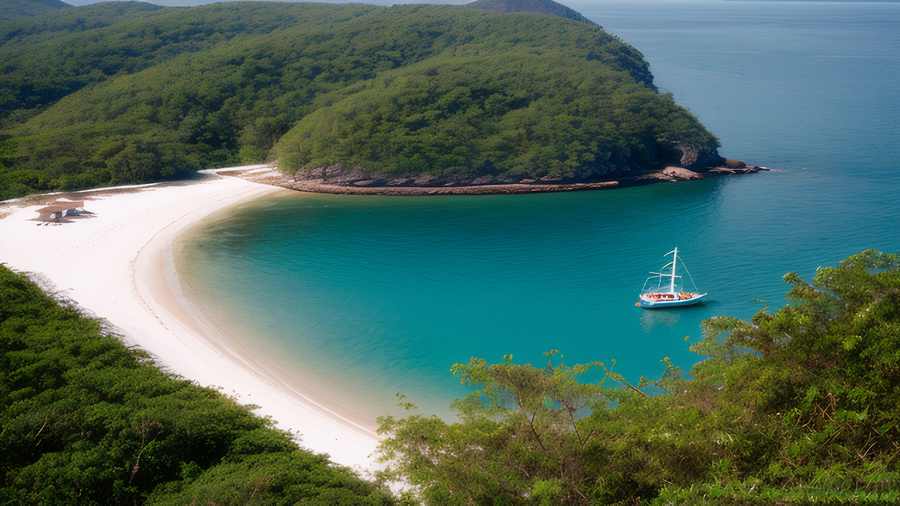
This route is written for a Foreign Car Entry Self-Drive and works equally for Renting a Car in China as a Foreigner. Fifteen days, 975 km: an average of 65 km per day, which is why the plan carries so many stops. Hainan's ring expressway makes any itinerary easy, but the island's real texture is in the county towns — coffee, volcanic stone villages, academies, salt flats, rainforest roads — and those take time.
Trip overview
- Wenchang: coconut country, the old overseas-Chinese town, and the launch site on the east coast
- Ding'an: a mountain temple on a karst peak and a lake park
- Chengmai: mangrove bay and a coffee township
- Danzhou: the Su Dongpo academy and a limestone cave with an underground river
- Changjiang: empty beach at Qiziwan, then rainforest up to Bawangling
- Wuzhishan: the island's high centre and a gorge road
- Sanya: bay, headland and a seaside temple
- Ledong and Haitangwan: a quiet bay, and the island ferry at Lingshui
Six places take two nights, so laundry and rest are built in.
D1 · Haikou — Wenchang, 85 km
Road
East on the ring expressway and the airport link; ninety minutes, good road.
Sights
Wenchang is the coconut county: palms line the roads in long ranks, copra dries in yards, and the product you actually taste is coconut — rice cooked in coconut milk, chicken boiled in coconut water, cakes sweetened with its flesh. Wenchang people also emigrated: for a century men left for Southeast Asia and sent money home, and the overseas-Chinese township of Shigong still wears that history in its arcaded shopfronts and its small Western-style houses beside Chinese ancestral halls. Wenchang chicken, the local dish, is a cold-cut bird served with a chili-and-lime dipping sauce; the best version is at a market restaurant rather than a hotel. Spend the afternoon in the old town lanes and on the riverside, and get an early start tomorrow for the coast.
Food
Wenchang chicken with rice, coconut cakes, sugarcane juice.
Where to stay
Wenchang town, or near the coast.
Day 2 · Wenchang sightseeing, 0 km
Road
No driving today; the town, the grove road and the temple are within reach on foot or by village electric cart.
Sights
A second day in Wenchang is for what a fly-by misses. The Confucian temple at the north of the town is one of the best-preserved in Hainan: gates, a bridge over a half-moon pond, a courtyard of trees, and steles that record how a frontier county paid for schooling. Beside it the arcade lanes still hold hardware shops, herbalists and a coffee-and-rice-noodle counter under the same shutters they had eighty years ago. Then take a village cart out into the coconut groves east of town: the palms are planted in ranks with a ditch of brackish water between them, goats are tied along the dyke, and there are drying yards where husked copra is raked into circles. The same road passes small workshops cutting coconut flesh into cakes and pressing the oil; you can stand at the bench, watch, and buy the day's batch. Late afternoon back at the river for the market boats.
Food
Seafood at Longlou: steamed fish, clams with basil, coconut rice.
Where to stay
Back in Wenchang town.
D3 · Wenchang — Ding'an, 60 km
Road
South-west then west across the plain; about ninety minutes.
Sights
Ding'an is a farming county with two claims. Wenbi Peak is a karst hill that carries a Daoist temple route up its limestone — a stair of switchbacks past gates, halls and a cave, ending at a summit pavilion that sees the whole rice plain. The climb is real but short; the shade and the rock are the reward. Nanli Lake, to the north, is a reservoir turned lake park: a ring road, wetland boardwalks, birdlife in the reeds, and a set of garden plots the county uses for flower shows. Ding'an's other claim is food and absence: it is one of the province's poorest agricultural counties, and its people have historically left to work elsewhere; what remains is an unusually intact county town, with its old wall line, arcade shops and a rice market that still trades in the street.
Food
Ding'an: goose, inland river fish, stuffed tofu, sea-porridge rice.
Where to stay
Ding'an town.
Day 4 · Ding'an sightseeing, 0 km
Road
Local roads to the lake and the peak; under 30 km.
Sights
The second day is a slow loop between the two sites. Go up Wenbi early, when the stone is cool and the temple court sweepers are still working; from the top the plain is green in every direction and the hills behind the town show the limestone shapes that give the area its water. Then drive to Nanli Lake for the long walk: bird hides at the reed end, a causeway across the shallow side, and shaded benches where the county's retirees play the two-stringed fiddle in the evenings. In Ding'an town itself, the old lanes and the Confucian temple grounds deserve an hour, and the market stalls at the north end sell the preserved meats and dried seafood that Hainan travellers take home. This is the rest day of the first week — plan to be in a chair by late afternoon.
Food
Second night: claypot chicken, rice noodles in broth, a bowl of mung-bean dessert.
Where to stay
Same hotel, second night.
D5 · Ding'an — Chengmai, 40 km
Road
North-west on the expressway, then down to the bay; under an hour.
Sights
Chengmai's south shore faces a wide, shallow bay where mangrove forest runs down to the water — the red-tree bay, a reserve of salt marsh and tidal creeek, with boardwalks built out over the mud so you can see the roots breathing. At low tide the crabs and fiddlers cover the flat; at high water the trees stand up to their ankles in the sea. The birds arrive with the light. Then the coffee township of Fushan inland: Hainan's coffee was planted here a century ago by returned overseas Chinese, and Fushan still roasts in small workshops, some of them family-run, serving a thick dark cup with condensed milk. The township museum is a converted hall with old roasters and bags. Chengmai also holds an old county seat with Ming-Qing lanes; between the two, this is a comfortable two-night stop.
Food
Chengmai: Fushan coffee, short ribs with rice, a plate of bay shrimp.
Where to stay
Chengmai town or the Fushan side.
Day 6 · Chengmai sightseeing, 0 km
Road
Short local driving; the bay and the township are in opposite directions.
Sights
Do the mangroves at first light, when the mudflat is cool and the wading birds are feeding, then the coffee workshops in the midday heat — a cup in Fushan and a bag for the car. In the afternoon, walk Laocheng, the walled old county seat on the inland river: it was the island's administrative centre for centuries, and its lanes, ancestral halls, city-god temple and gate arches are still the layout people live inside rather than a restored set. Hainan's coastline gets the publicity, but Laocheng is the best surviving answer to the question of how this island was governed. Finish the evening on the bay road above the mudflats, where the light comes back off the water and the fishermen push their boats off the bank.
Food
Second night: steamed fish with sour greens, rice cakes, coconut water.
Where to stay
Same place, second night.
D7 · Chengmai — Danzhou, 60 km
Road
West along the coast road; an hour.
Sights
Danzhou is the large western city and the island's second cultural seat. The Dongpo Academy commemorates Su Shi, the eleventh-century poet-official exiled to Hainan, who stayed fifteen months and left a permanent mark on the island's schooling: the academy beside the old well he used holds halls, steles and a pond, and the site explains why a frontier island kept a Confucian tradition. Its other attraction is geological: Shihua Water Cave, forty minutes to the north, is a limestone cave with an underground river you enter by boat, its chambers hung with formations and a small museum of volcanic rock at the entrance. The grounds of Hainan University's older campus, on the edge of town, give a third reason to stop, with trees and a quiet avenue.
Food
Danzhou: rice noodles in seafood broth, mutton hot pot in cool weather, a cup of local tea.
Where to stay
Danzhou city.
Day 8 · Danzhou sightseeing, 0 km
Road
Forty-minute drive out to the cave and back.
Sights
The second day belongs to the cave and the coast road. In the morning, drive to Shihua Water Cave: the boat takes you in through a low mouth and opens into chambers where the water is dark and still and the dripstone reaches to the ceiling; the path continues on foot through a second system, and the whole visit is two cool hours. The volcanic-rock museum at the gate is small but genuinely informative — Hainan's north-west is old lava country, and the black stone used in nearby villages comes from it. Afternoon: take the coast road north to Yuntai Village and the salt flats, or simply drive toward the volcanic cones and back. Danzhou's evening food street is the social centre of the west coast, and the portions are honest.
Food
Second night: oysters grilled with garlic, seafood congee, stir-fried morning glory.
Where to stay
Same hotel, second night.
D9 · Danzhou — Changjiang, 115 km
Road
South-west on the expressway, exit for the coast; two hours.
Sights
Changjiang's Qizi Bay is the island's emptiest good beach: a long curve of sand and rock with a headland at either end, named for the stones that look like a chessboard from above. The sea here is clean, the shore is broad at low water, and because the resort building stopped short of mass towers, you can still walk for half an hour without passing a sunbed. The county's other card is inland: the road up toward Bawangling, the highest forested massif in Hainan, runs through Li villages and up into cloud forest. On this day, arrive early enough to spend the late afternoon at the water; bring your own drinking water if you walk the northern rocks, as there are no vendors.
Food
Changjiang: fish cooked in banana leaf, rice in bamboo tubes, a sweet potato dish.
Where to stay
Beach-side lodging at Qizi Bay.
D10 · Changjiang — Wuzhishan, 125 km
Road
East and then inland up the mountain road; about three hours, last hour twisting.
Sights
The drive from coast to central highlands is the best road day on the loop. You leave the salt-flat country, pass through the Li and Miao township of Shilu with its old mining houses, and climb through rubber and areca plantations into the forest zone, where the road narrows, the temperature drops and the cloud arrives before you reach the ridge. Wuzhishan, named for the mountain massif that looks like five fingers, is the island's cool centre: red sandstone cliffs, a gorge road with a stream below, and rainforest parks with canopy walkways. It is also the heart of Li culture on Hainan, and the town's market sells Li textiles and boat-shaped houses of the type built in the villages.
Food
Wuzhishan: Li-style smoked meat, bamboo-tube rice, wild herbs, a bowl of sour soup.
Where to stay
Wuzhishan town.
Day 11 · Wuzhishan — Sanya, 70 km
Road
South down the mountain road and out onto the south coast; two hours.
Sights
Morning in the highlands, afternoon at the sea. Before you leave, walk the Red Canyon road — a sandstone gorge with a viewing platform above the river and, on clear days, the ridge that gives the prefecture its name. The descent then opens onto Sanya, and the first stop is Yalong Bay: seven kilometres of white sand with water that stays shallow for a long way out, lined by resorts but still with public access to the beach at the head of the road. The old headland of Tianya Haijiao, further west, is the island's most photographed rock — two boulders on a shore inscribed with the phrase for edge of the world, from the poets who were exiled here. It is a busy site with a long history; go early or late, and walk the coast path behind the ticketed area to escape the crowd.
Food
Sanya: seafood you pick from the tank at the market, coconut chicken hot pot.
Where to stay
Sanya, on the bay side you prefer.
Day 12 · Sanya sightseeing, 0 km
Road
City driving; the temple is forty minutes west, the bays east.
Sights
Give the twelfth day to the two Sanyas: the monastery and the sand. Nanshan, on the western headland, is a modern seaside temple complex built around a colossal Guanyin standing in the surf, with a garden of rock carving, halls facing the water and a long causeway — the scale surprises people who expect a beach resort only. In the afternoon, take one of the eastern bays and use it as a beach: Haitangwan has the best open surf and the fewest swimmers, because the water drops fast, and its sand is wide. Between them, the town's night market and the fruit stalls show the other reason people come here: tropical produce at low prices — wax apple, papaya, jackfruit, sugar-apple, cut and bagged by the kilogram.
Food
Second night: a seafood grill on the sand, coconut jelly, a plate of cut fruit.
Where to stay
Same lodging, second night.
D13 · Sanya — Ledong, 80 km
Road
West along the coast expressway, exit for Huangliu; ninety minutes.
Sights
Ledong is the quiet south-west: far fewer hotels, longer empty shore. Longqi Bay is the reason to stop — a clean, uncrowded crescent with rock outcrops and a shallow area for children, watched over by a lifeguard stand and not much else. The county's other curiosity is inland at Maogong, where a hill's profile is said to resemble a reclining figure and has become a place of pilgrimage for older visitors; the road up passes pineapple fields, which are Ledong's main crop. The salt-pounding tradition of the coastal villages, in which sea water is poured over sand and then leached, predates the evaporation ponds and can still be explained by local families.
Food
Ledong: fish balls, congee with greens, grilled prawns at the beach stalls.
Where to stay
Ledong beach lodging.
D14 · Ledong — Haitang Bay and the island ferry, 95 km
Road
East back past Sanya to Lingshui's coast; about two hours.
Sights
Today is coast, then island. Head east to Haitang Bay, the crescent north-east of Sanya where the resort strip has been built back from the sand, leaving a long public beach with a reef line offshore. Then the ferry at Gongqi port for Wuzhizhou, the small island the tour trade calls the Turtle Island: it is a protected patch of coral-rimmed water and granite outcrops, reached by a short crossing, with a loop path around the shore, a rock garden and a bridge over the water at the near end. Book the boat online before you arrive — passenger numbers are capped daily, which is the only downside of a very good snorkelling site.
Food
Lingshui acid noodles at the port, seafood at the beach restaurants.
Where to stay
Haitang Bay or Lingshui town.
D15 · Lingshui — Haikou, 245 km
Road
North on the east-coast expressway; three hours, easy, one service area worth stopping at.
Sights
The closing day runs up the island's east side, past the surf beaches of Riyuewan — where boards are rented in the morning and the swell is reliable enough that lessons sell by the hour — and through Wanning, whose coffee estates were planted by returned overseas Chinese and still produce the province's beans. Then the airport city and the ring road home. If you have hours to spare in Haikou before a flight, walk Qilou old street once more, eat a last bowl of noodle soup, and settle the fuel bill with a full tank; the loop is done, and the drive back to the north coast is the easiest part of fifteen days.
Food
Haikou: noodle soup, claypot rice, a coconut to finish.
Where to stay
Haikou.
Practical tips
- Ferry tickets to Wuzhizhou are capped daily; buy online the day before, not at the pier.
- On the ring expressway, watch the variable limits and the bus-only lanes near the airport.
- Rainforest roads are wet all year; carry a rain shell for the Wuzhishan leg and expect cloud.
- Sun on Hainan is a real hazard — 50+ and a hat are needed even in December.
- Coconut and coffee are the island's souvenirs and are cheaper in the counties than at the airport.
- This 975 km circuit was planned as a Foreign Car Entry Self-Drive, and Renting a Car in China as a Foreigner in Haikou is the standard alternative.
About this route
About this route: 15 days, 975 km, Haikou start and finish. Only the final day exceeds 150 km. Six stops take two nights. December to March is the dry, cool season; the summer months are hot but bring the emptiest beaches.
Distances were logged against signage. Launch schedules at Wenchang, cave boat times and the Wuzhizhou ferry all follow posted notice and are weather-dependent.
Route notes by Zara, Yunnan Province International Travel Agency (Group) Co., Ltd.