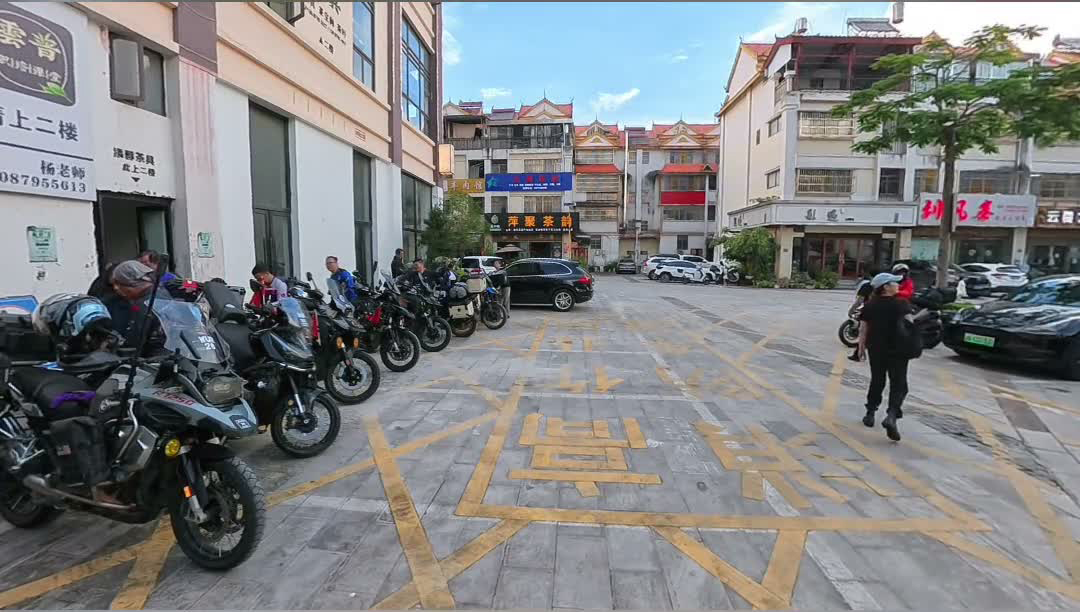
This photo shows a long line of motorcycles parked neatly along the edge of a city square, riders in helmets and some busy at the bikes, the ground marked with large yellow words Fire Lane and no-parking grid lines, Dai-style buildings with pointed roofs behind, shop signs, cars in the distance, a pedestrian crossing the square, the sky a touch overcast.
I want to talk specifically about parking, because it looks like a small thing but it shows the quality of a visiting rider more than anything, and it's the easiest way to ask for needless trouble.
The words on the ground in the photo, Fire Lane, couldn't be plainer. It's the channel kept for fire engines and emergency vehicles, and it can't be occupied or blocked at any time. Park there for the convenience and, in a fire or an emergency, the rescue vehicles can't get in, and what's delayed is a matter of life. Every time I take a convoy I press it: the fire lane and the no-parking grid, even empty and even for a minute, are not to be used.
I should tell you how I came to understand. Honestly, when I was young in unfamiliar cities I didn't much attend to the yellow lines on the ground, and sometimes, unable to find a space and seeing the no-parking area empty, I'd park on a chance and think what could come of it. A local old rider put me right. He said the lines aren't drawn for show and each has its reason, and a fire lane occupied, when the real thing happens, leaves no time even for tears. I've kept that sentence to this day, and after it I treated every no-parking sign and line with more respect.
Abroad or in China, the parking rules are much the same. Don't stop where it's forbidden, on the pavement, at junctions, at bus stops or by fire hydrants; park in the marked spaces, with the direction and position as tidy as can be; where a fee applies, pay it and don't evade. As a guest from far away you ought to keep the local rules more, not only to avoid the fine but as a basic respect.
I should tell a small embarrassment of my own. Once in a city I didn't see the sign and parked where I shouldn't, and when I came back a ticket was on the bike. Worse, on a foreign temporary plate, handling the fine meant a special trip and a fair bit of time, and it nearly affected the route after. The lesson was a deep one; a ticket isn't only the money, it draws on the energy and can even affect the smooth return of the deposit at departure. After that I'd rather walk a few more steps and take a little more time and always park in a legal, sound place.
The square in the photo, with the Dai-style pointed roofs, has a strong local character, and I've always been fond of such cities. But in the pretty, busy places, with the people and the traffic, the parking order matters more. The motorcycles in the photo, I see they're parked fairly to the edge and not across the centre of the fire lane, so the lead ought to know the rules, keeping everyone tight to the side and leaving the channel open.
I'd also say parking in the city is a different thing from the empty west. Out there the land is wide and the choices many; in the city the ground is dear and the spaces tight, so you need patience and a slow search rather than haste. Now when I reach a city I learn beforehand where to park, or simply leave the vehicle in a suitable place and walk about, which is easier. The motorcycle has a benefit in it, being flexible and asking for little space, but that doesn't mean you can stop at random.
My English friend, taking his large motorhome into the city, found parking the worst of his worries, often circling for ages with no space to fit. We on two wheels have it easier by comparison, but he joked with me that easy or not, the rules don't change. Two old men of one view on it: small bike or large, the rule of keeping order is the same.
When I was young I took parking as a pure technical problem, a matter of fitting in. Now I see it as a matter of quality, and how you park shows how you treat the city and the people in it. A person who parks without a qualm in the no-parking area, however good the technique, isn't a rider to be respected.
The yellow words Fire Lane in the photo stay clear under the overcast sky, like a silent reminder. The motorcycles will leave after the short stop, and the channel must stay open all the while. Read the words and hold the line, and you'll be a visiting rider who knows the rules and is genuinely welcome.