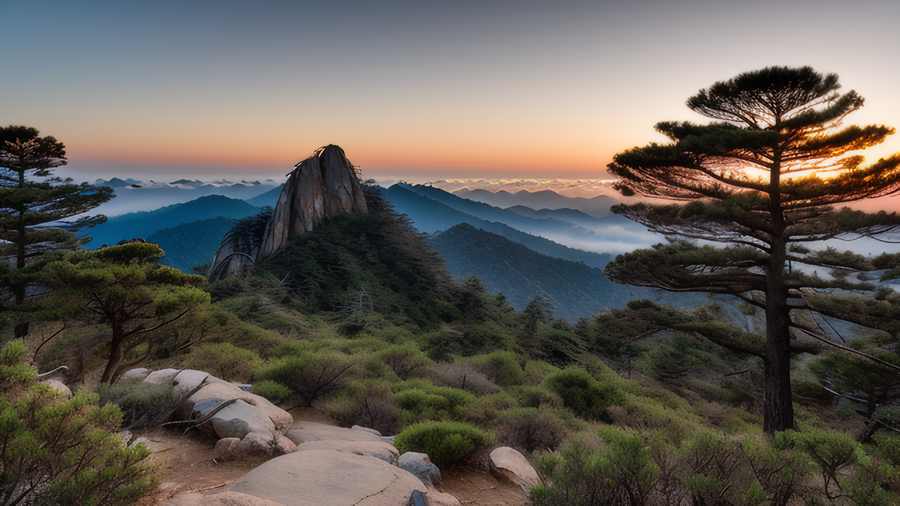
Southern Anhui is easier to travel by car than by train, because the interesting parts sit in valleys the rail lines never reached. I started this loop at Tangkou, the town at the south foot of Huangshan, and gave myself four days: one on the road, one whole day on the Buddhist mountain, one in Jingxian county, and one to get back. Total 355 km. The roads are good, the distances are honest, and the two mountains could not be more different — Huangshan is granite, mist and pine; Jiuhuashan is forest, temple stairs and incense. Jingxian, the county in between, is where Chinese calligraphy paper is still made by hand and where a Ming-Qing village survives along three streams. If you are in the region on Foreign Car Entry Self-Drive, note that the mountain carparks fill by nine in the morning and that some of the ancient-town lanes are closed to engines, so plan to leave the car at the visitor centre. For most visitors this trip works better as Renting a Car in China as a Foreigner: pick up in Huangshan city or at the airport, and the loop costs you nothing in border paperwork.
Trip overview
- Day 1 – Huangshan (Tangkou) to Jiuhuashan, 165 km, mostly expressway; evening on the temple street.
- Day 2 – A full day on Jiuhuashan: the flesh reliquary hall, the hundred-year palace, the Tiantai cable car.
- Day 3 – Jiuhuashan to Jingxian, 85 km: Li Bai's ferry bank at Taohuatan, then the old town of Chaji.
- Day 4 – Jingxian back to Huangshan, 105 km, via the paper museum and the expressway.
Total 355 km over four days, an average of 89 km a day, and none of the stages exceeds two hours of driving. It is a route you can run in sandals and a rain shell, with a tank of fuel lasting the whole trip.
Day 1 · Huangshan to Jiuhuashan, 165 km
Road
Leave Tangkou early and take the short feeder down to the G3 expressway at Taiping, then run north-west past Lake Taiping, through the tunnels, to the Jiuhuashan exit. 165 km, about two hours. The tunnel sections are lit and well signed in English; the exit road to the temple town is a two-lane avenue lined with shops and gets congested around the afternoon bus arrivals. The scenic-area gate is where you transfer to the shuttle bus; private cars park at Ke Village.
Sights
The drive itself has content: the Taiping Lake stretch is a wide, island-dotted reservoir ringed by forest, and the exit at Ganqiang puts you in sight of the mountain's northern ridges. Jiuhuashan, in Qingyang county, is one of the four great Buddhist mountains of China. Its claim comes from an eighth-century monk from Silla on the Korean peninsula, Kim Qiaojue, who is said to have spent decades practising in its caves and whose body was held not to have decayed after death, which is the technical meaning of a flesh relic. Later followers built the Roushen Baodian, the Hall of the Flesh Reliquary, over the pagoda that enclosed his remains; it is now the centre of the mountain's worship and the most climbed set of steps on the island's religious circuit. Temples are strung along the valley road rather than concentrated: Zhiyuan Si at the entrance is the largest and the most formal, with a hall of five-hundred arhat figures; Huacheng Si is older and quieter. Do not attempt to reach the summit temples by car — they are above the shuttle line and reached by steps.
Food
The mountain's kitchens are famous for vegetarian cooking, which is a real cuisine here rather than a concession: bean curd skin, mountain bamboo shoots, and yuba formed into shapes that imitate pork, served in a clear broth. If you want the local meat version, Qingyang is known for small pan-fried buns with chive and bean paste filling, sold hot from a stall at the market crossing, and for a stew of local chicken with the lichen called shier, which grows on the shaded rocks of both mountains.
Where to stay
Stay on Jiuhua Street, the temple town inside the scenic boundary, if you want to hear the morning chanting and be at the cable car in five minutes; the rooms are simple and the price includes the shuttle. Stay at Ke Village, outside the gate, if you want a modern hotel, a monitored car park and a quiet night, and accept that you will be taking buses in.
Day 2 · Jiuhuashan, full day 0KM
Road
No long driving today: you are on shuttle buses and steps. From Jiuhua Street the bus runs to the Yantian cable car; take it up, walk the ridge temples, come down the other side and take the bus back. Wear shoes with grip — the stone steps here are worn smooth in the middle and polished by centuries of feet.
Sights
A full day on Jiuhuashan is really a day of stairs between temples. Start at Baisui Gong, the Hundred-Year Palace, built into a cliff above the street and holding the preserved body of Wuxia, a Ming-dynasty monk whose relics, like those of Kim Qiaojue, were taken to be incorrupt; the hall is entered through a passage cut in the rock and the view back down the valley is the best on the mountain. Then take the cable car to Tiantai, the Tiantai summit at roughly 1,300 metres, where the temple complex sits on a narrow shoulder of rock with a pavilion cantilevered over the drop; on a clear day you can see the Yangtze. The descent passes the Great Compassion temple and a series of hermitage cells, many now shuttered, some with an old nun sweeping the landing. The Hall of the Flesh Reliquary is the last stop and the busiest: a nine-tiered wooden structure around the pagoda, approached by eighty stone steps, and circles of pilgrims walking clockwise around it with incense held low. The whole circuit takes six or seven hours, and the mountain restaurants along the way serve soup and rice for very little.
Food
Eat where the pilgrims eat. Around the Hall of the Flesh Reliquary the vegetarian halls sell noodles in a mushroom broth and small plates of braised bamboo; a tea house near the cable station serves the local wild tea with sesame cakes. The mountain's yujing, a candied polygonatum root, is sold as packets on the street — take one, it is what hikers here have eaten for centuries.
Where to stay
Second night in the same place. If the weather closes in, this is the day to give up the summit and spend three hours in the smaller eastern temples instead, where the monks are still saying the evening service in the original wooden hall.
Day 3 · Jiuhuashan to Jingxian, 85 km
Road
Down the mountain, then the S103 and the Tangling direction east to Jingxian. About 85 km, one hour fifty minutes, with the last section running along a river and the road quality dropping to a good but narrow two-lane. Chaji village has one entrance road and a paid car park at the head; the lanes inside are for walking.
Sights
Jingxian is a county of paper and rivers. Your first stop is Taohuatan, the Peach Blossom Ford, made famous by a poem Li Bai wrote about a local host named Wang Lun, who allegedly lured him there with talk of ten-thousand peach trees and a thousand-foot pool. What is real is better than the legend: a deep green pool under a bank of mossy stones, the old ferry step where Wang Lun is said to have sung his farewell where the farewell was said to have happened, an eleventh-century pagoda at the village edge, and a hall of inscriptions with tablets copied from several Li Bai poems. The lanes behind the bank are quiet and the whole visit takes ninety minutes. Then Chaji, thirty minutes on: the largest surviving old village in southern Anhui, spread along three streams that meet under a series of stone bridges. House fronts are whitewashed with horse-head gables, the domestic courtyard type you associate with this region, and the details are remarkably varied — carved doorframes, bracket sets, brick screens, ancestral halls with inscribed lintels dating from the Chenghua reign. There is no stage-managed performance here; students sit on small stools at the bridge heads copying the doorcarvings into sketchbooks, and laundry hangs from the back balconies.
Food
Jingxian's signature dish is maolin hu, a thick savoury porridge of rice flour cooked with pork, bamboo shoots and wild greens, finished with pepper and sesame oil — ordered by the pot in the county town. Along the Taohuatan bank the restaurants cook the pool's fish in a clay pot with ginger and bamboo shoots; the small silver fish endemic to one of the county's streams are traditionally dried and floated in tea, which is a novelty worth one bowl. Chaji itself is a wood-fire cooking town: cured pork, greens from the terraces, rice cooked in the pot.
Where to stay
Stay in Chaji, in a converted old house with a courtyard. They are basic but genuinely old, and the village at seven in the morning, before the sketching students set up, is the reason to sleep there rather than in the county seat.
Day 4 · Jingxian back to Huangshan, 105 km
Road
South on the S322 and then the expressway. 105 km, about two hours, a good surface all the way, with the river beside you for the first stretch. Leave midday; the afternoon light comes into the valleys on the Huangshan side and the feeder road down to Tangkou is the part you would rather be driving.
Sights
If you want the county's third claim, stop on the way out at the Xuan paper cultural park at the edge of Jingxian town. Xuan paper is the paper that Chinese painting and calligraphy were made on for a thousand years, and it is still produced the same way: the bark and the rice straw are soaked, sun-bleached and beaten, then lifted out of a vat on a bamboo mould by a craftsman working a pair of screens, pressed into a cake, and dried against a heated wall. The workshop lets you watch the vat row, and you can pull a sheet yourself with an instructor holding your hands; the whole visit takes one hour to one and a half. Reaching Tangkou late in the day, do not miss the short walk along the Shang’e stream at the town's edge: it is where hikers start the mountain path, and at dusk the water is loud and the light on the wall is the best photograph in the area.
Food
Back in Huangshan country, eat the two dishes the region is named for: stinky mandarin fish, fermented briefly then braised so that the flesh is tight in flakes, and hairy tofu, which is mould-ripened pan-fried curd served with chilli and soy. A bowl of stone-ear lichen soup with free-range chicken closes it. Both are acquired tastes; the fish in particular smells far stronger than it eats.
Where to stay
End at Tangkou. Keep the car with a full tank; the mountain roads in every direction — toward Hongcun, toward Mount Songluo, toward Qiyun — are the next obvious days.
Practical tips
- The Jiuhuashan shuttle and the cable car are both separate tickets; buy the mountain entry at the Ke Village centre, not from the street touts.
- Incense sellers on the temple street are aggressive about commission — the honest answer is a shake of the head and keep walking.
- Do not leave valuables visible in a parked car at Taohuatan or Chaji; both have monitored lots and they cost almost nothing.
- The lanes at Chaji are one-way for cars and narrow enough that a large SUV will not turn; walk in from the head lot.
- Xuan paper workshops are humid and the floor is wet; take a bag for the sheet you make so it does not crease on the drive.
- On this loop the practical version is Renting a Car in China as a Foreigner rather than Foreign Car Entry Self-Drive, since the car is shipped across the strait for the latter.
About this route
Four days is the right length for this loop. Day two on Jiuhuashan is the reason it works at all — the mountain cannot be done properly in an afternoon — and Jingxian rewards a night rather than a stop. The route is a good middle choice for first-time southern Anhui: fewer kilometres than a Huangshan-plus-villages trip, more cultural content than a single-mountain visit, and no road above second-class. If you want to extend, add the Hongcun and Xidi old houses, or run on to Wuyuan for the terraced rapeseed in March.
Distances and times are from this drive, checked against signage and the toll tickets. Ticket prices and cable-car arrangements were confirmed at the gate and change with the season.
Route notes by Zara, Yunnan Province International Travel Agency (Group) Co., Ltd.