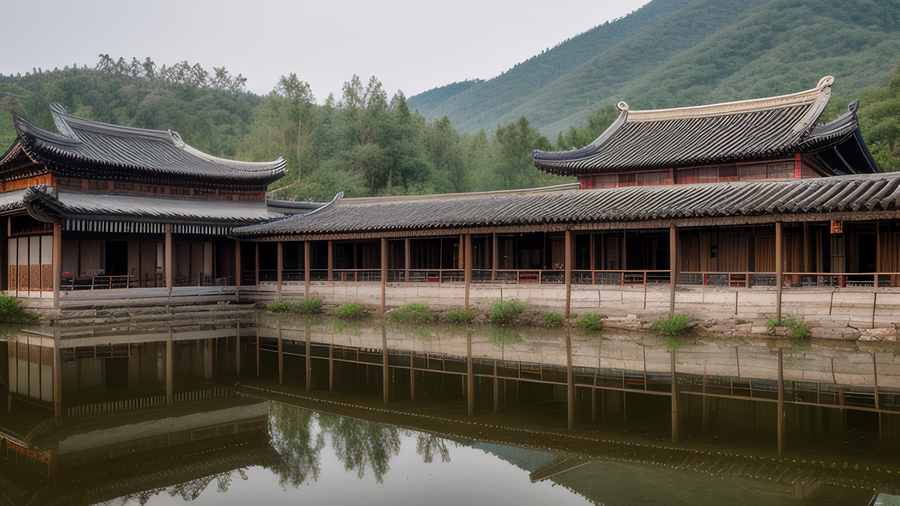
Written for a Foreign Car Entry Self-Drive and equally workable for Renting a Car in China as a Foreigner: 12 days, 905 km, six places given two nights so nothing feels rushed. Moving days average about 130 km. The thread here is Huizhou culture — the merchant prefecture that built the halls of Shexian and Jingxian — with the river towns of the north as its prologue.
Trip overview
- Caishiji: Yangtze cliff, Li Bai shrine and the river ferry view
- Tongling: Tianjing Lake and the preserved river town of Datong
- Wuhu: theme parks, Mirror Lake and the old customs house
- Xuancheng: Jingting hill and the Xie Tiao tower
- Jixi: Longchuan village and the start of the Huizhou–Hangzhou trail
- Jingxian: Peach Blossom Pool, Zhaji village and handmade paper
- Shexian: Huizhou old city, Xuguo archway and Yuliang dam
- Jiuhuashan: one of China's four Buddhist mountains
Two nights each at Jixi, Jingxian and Jiuhuashan; the mountain day is the only real climb.
Day 1 · Caishiji — Tongling, 130 km
Road
Out of Ma'anshan on the riverside expressway west, then the crossing toward Tongling; about two hours, motorway, one toll link.
Sights
Morning belongs to Caishiji, the Cui Luo headland where the Yangtze presses against a cliff. It has been a literary site for twelve hundred years: a shrine to Li Bai sits above the water, the Ranshui Pavilion and the Three-Tier Tower look down on the channel, and the rock stair down to the bank shows where boats once tied up. The river here is wide enough that the far shore is a line, and freight traffic passes in both directions all morning. Then drive west. Tongling's name means bronze, and the city has mined and smelted copper for two thousand years; today it is a low, tidy place along Tianjing Lake, whose causeways, islets and pavilions are the local evening promenade. The lake is small and shallow, planted with lotus, and its best hour is late afternoon when the fishing cormorants come back.
Food
Tongling: Yangtze fish, river shrimp, a bowl of braised noodles.
Where to stay
Tongling city, near the lake.
Day 2 · Tongling sightseeing, 0 km
Road
One flat hour out and back on the provincial road to Datong, or stay in the city.
Sights
Take the morning to Datong, a river town 20 km south that was once one of China's four great trading ports on the Yangtze — the place where timber, tea and medicine changed hands between the interior and the coastal ships. What survives is a grid of old lanes on He Yue islet, a customs-era street, warehouse doorframes, and a ferry landing where the town's life still visibly depends on the water. It is quiet, unrenovated and worth the drive. In the afternoon return to the city and stand on the Yangtze bridge approach where the channel narrows: Tongling runs a rescue station for the Yangtze finless porpoise, the small grey animal local fishermen call the goddess dolphin, and the reserve board explains why the deeper channel bends south of the town are its remaining home.
Food
Second night: lotus-seed soup, pickled vegetables, a claypot of river fish.
Where to stay
Same hotel, second night.
Day 3 · Tongling — Wuhu, 90 km
Road
North-east on the expressway, crossing to the north bank; about an hour and a half, easy.
Sights
Wuhu is the most industrial of these cities and the least museum-like. Its old core sits where the Qingyi river meets the Yangtze, and the first walk is along the riverfront: the Qing dynasty customs house, the treaty-port facades, the mouth of the little creek where boats once loaded rice. Then Mirror Lake in the middle of the old walls — a park of two connected sheets of water, causeway bridges, pavilions and a willow line, with teahouses on the north shore where old men play sandan for hours. Wuhu's signature craft is iron picture: wire hammered hot, blackened against silk, and soldered into landscapes, a technique from the seventeenth century that you can watch made in a workshop near the lake.
Food
Wuhu is famous for duck with a lacquered skin, and noodle shops open till two in the morning.
Where to stay
Wuhu city centre, near Jiefang Road.
Day 4 · Wuhu sightseeing, 0 km
Road
Flat city driving, or no driving at all if you stay central.
Sights
Wuhu's second day has two faces. If you travel with teenagers, Fantawild is a full day: it is the largest of the domestic theme-park groups, with several separately ticketed parks on the east side of the river, coasters, a dark ride based on Chinese mythology, and indoor queues that beat the summer heat. If you would rather stay in town, spend the day on the old streets and the river: the Xieshan community lanes, a Qing-dynasty academy, the Zhongshan Road pedestrian street with its arcade shops, then the bridge at sunset. Either way, end the evening on the north bank at Jiuzhaigou road for beer and crayfish — Wuhu sits an hour from the province's brewing capital and the river crustaceans arrive daily.
Food
Dumpling-and-soup shops, braised duck, stir-fried water shield.
Where to stay
Same hotel, second night.
Day 5 · Wuhu — Xuancheng, 65 km
Road
South on the expressway, one hour; the exit to the city is signposted and obvious.
Sights
Xuancheng is a prefectural seat on a plain, and its claim to fame is a hill. Jingting Shan is only 286 metres, but Li Bai visited it repeatedly and left the line that made it permanent — two things looking at each other without tiring, and only Jingting — so the path up is lined with inscribed stones, a pavilion, and a small museum of the poems written here. The climb takes forty minutes on a paved stair with landings, and the view back over the city and the water is the reason to go late in the day. Back in town, the Xie Tiao tower stands on the north wall line: a Song-form rebuild of a fifth-century governor's viewing pavilion, associated with the poet Xie Tiao and with Li Bai's own copy of it. Xuancheng also names itself the home of the four studio treasures — paper, ink, brush and inkstone — and has a museum for them.
Food
Xuancheng: honey dates from Shuidong, braised pork with dried bamboo, rice wine.
Where to stay
Xuancheng city.
Day 6 · Xuancheng sightseeing, 0 km
Road
Optional 25 km detour on good road; otherwise city and bus.
Sights
Give the sixth day to the studio arts, because this is the one place in China where you can watch all four made nearby. The workshop quarter explains the paper ladder — steaming bark, lime soaking, beating the pulp, and the vatman lifting a screen of slurry so that a sheet forms in one motion. Ink is soot kneaded with glue and pressed into moulds, then smoke-dried for months; brushes here use weasel and goat hair set into bamboo. Buy a sheet or two to carry, and understand what you are paying for: a good Huizhou ink stick was once a gift between officials. In the afternoon walk the old street behind the river, where the guild halls have been turned into exhibition rooms, and take the evening light on Jingting hill if the weather was poor the day before.
Food
Xiaoguo noodles, ham and bamboo-shoot soup, a plate of water shield.
Where to stay
Same hotel, second night.
Day 7 · Xuancheng — Jixi, 120 km
Road
South-east through hills, expressway then mountain approach; about two hours, several tunnels.
Sights
Jixi sits in a Huizhou basin and is the county that gave the merchant culture two of its exports: ink and its most famous modern family. Longchuan, an hour east, is a Huizhou village laid out along a stream inside a bend of hills — the Hu clan hall is the showpiece, with walnut-wood carvings on every beam, a row of stone arches along the lane, and the ancestral shrine still used at festivals. The lane is unpaved in places and the roofs are still working buildings, not a stage. Jixi is also the western end of the Huizhou–Hangzhou trail, the porter route that carried tea and ink over the mountains to the coast; the village of Jiangnan at the trail foot is where hikers register, and the first section climbs through a notch with a gate wall across it.
Food
Jixi is the home of Huizhou cooking: a one-pot layered dish of egg, meat and bamboo, and chive omelette.
Where to stay
Jixi county town, or a guesthouse at Longchuan.
Day 8 · Jixi sightseeing, 0 km
Road
Walking; the trail foot is 15 km of mountain road if you want to drive there.
Sights
Take the trail for the day, even only the first three kilometres. The path is flagstone, laid by merchant money in the Qing dynasty, and it climbs with switchbacks through a notch called the One-Line Sky, where the rock closes to a passage with a wall built across it. Above the notch the old teahouse platforms are still visible as terraces. It is a genuine walk — steady up, about three hours to the first good viewpoint — so wear grip and leave the car at the lower village. Back in the county town, the Hui ink museum and the old street give the afternoon: a workshop will grind an ink stick on a stone with water so you can smell the pine soot and the glue, which is the only fair test. Fill a tank in the county town before you cross south into the paper valley.
Food
Braised river prawn, cured ham with greens, a bowl of taro soup.
Where to stay
Same place, second night.
Day 9 · Jixi — Jingxian, 75 km
Road
West over a low pass to the Qingyi valley; about two hours, narrow in parts, several village by-passes.
Sights
Peach Blossom Pool is the first stop and the most literary: a reach of the Qingyi river where, in the eighth century, a local host named Wang Lun sent off Li Bai with a song from the bank, and the poem — deep for a thousand fathoms, not as deep as Wang Lun's feeling for me — is why there is a pavilion, a landing stone and a hall on this shore today. The water is green and slow, the boats are punt-driven, and the hills either side close enough to hold the wind out. Afternoon belongs to Zhaji, a large old village strung along a stream with a stone bridge every hundred metres: Ming and Qing houses with stepped gable walls, lane gates, and artists' students sketching on the banks. It is one of the biggest surviving residential villages in the region precisely because nobody turned it into a hotel.
Food
Jingxian river fish, dried bamboo, a claypot of pork with chestnut.
Where to stay
Jingxian, near the Taohuatan bank, or at Zhaji.
Day 10 · Jingxian — Shexian, 90 km
Road
South on the expressway into the Xin'an river valley, east to Shexian; about two hours.
Sights
Jingxian is where Xuan paper is actually made, in villages along the Taohuatan road where the pulp is still lifted by hand; the Dingjiaqiao workshops will let you watch the whole process and dry a sheet for you to take. Then drive south to Huizhou's administrative capital. Shexian's old city holds a rare double: the prefectural yamen, rebuilt to Song-Ming form, and the Xuguo paifang — an eight-legged stone archway raised in the sixteenth century for a grand secretary, the only example of its type. Outside the east gate, Yuliang is the river port that fed the city: a stepped stone dam closing the stream, a lane of merchant houses above it, and the boat tracks on the rock. Ten kilometres west, the Tangyue archway group is seven stone paifang in a row along a path between fish ponds, granted over four centuries to one clan for loyalty, chastity and philanthropy.
Food
Huizhou: mandarin fish browned and braised, bamboo shoot with ham, a pot of glutinous rice with pork.
Where to stay
Shexian, inside or beside the old city.
Day 11 · Shexian — Jiuhuashan, 155 km
Road
South-west over the border ridge toward Qingyang; three hours, expressway and one mountain climb.
Sights
Jiuhuashan is one of the four great Buddhist mountains of China, dedicated to Ksitigarbha, and it is still a functioning monastic mountain rather than a theme park. Ninety-nine peaks, and the working core is a string of temples up one valley: the Zhiyuan temple at the gate with its drum towers, the Bai Sui palace on a shelf of rock holding the mummified body of a Ming monk who lived a hundred years, and the Flesh Treasure Hall above, a small pagoda-tomb around the remains said to be that of the Korean prince-monk Jin Dizang, its steps climbed on hands and knees by pilgrims. Take the cable car to the Tiantai summit for the ridge view, then walk back down. The evening is for the chant heard through the valley from the evening service.
Food
Mountain vegetarian cooking: bamboo, fungus, tofu in stone pots.
Where to stay
A temple-side guesthouse in the Jiuhua street.
Day 12 · Jiuhuashan — Caishiji, 180 km
Road
Down to Qingyang, north on the expressway to the river and back to Ma'anshan; about three hours.
Sights
The closing day is a transfer with one more stop. Descend early, and on the plain outside the park the Great Vow cultural park holds a ninety-nine-metre Ksitigarbha statue facing a reflecting pool — the modern scale of the mountain's fame. Then north across the river valleys to Caishiji, arriving with the afternoon left. If you skipped the cliff on day one, walk it now: the moon-snatching legend, the ferry channel, and the river traffic under low light. Otherwise hand the car over, or fill it and leave the tanks full if you are taking your own vehicle back to the port of entry. Twelve days in, the loop closes where the poet did: on a stone shelf above the Yangtze.
Food
Riverside last lunch: fish head with chilli, greens, a bowl of rice.
Where to stay
Ma'anshan, near your onward road.
Practical tips
- Jiuhuashan sells a combined entry plus separate cable cars; the Flesh Treasure Hall stair is crowded before ten in the morning.
- The Huizhou–Hangzhou trail is a real hike, not a stroll; the first three kilometres are enough for most people.
- Zhaji village has no big car park; leave the vehicle at the entrance lane and walk in.
- Xuan paper sheets are fragile in humidity — ask for a rigid sleeve if you are flying out.
- Fill up in Jixi and again in Jingxian; the pass road has few stations.
- This loop suits a Foreign Car Entry Self-Drive, and Renting a Car in China as a Foreigner from Hefei or Hangzhou is the easier version.
About this route
About this route: 12 days, 905 km, starting and ending at Caishiji near Ma'anshan. Longest drive 180 km, and six stops take two nights. Road quality is good throughout; only the Jixi–Jingxian pass and the Jiuhuashan climb ask for care.
Figures in this article are as recorded against road signage. Huizhou halls, paper workshops and Jiuhuashan shuttles follow posted notice and change with the season.
Route notes by Zara, Yunnan Province International Travel Agency (Group) Co., Ltd.