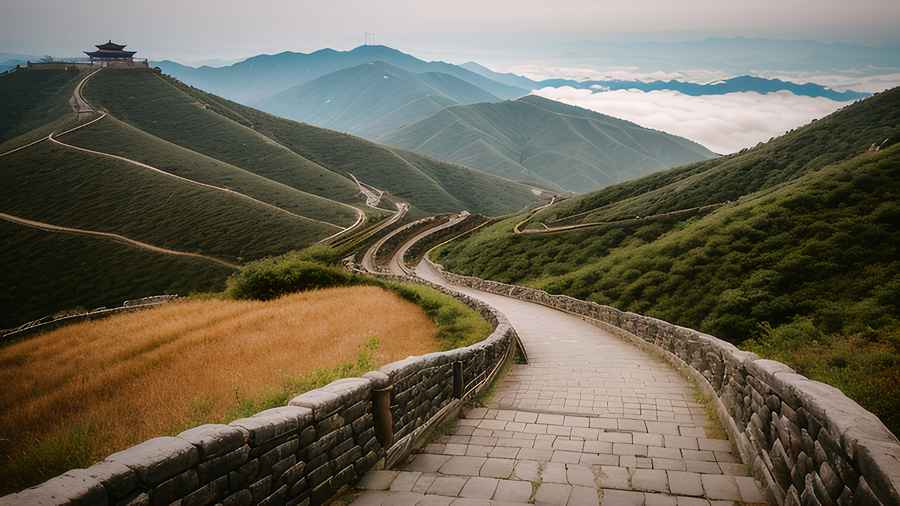
I drove this in the last week of October, which is the right month here: the north is dry and mild, the mountains have turned, and the crowds on Jiuhua Shan have thinned. The shape of the route is a loop with one long diagonal: north-east from Chuzhou to the Huai river, west along the plain to Bozhou, then a single long run south into the Dabie range, before coming back east through Jiuhua Shan. Two days are mostly driving and the rest are short hops, so the car does not dominate the week. What follows is the day-by-day record.
Trip overview
- D1 Chuzhou to Huainan, 160 km, Bagong Shan and the old city of Shouxian
- D2 A day around Huainan, 0 km
- D3 Huainan to Bengbu, 60 km, Longzi Lake and Zhanggong Shan
- D4 A day in Bengbu, 0 km
- D5 Bengbu to Suzhou, 110 km, Huangzang Valley and the tomb of Yu Ji
- D6 A day around Suzhou, 0 km
- D7 Suzhou to Bozhou, 140 km, the Flower Opera Tower and Cao Cao's tunnels
- D8 Bozhou to Tiantangzhai, 375 km, into the Dabie Mountains
- D9 Tiantangzhai to Jiuhua Shan, 210 km, the temple terraces
- D10 Jiuhua Shan back to Chuzhou, 240 km
1,295 km over ten days, with one day at 375 km and one at 240 km. The northern half is flat and fast on provincial roads; the approach to Tiantangzhai climbs for the last forty kilometres and should be done in daylight. Fuel is easy except on the mountain stretch between Tiantangzhai and Jiuhua Shan, where stations are far apart.
D1、Chuzhou–Huainan 160KM
Road
West out of Chuzhou on the G3 for sixty kilometres, then provincial roads across the Huai plain; the surface is good and the traffic light, with one stretch of roadworks near the river.
Sights
Bagong Shan is a low wooded ridge west of Huainan with a Daoist temple on the shoulder and a scatter of stone tablets in the yard; the walk up takes half an hour and the view covers the plain in every direction. Shouxian is a walled town on the river with a complete circuit of ramparts, a gatehouse with a slab road through it, and a mosque in the old quarter with a carved doorway. The wall is walked in about an hour and the best light is the last hour before dusk, when the bricks turn the colour of weak tea.
Food
Huainan is famous for a beef soup with vermicelli and a great deal of pepper, eaten at breakfast; the local tofu is also worth ordering, cooked in a clay pot with pickled greens.
Where to stay
A hotel on the river road with parking in front, plain rooms and a breakfast of soup and steamed buns.
D2、Huainan on foot 0KM
Road
No driving. Shouxian is walked, and the taxi to Bagong Shan takes fifteen minutes.
Sights
I went back to Shouxian in the morning to walk inside the wall, where the lanes are narrow and the houses have wooden shopfronts with their original shutters. The Confucian temple has a courtyard of old cypresses and a stone bridge over a dry pool. In the afternoon the Bagong Shan ridge again, this time along the upper path to a second temple, where the yard looks down on the river and the plain beyond it. The stone steps there are worn into shallow bowls by centuries of feet.
Food
A bowl of the beef soup at a stall near the east gate, and a plate of fried tofu with chives in the evening.
Where to stay
Same hotel, second night.
D3、Huainan–Bengbu 60KM
Road
Sixty kilometres east on a provincial road that follows the river for part of the way; flat, fast and quiet, with a bridge crossing at the end.
Sights
Longzi Lake is a long sheet of water on the east side of Bengbu with a causeway across it and a park along the shore; the water is shallow and warm in October and the reeds at the edge are full of small birds. Zhanggong Shan is a wooded hill inside the city with a pagoda on the summit and a stairway of several hundred steps, and from the top the lake and the railway both show at once. The park below has a small zoo and a yard of old locomotives.
Food
Bengbu does a braised carp with vinegar and sugar that is served cold as often as hot, and a bowl of noodles with pickled vegetables and shredded pork.
Where to stay
A hotel near the lake causeway, with a car park and rooms on the upper floors facing the water.
D4、Bengbu on foot 0KM
Road
No driving; the lake park and the hill are inside the city and taxis cover the rest.
Sights
The morning went to the lake shore, where fishermen work from small boats among the reeds and the causeway is used by cyclists. Then the hill: the stairway up, the pagoda at the top with its view over the railway yards, and the terrace where the old locomotives are kept, one of them a narrow-gauge engine with a brass plate. In the afternoon the old street behind the station, where the shops sell dried fish and the noodle stalls set up at four.
Food
A cold plate of the vinegar carp, and a bowl of rice with braised pork and preserved vegetables.
Where to stay
Same hotel, second night.
D5、Bengbu–Suzhou 110KM
Road
North on the G3 for most of the way, 110 km of motorway with light traffic and one service area; the exit for Huangzang Valley is well marked.
Sights
Huangzang Valley is a wooded gorge in the hills north of Suzhou, with a stream running through it, stone steps along both banks and a temple halfway up that is reached by a bridge over the water. The valley is cool even in summer and the maples along the stream turn properly in late October. The tomb of Yu Ji is a low mound in a field outside the town, with a stone marker and a small enclosure; it takes twenty minutes and the setting, with nothing else around it, is what stays with you.
Food
Suzhou makes a salted chicken that is boiled whole and torn apart at the table, and a flatbread baked in a clay oven and eaten with sesame paste.
Where to stay
A hotel in the town centre with parking at the side; simple, and the street outside has a night market until ten.
D6、Suzhou on foot 0KM
Road
No driving; the town is flat and the valley is a taxi ride away.
Sights
Back to Huangzang Valley in the morning for the upper path, which climbs above the temple to a ridge with a view over the whole gorge and the plain beyond. The stone steps are uneven and the handrails are stone posts with iron chains. In the afternoon the old quarter of Suzhou, where a few timber houses survive among the new build, and the market where dried chillies are sold by the sack. The river embankment at dusk has a long row of plane trees, planted when the road was built.
Food
A bowl of mutton soup with a flatbread broken into it, and a plate of stir-fried beansprouts with dried shrimp.
Where to stay
Same hotel, second night.
D7、Suzhou–Bozhou 140KM
Road
West across the plain on provincial roads, 140 km of straight two-lane with villages every few kilometres; watch for tractors and for grain being dried on the road edge.
Sights
The Flower Opera Tower in Bozhou is a wooden stage building with carved beams, a painted ceiling and a courtyard of stone lions; the carvings along the eaves are the reason to come, and the caretaker will point out the opera scenes if asked. Cao Cao's underground tunnels run beneath the old town, a network of brick passages with ventilation shafts and a few chambers, entered through a stairwell in a courtyard. The walk through takes about half an hour and the air below is cool and still.
Food
Bozhou does a beef noodle with a dark spiced broth, and a steamed bun filled with mutton and eaten with vinegar.
Where to stay
A hotel near the old town wall, with parking in a yard and rooms away from the street.
D8、Bozhou–Tiantangzhai 375KM
Road
The long day: 375 km south, mostly motorway, then provincial roads and a final forty kilometres of climbing bends into the forest park. Start early, since the last stretch should be driven in daylight.
Sights
The drive crosses the whole province from the dry northern plain into the wet hills, and the change shows in the fields: wheat and poplar give way to tea terraces and bamboo. Tiantangzhai itself is a forest park on the Dabie ridge, with a cable car to the shoulder and a path along the top above the tree line. The waterfalls below the ridge come down in steps over dark rock, and the air at the top is cold enough for a jacket even at midday.
Food
Mountain cooking: cured pork with bamboo shoots, wild garlic with egg, and a chestnut stew that appears from October.
Where to stay
A farmhouse guesthouse inside the park boundary, wood floors, a stove in the common room and hot water from a tank.
D9、Tiantangzhai–Jiuhua Shan 210KM
Road
Down from the park, then east on provincial roads and a stretch of motorway; 210 km with one long climb at the end to the temple terraces, where the road becomes narrow and steep.
Sights
Jiuhua Shan is one of the four Buddhist mountains of China, and the lower slopes are a village of temples, guesthouses and stairways that goes on for a kilometre. The cable car takes you to the upper terraces, where the halls are built into the rock and the stairways are cut into the cliff. The shrine of the bodily remains is the one most pilgrims come for, a small hall behind a courtyard where the queue moves slowly and quietly.
Food
Temple food here is vegetarian and simple: bamboo shoots with mushrooms, tofu in a brown sauce, and a bowl of noodles with pickled greens.
Where to stay
A guesthouse on the terraces below the upper halls, reached on foot with luggage carried by porters; rooms are small and the night is very quiet.
D10、Jiuhua Shan–Chuzhou 240KM
Road
Down the mountain road in the morning, then 240 km of motorway east with two service areas; the traffic thickens near Chuzhou in the late afternoon.
Sights
Nothing scheduled except the descent, which looks over the valley and the temple roofs stacked below. Halfway down there is a bend with a wide shoulder where everyone stops for the view; beyond it the road runs through bamboo and out onto the plain.
Food
A bowl of noodles at the second service area; Chuzhou has better, so I waited and ate in the city.
Where to stay
A hotel near the Chuzhou station for an early train, with parking and a laundry service.
Practical tips
- The 375 km day to Tiantangzhai needs an early start; the last forty kilometres climb and are slow, and should not be driven after dark.
- Fuel between Tiantangzhai and Jiuhua Shan is sparse for about ninety kilometres, so fill up before leaving the park.
- Jiuhua Shan charges an entry ticket and the cable car is separate; luggage on the terraces is carried by porters for a fixed fee posted at the gate.
- Grain is often dried on the edge of provincial roads in October, which narrows the usable width; slow down rather than swerve.
- Temple guesthouses on the terraces are cold at night in late October and blankets are limited, so ask before booking.
- Foreign Car Entry Self-Drive across Anhui is mostly motorway and plain roads, and Renting a Car in China as a Foreigner needs only the temporary licence, the passport and the vehicle papers kept in the car.
About this route
Ten days, 1,295 km, six bases: Huainan, Bengbu, Suzhou, Bozhou, Tiantangzhai and Jiuhua Shan. Best in late October for the mountain colour, or April for the tea terraces. One 375 km day, one mountain climb, and the rest short and easy.
Distances, road surfaces and ticket arrangements were checked on the ground in October. For documents, customs formalities and vehicle papers, the Anhui traffic management office in Hefei and the airport counters answer enquiries directly.
Route notes by Zara, Yunnan Province International Travel Agency (Group) Co., Ltd.